


- UNESCO
- Free 1st Sunday
Photo: L.VII.C, CC BY-SA 3.0 · Wikimedia Commons
Archaeological site
Ancient religious monument in Rome, Italy
The Temple of Vesta, or the aedes (Latin: Aedes Vestae; Italian: Tempio di Vesta), was an ancient edifice in Rome, Italy. It is located in the Roman Forum near the Regia and the House of the Vestal Virgins. The Temple of Vesta housed Vesta's holy fire, which was a symbol of Rome's safety and prosperity. The temple has a circular footprint, making it a tholos.
Since the worship of Vesta began in private homes, the architecture seems to pay homage to the architecture of early Roman homes. The temple's current, ruinous form employs elements of Greek architecture with Corinthian columns and marble. The sacred hearth was housed in a central cella. The surviving structure indicates that there were twenty Corinthian columns built on a podium fifteen meters in diameter. The roof probably had a vent at the apex to allow smoke to escape.
The first Temple of Vesta was built by Numa Pompilius, the second king of the Roman Kingdom. He also built the original Regia ("king's house") and the House of the Vestal Virgins, and founded the priestly order of Vestal Virgins. At first there were just two Vestals, but by the end of the Republic, there were six. Vesta was the goddess of Rome's hearths. The Romans believed that her sacred fire was closely tied to the fortunes of the city, and that its extinction signified imminent disaster for Rome. Although it is known as a temple in modern times, its site, orientation and floor plan were not determined through augury. It was therefore known as a shrine (in Latin, aedes).
The Temple of Vesta was tended by the six Vestal Virgins, drawn between the ages of 6 and 10 from freeborn, or traditionally, aristocratic families. They surrendered all legal connections with their birth family, and came under the authority of the pontifex maximus, Rome's chief priest. The Vestal oath of virginity during their 30-year tenure set them apart from other Roman women. While chastity until marriage was considered proper in Rome, long-term celibacy was not, as women were generally expected to marry, and give birth to heirs for their husbands. A Vestal who broke her vow of chastity during her priestly tenure disrupted the relationship between Rome and its gods. The Romans believed that this would lead to disaster, such as pestilence, social breakdown or military defeats. …
The Temple of Vesta remained reasonably intact until the Renaissance. However, in 1549 AD, the temple was demolished, and its marble was repurposed to build churches and papal palaces. Most of our knowledge about what the original Temple of Vesta looked like come from its depictions on coins and art. One piece of art that depicts the Temple of Vesta is a marble relief in the Uffizi in Florence, Italy. These depictions and others like it allow us to understand what the temple looked like in antiquity.
Modern archaeological investigation began on the site of the Temple of Vesta in the late nineteenth century. The exploration began in 1877 with archaeologist R. Lanciani's excavation of the Temple of Vesta and the publishing of his findings. During his exploration he was able to uncover many parts of the Temple of Vesta, including parts of the entablature and ceiling. Exploration continued from 1898 to 1900 when Giaccomo Boni, director of the Roman Forum, embarked on a new round of excavations. His works were published in 1900 and included measurements and sections of the temple's foundation, photos and drawings of the principal architectural elements, and a restored plan of the building. Finally, in 1930-1931 Alfonso Bartoli reconstructed two and a half of the Temple of Vesta's bays, which can still be seen in the forum today.
Text from Wikipedia, the free encyclopedia, under CC BY-SA 4.0. Full article: «Temple of Vesta».
Events and people from Wikidata (CC0).
Distances are as the crow flies, not walking or driving.


Temple of Vesta is in Rome, in the province of Roma (Lazio), Italy. GPS coordinates: 41.89171, 12.48621.
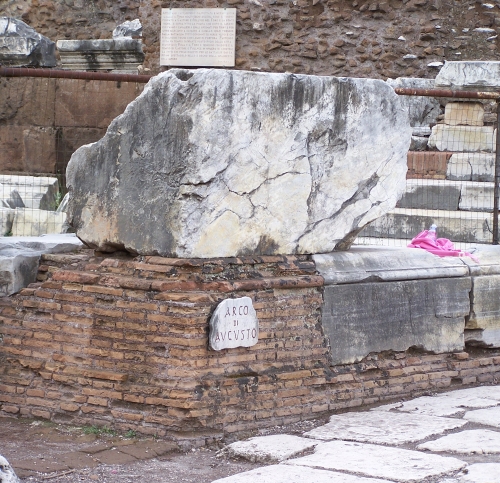
Nearby you’ll find: Statio aquarum (0 m away), Arch of Fabius (0 m away), Arch of Augustus (0 m away).
Text. Wikipedia, the free encyclopedia (CC BY-SA 4.0).
Data. Wikidata (CC0); opening hours and contacts OpenStreetMap (ODbL).
Photos. Wikimedia Commons, author and licence on every image.
Updated 28 October 2026. All sources and licences