


- UNESCO
- Free 1st Sunday
Photo: L.VII.C, CC BY-SA 3.0 · Wikimedia Commons
Archaeological site, 28 BC
Building in Roman Forum, Italy
The Temple of Caesar or Temple of Divus Iulius (Latin: Aedes Divi Iulii; Italian: Tempio del Divo Giulio), also known as Temple of the Deified Julius Caesar, delubrum, heroon or Temple of the Comet Star, was an ancient structure in the Roman Forum of Rome, Italy, located near the Regia and the Temple of Vesta.
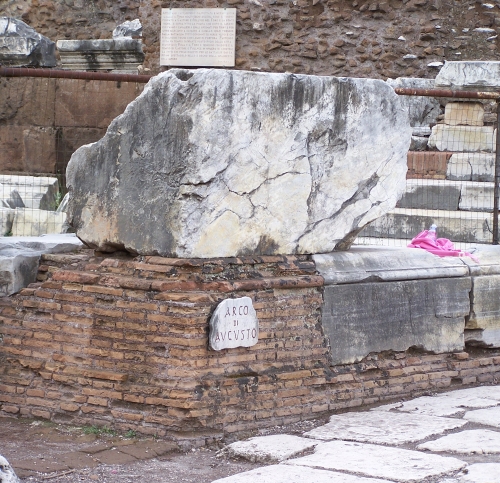
The remains of Caesar's altar are a pilgrimage site for visitors from across Italy and the world. Flowers and other items are left there daily and special commemorations take place on March 15 to commemorate Caesar's death.
The temple was decreed by the triumvirs Octavian, Antony and Lepidus in 42 BC after the senate deified Julius Caesar posthumously. However it was completed by Octavian alone: he dedicated the prostyle temple (it is still unknown whether its order was Ionic, Corinthian or composite) to Caesar, his adoptive father, on 18 August 29 BC, as part of the triple triumph celebrating his victory over Antony and Cleopatra. It stands on the east side of the main square of the Roman Forum, between the Regia, Temple of Castor and Pollux, and the Basilica Aemilia, on the site of Caesar's cremation.
Construction may not have begun in earnest until 32 or 31 BC. In any event, the temple was not formally dedicated until 29 BC, after Octavian had defeated his erstwhile partner Antony and assumed sole rulership of the Roman world.
The temple was finally consecrated as part of Octavian's "triple triumph" in 29, celebrating his victories in Dalmatia, Egypt, and at the Battle of Actium.
The temple's roots in Caesarian popular politics were visible in its design. Its high podium provided an excellent speaker's platform, or rostra (known as the Rostra ad Divi Iuli (lit. 'Podium to the Divine Julius') to distinguish it from the Rostra Augusti (lit. 'Podium of Augustus') at the opposite end of the Forum). Like the older rostra it was decorated with the beaks of ships, in this case those taken at the battle of Actium. It faced the long open space of the central forum, which at the time of its construction offered plenty of room for popular gatherings and the erection of grandstands. This platform would be commonly used for imperial eulogies, political addresses, and contiones. Drusus and Tiberius delivered a double speech in the Forum; Drusus read his speech from the Rostra Augusti and Tiberius read his from the Rostra ad Divi Iuli, one in front of the other. The emperor Hadrian delivered what was perhaps a funeral speech from the Rostra ad Divi Iuli in 125 AD, as can be seen on the coin series struck for the occasion. The temple was also used as a legislative voting assembly. The political and religious messages mixed seamlessly: the rostra stood above the circular altar which was the focus of the Caesar cult and which marked the site of Caesar's cremation. The temple thus embodied the Augustan "restoration of the Republic" in a setting that could only remind voters of the Caesarian party and its leader. …
Some months after Caesars' death, a comet appeared in the skies over Rome. The comet was bright enough to be visible in daylight, appearing an hour before sunset for seven consecutive days. The comet's appearance coincided with funeral games sponsored by Octavian on behalf of the assassinated Caesar; popular opinion (helped along, it is believed, by Octavian and the Caesarian party) saw this apparition as proof that Caesar had ascended into the heavens alongside the gods. Inevitably, the comet became known as the sidus Iulium or, in English, "Caesar's Comet."
The comet quickly became a key part of the iconography of the deified Caesar. Pliny the Elder, in his Natural History, quotes Augustus as
"During the very time of these games of mine, a hairy star [comet] was seen during seven days, in the part of the heavens which is under the Great Bear. It rose about the eleventh hour of the day, was very bright, and was conspicuous in all parts of the earth. The common people supposed the star to indicate, that the soul of Cæsar was admitted among the immortal Gods; under which designation it was that the star was placed on the bust which was lately consecrated in the forum."
Octavian added a star to the statue of Caesar which he was in the process of erecting on the site of the future temple, and from then on a star became a common graphic motif in allusions to Caesar's divinity. The star was typically shown as an eight-pointed radiate star, sometimes with an additional "flame" marking it as a comet. Coins with this image were quite common under Augustus, but the image continued in use at least until the first century: the last known example is a solitary issue by the Rhine Legions during the confusion of the Year of the Four Emperors. …
The plan of this temple is missing in the Imperial Forma Urbis. The remaining fragments for this area of the Roman Forum are on slabs V-11, VII-11, VI-6 and show plans of the Regia, the Temple of Castor and Pollux, the Fons and Lacus Iuturnae, the Basilica Iulia and the Basilica Aemilia. Vitruvius wrote that the temple was an example of a pycnostyle front porch, with six closely spaced columns on the front.
The arrangement of the columns, however, is uncertain, as it could be either prostyle or peripteral. The column order originally used for this temple is uncertain. Ancient coins with representations of the Temple of Divus Iulius suggest the columns were either Ionic or composite, but fragments of Corinthian pilastre capitals have been found on the site by archaeologists. Some scholars hypothesize that the temple had an Ionic pronaos combined with Corinthian pilasters on the cella walls, i.e., at the corners of the cella; other scholars consider the temple to have been entirely Corinthian and the coin evidence as bad representations of Corinthian columns. The distinction between Corinthian and composite columns is a Renaissance one and not an Ancient Roman one. In Ancient Rome Corinthian and composite were part of the same order. It seems that the composite style was common on civil buildings and Triumphal arch exteriors and less common on temple exteriors. Many temples and religious buildings of the Augustan Age were Corinthian, such as the Temple of Mars Ultor, the Maison Carrée in Nîmes, and others.
The temple was destroyed by fire during the reign of Septimius Severus and then restored. Comparisons with coins from the times of Augustus and Hadrian suggest the possibility that the order of the temple was changed during the restoration by Septimius Severus. The entablature and the cornice found on the site have a modillions and roses structure typical of the Corinthian order. …
Text from Wikipedia, the free encyclopedia, under CC BY-SA 4.0. Full article: «Temple of Caesar».
Events and people from Wikidata (CC0).
Distances are as the crow flies, not walking or driving.


Temple of Caesar is in Rome, in the province of Roma (Lazio), Italy. GPS coordinates: 41.89204, 12.48609.
Wikidata dates it to 28 BC.
Nearby you’ll find: Tombe preistoriche dell'Arco di Augusto (0 m away), Arch of Augustus (0 m away), Regia (0 m away).
Text. Wikipedia, the free encyclopedia (CC BY-SA 4.0).
Data. Wikidata (CC0); opening hours and contacts OpenStreetMap (ODbL).
Photos. Wikimedia Commons, author and licence on every image.
Updated 28 October 2026. All sources and licences