

- UNESCO
- Free 1st Sunday
Photo: Kefas de Merciful, Public domain · Wikimedia Commons
Archaeological site, 19 BC
Former triumphal arch in Rome, Italy
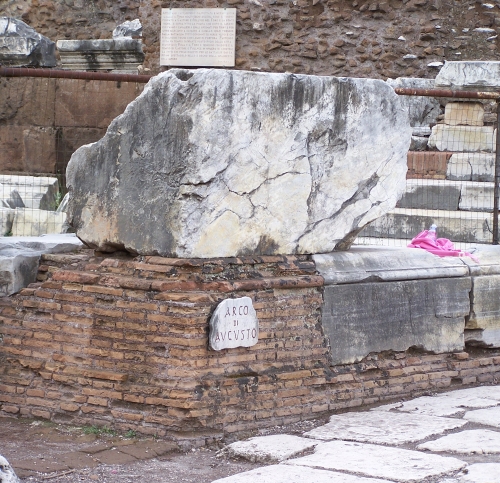
The Arch of Augustus (Latin: arcus Octaviani, Italian: Arco di Augusto) was the triumphal arch of Augustus, located in the Roman Forum. It spanned the Via Sacra, between the Temple of Castor and Pollux and the Temple of Caesar, near the Temple of Vesta, closing off the eastern end of the Forum. It can be regarded as the first permanent three-bayed arch ever built in Rome.
The archaeological evidence shows the existence of a three-bayed arch measuring 17,75 x 5.25 meters between the Temple of Caesar and the Temple of Castor and Pollux, although only the travertine foundations of the structure remain.
Ancient sources mention arches erected in honor of Augustus in the Forum on two occasions: the victory over Antony and Cleopatra in 31 BC, and the
recovery of the standards lost to the Parthians in 20 BC.
Cassius Dio reports that after the Battle of Actium the Senate granted Augustus a triumph and an arch in an unspecified spot in the Forum. No contemporary description of the structure remains, although it is possible that the Actian Arch is represented on a coin minted in ca. 30–29 BC. However, the arch depicted on the coin could also refer to another instance in which Augustus was granted a triumphal arch after the victory over Sextus Pompey in 36 BC.
The 13th century travel guide to Rome De mirabilibus urbis Romae describes it in detail, though there is no other evidence that the arch still existed by the time this was composed. He claims it is "Not far from this temple (the Pantheon)" and bears the following inscription "Because Augustus restored a conquered world to Roman rule, regaining it for the Republic, the Roman people erected this monument". It was supposedly "Multiple", "constructed of marble", and had a "stone platform, which projects outwards quite a distance" where "statues were placed of military commanders and those who had either distinguished themselves on campaign or fallen in the thick of battle", including a statue of Augustus himself. The arch described also had reliefs of the army, war, and the Battle of Actium wherein "Caesar, emerging from the struggle with a greater victory than he expected, pursues Cleopatra's fleeing galley." The arch may also have borne reliefs of Augustus's triumph after this event, but the wording is unclear.
A marble slab 2.65 m long and 0.59 m high bearing an inscription in honor of Augustus as savior and keeper of the Republic discovered in 1546 and subsequently lost was attributed to the Actian Arch.
Cassius Dio mentions an ovatio and another triumphal arch granted to Augustus after he recovered the eagles lost in the Battle of Carrhae and during Antony's campaign in Atropatene without specifying its location. A Veronese scholiast commenting on Vergil's Aeneid situates the structure next to the Temple of Caesar.
The arch is not mentioned by Augustus in his autobiography; moreover, Suetonius and Cassiodorus report that he refused to celebrate a triumph in 19 BC, leading some scholars to believe that the Parthian Arch might have been projected but never realized.
Coins minted in Pergamon, Tarraco, and Rome in the years 19–16 BC show a three-bayed arch with a quadriga on the top and figures holding bows and standards on the lower bays. Accordingly, the proposed reconstructions display a structure consisting of a higher central vaulted bay with Corinthian semi-columns and a triumphal chariot on top. The lower bays had square-topped pediments with Doric columns or semi-columns surmounted by statues of Parthians holding bows and the recovered eagles.
The Fasti Consulares and the Fasti Triumphales, unearthed in the Forum in 1546, may have been originally part of this monument, standing in the lateral aediculae; alternatively, they may have belonged to the nearby Regia.
Text from Wikipedia, the free encyclopedia, under CC BY-SA 4.0. Full article: «Arch of Augustus».
Events and people from Wikidata (CC0).
Distances are as the crow flies, not walking or driving.


Arch of Augustus is in Rome, in the province of Roma (Lazio), Italy. GPS coordinates: 41.89189, 12.48599.
Wikidata dates it to 19 BC.
Nearby you’ll find: Tombe preistoriche dell'Arco di Augusto (0 m away), Temple of Caesar (0 m away), Temple of Vesta (0 m away).
Text. Wikipedia, the free encyclopedia (CC BY-SA 4.0).
Data. Wikidata (CC0); opening hours and contacts OpenStreetMap (ODbL).
Photos. Wikimedia Commons, author and licence on every image.
Updated 28 October 2026. All sources and licences