




- UNESCO
- Free 1st Sunday
Photo: Bgabel, CC BY-SA 3.0 · Wikimedia Commons
Archaeological site, 100s
Trajan's Forum was the last of the Imperial fora to be constructed in ancient Rome. The architect Apollodorus of Damascus oversaw its construction. monumental square in Rome
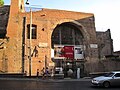
Trajan's Forum (Latin: Forum Traiani; Italian: Foro di Traiano) was the last of the Imperial fora to be constructed in ancient Rome. The architect Apollodorus of Damascus oversaw its construction.
This forum was built on the order of the emperor Trajan with the spoils of war from the conquest of Dacia, which ended in 106. The construction began between 105 and 107; according to the Fasti Ostienses the Forum was inaugurated in 112. Trajan's Column was erected and then inaugurated in 113.
To build this monumental complex, extensive excavations were required: workers eliminated a ridge connecting the Quirinal and Capitoline (Campidoglio) Hills. Over 300,000 cubic meters of soil and rock were excavated and dumped outside the Porta Collina.
It is possible that the excavations were initiated under Emperor Domitian, while the project of the Forum was completely attributed to the architect Apollodorus of Damascus, who also accompanied Emperor Trajan in the Dacian campaign.
During the time of the construction, several other projects took place: the construction of the Market of Trajan, the renovation of Caesar's Forum (where the Basilica Argentaria was built) and the Temple of Venus Genetrix.
The Forum consisted of a sequence of open and enclosed spaces, beginning with the vast portico-lined piazza measuring 300 metres (980 feet) long and 185 metres (607 feet) wide, with exedrae on two sides. The main entrance was at the south end of the piazza, through a triumphal arch at the center commemorating the Dacian Wars, decorated with friezes and statues of Dacian prisoners. The arch was flanked by tall walls built from blocks of Peperino tuff clad entirely in marble, which enclosed the Forum on three sides.
The tuff walls which enclosed the piazza to the west and east featured exedrae; outside the exedrae, separated by streets, were markets of concentric shape. The three-story eastern market, known as Trajan's Market, buttressed the excavated edge of the Quirinal Hill. The open space of the Forum measured about 91 metres (299 feet) by 120 metres (390 feet), and was paved entirely in Carrara marble. Via a doorway in the far east wall of the Forum, one gained entry to an open courtyard with a portico, which communicated in turn with the adjacent Forum of Augustus.
Along the piazza's north side was the Basilica Ulpia, and north of that was a smaller piazza, with a temple dedicated to the deified Trajan on the far north side facing inwards. The position of – and very existence of – the temple dedicated to the deified Trajan is a matter of hotly contested debate among archaeologists, particularly clear in the ongoing debate between James E. Packer and Roberto Meneghini. Between the Basilica Ulpia and the terminal piazza containing the temple, were two libraries, one housing Latin documents and the other Greek documents. Between the libraries stood the 38-metre (125-foot) Trajan's Column. The libraries housed state archives including the acts of the Emperors and the edicts of the praetors. …
In the mid-9th century, the marble cobble blocks of the piazza were systematically taken for re-use, because of the good quality of the lime. They were replaced with concrete, showing that the piazza was still in use as a public space. By the 10th century the Imperial Fora were semi-rural, with a patchwork of houses and farmland crisscrossed by roads occupying the former plaza of Trajan's Forum. In the late-16th century, the whole area of the Imperial Fora, which by then lay 3–4 meters below ground, was built up during a wave of urban expansion and the area became known as the Alessandrino district.
In 1526 the arch which formed the entrance to the Forum was demolished by the maestri di strade, Rome's Commissioners of Streets, which caused the Conservatore Francesco Cenci to submit a report to Rome's municipal government seeking redress for the destruction. Vestiges of the arch were found later in the century, including friezes which depicted scenes from the Dacian Wars, according to the descriptions of Flaminio Vacca.
In modern times only a section of the markets and the column of Trajan remain. A number of columns which historically formed the Basilica Ulpia remained on site, and have been re-erected. The construction of the Via dei Fori Imperiali in 1933 covered a number of these columns, which remain visible under the arches on which the road runs.
Text from Wikipedia, the free encyclopedia, under CC BY-SA 4.0. Full article: «Trajan's Forum».
Events and people from Wikidata (CC0).
Distances are as the crow flies, not walking or driving.


Trajan's Forum is in Rome, in the province of Roma (Lazio), Italy. GPS coordinates: 41.89542, 12.48587.
According to OpenStreetMap the opening hours are: Every day: 9:30–19:30. Always check the official website before your visit.
Wikidata dates it to 100s.
Nearby you’ll find: Temple of Trajan (0 m away), Trajan's Market (0 m away), Museo dei Fori Imperiali (100 m away).
Text. Wikipedia, the free encyclopedia (CC BY-SA 4.0).
Data. Wikidata (CC0); opening hours and contacts OpenStreetMap (ODbL).
Photos. Wikimedia Commons, author and licence on every image.
Updated 28 October 2026. All sources and licences