




- UNESCO
- Free 1st Sunday
Photo: sailko, CC BY 2.5 · Wikimedia Commons
Archaeological site
Ancient Roman platform for speakers
The Rostra (Italian: Rostri) was a large platform built in the city of Rome that stood during the republican and imperial periods. Speakers would stand on the rostra and face the north side of the Comitium towards the senate house and deliver orations to those assembled in between. It is often referred to as a suggestus or tribunal, the first form of which dates back to the Roman Kingdom, the Vulcanal.
It derives its name from the six rostra (plural of rostrum, a warship's ram) which were captured following the victory which ended the Latin War in the Battle of Antium in 338 BC and mounted to its side. Originally, the term meant a single structure located within the Comitium space near the Roman Forum and usually associated with the Senate Curia. It began to be referred to as the Rostra Vetera ("Elder Rostra") in the imperial age to distinguish it from other later platforms designed for similar purposes which took the name "Rostra" along with its builder's name or the person it honored.
Magistrates, politicians, advocates and other orators spoke to the assembled people of Rome from this highly honored, and elevated spot. Consecrated by the Augurs as a templum, the original Rostra was built as early as the 6th century BC. This Rostra was replaced and enlarged a number of times but remained in the same site for centuries.
In 338 BC the Rostra got its name when, following the defeat of Antium by the consul Gaius Maenius, the Antiate fleet was confiscated by Rome, of which the prows (literally rostra in Latin) of six ships were set upon the Rostra. Maenius paid for it out of his share of war booty. He also erected a victory column, the Columna Maenia, close to the Rostra.
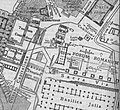
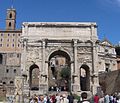
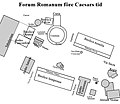
Julius Caesar rearranged the Comitium and Forum spaces and repositioned the Senate Curia at the end of the republican period. He moved the Rostra out of the Comitium. This took away the commanding position the curia had held within the whole of the forum, having advanced extremely close to the Rostra during its last restoration. Augustus, his grand-nephew and first Roman emperor, finished what Caesar had begun, as well as expanded on it. This "New Rostra" became known as the Rostra Augusti. What remains in the excavated forum today, next to the Arch of Septimius Severus, has endured several restorations and alterations throughout its historical use. While a few different honorary names are attributed to those restorations, scholars, archeologists and the government of Italy recognise this platform as the "Rostra Vetera" encased inside the "Rostra Augusti".
The term rostrum, referring to a podium for a speaker is directly derived from the use of the term "Rostra". One stands in front of a Rostrum and one stands upon the Rostra. While, eventually, there were many rostra within the city of Rome and its republic and empire, then, as now, "Rostra" alone refers to a specific structure.
Before the Forum Romanum, the Comitium was the first designated spot for all political and judicial activity and the earliest place of public assembly in the city. A succession of earlier shrines and altars is mentioned in early Roman writings as the first suggestum. It consisted of a shrine to the god Vulcan, that had two separate altars built at different periods. This early Etruscan mundus altar originally sat in front of a temple that would later be converted into the Curia Hostilia. …
In November 2008 heavy rain damaged the concrete covering that has been protecting the Vulcanal and its monuments located in the Imperial comitium space since the 1950s. This includes the stele accorded the name of "The Black Rock" or Lapis Niger. The marble and cement covering is a mix of the original black marble, said to have been used to cover the site by Sulla, and modern cement used to create the covering and keeping the marble in place.
Professor Angelo Bottini, Superintendent of Archeology in Rome, stated that an awning or tent covering is in place to protect the ancient relics until the covering is repaired, giving tourists of this millennium a look at the original suggestum for the first time in 50 years.
In 29 BC Augustus ordered the construction of another Rostra in front of the Temple of Caesar, at the opposite end of the Forum Iulium from Caesar's Rostra. This was used as a tribunal and was adorned with the prows of galleys captured at the Battle of Actium.
Text from Wikipedia, the free encyclopedia, under CC BY-SA 4.0. Full article: «Rostra».
Distances are as the crow flies, not walking or driving.


Rostra is in Rome, in the province of Roma (Lazio), Italy. GPS coordinates: 41.89264, 12.48461.
Nearby you’ll find: Umbilicus Urbis Romae (0 m away), Vulcanal (0 m away), Arch of Septimius Severus (Roman Forum) (0 m away).
Text. Wikipedia, the free encyclopedia (CC BY-SA 4.0).
Data. Wikidata (CC0); opening hours and contacts OpenStreetMap (ODbL).
Photos. Wikimedia Commons, author and licence on every image.
Updated 28 October 2026. All sources and licences