




- UNESCO
- Free 1st Sunday
Photo: L.VII.C, CC BY-SA 3.0 · Wikimedia Commons
Archaeological site
Building in Rome, Italy
The Temple of Concord, or Temple of Concordia, (Latin: Aedes Concordiae) in Rome refers to a series of temples dedicated to the Roman goddess Concordia, and erected at the western end of the Roman Forum. The Romans believed that the earliest temple was built by Marcus Furius Camillus in 367 BC, but archeological evidence indicates the first shrine to Concordia on the site was constructed in 218 BC by Lucius Manlius Vulso. The temple was rebuilt in 121 BC by Lucius Opimius, following the killing of the Gaius Gracchus and his supporters, and again by the future emperor Tiberius between 7 BC and AD 10.
According to Ovid and Plutarch, the first temple to Concordia was built on the site by Marcus Furius Camillus in 367 BC. The construction was to commemorate the passing of the Lex Licinia Sextia, the law opening the consulship to the Plebeian class. The office of Consul had previously been confined to the Patricians. Camillus is said to have been named Dictator to defend against an invasion of Gauls, backing the Lex Licinia Sextia as a means of resolving the ensuing crisis, and vowing the construction of the temple as a symbol of unity and reconciliation. Modern scholarship doubts much of the story of Camillus, but it was largely accepted as fact in the Roman world.
Camillus' story is not mentioned by Livy, who instead describes the dedication of the Temple of Concord in the Vulcanal, a precinct sacred to Vulcan on the western end of the forum, by Gnaeus Flavius in 304 BC. Flavius' identity in ancient sources is unclear; Livy makes the claim that he was an aedile, while Cicero and Pliny claim he was a scribe. In either case, he was reportedly the son of a freed slave, and therefore of low social standing. The nature of the conflicting identities of Flavius has caused some to call this story into question.
A third Temple of Concord was begun in 217 BC, early in the Second Punic War. This temple was built by the duumviri Marcus Pupius and Caeso Quinctius Flamininus, fulfilling a sacred vow made by the praetor Lucius Manlius Vulso following his victory over the Gauls in 218 BC. The reason why Manlius vowed a temple to Concordia specifically is not immediately apparent, but Livy alludes to a mutiny that had occurred among the praetor's men. The temple was completed and dedicated the following year by the duumviri Marcus and Gaius Atilius, and is the first temple attested in the archaeological record. …
The Temple of Concord, constructed by Lucius Opimus during the Republican period, had a typical rectangular podium 40.8 m × 30 m (134 ft × 98 ft). Based on the construction methods used in the base and support walls, the porch had eight Corinthian columns made out of travertine drums covered in stucco.
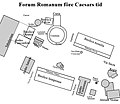
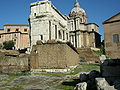
The later construction of the Temple of Concordia Augusta expanded and altered the previous temple. Backed up against the Tabularium at the foot of the Capitoline Hill, the design of the temple had to accommodate the limitations of the site. The cella of the temple, for instance, is almost twice as wide 45 m (148 ft) as it is deep 24 m (79 ft), as is the pronaos. A steep flight of stairs led up to the entrance of the temple on the long side, which would have been flanked by statues of Hercules and Mercury, symbolizing security and prosperity. A fragment of the marble threshold of the cella is preserved and features an engraved caduceus or wand of Mercury, which represented peace and reconciliation. Three statues were positioned on the apex of the pediment, which represented Concord along with two other goddess, Pax and Salus (or Securitas and Fortuna). Two soldiers, representing Tiberius and his brother Drusus, stood on either side of them. In the cella, a row of Corinthian columns rose from a continuous plinth projecting from the wall, which divided the cella into bays, each containing a niche. The capitals of these columns had pairs of leaping rams in place of the corner volutes. Only the platform now remains, partially covered by a road up to the Capitol.
The main temple in the Forum in Rome seems to have been a model for temples to the goddess elsewhere in the empire—a reproduction of this temple was found at Mérida in Spain, during the excavations of the town's forum in 2002.
Text from Wikipedia, the free encyclopedia, under CC BY-SA 4.0. Full article: «Temple of Concord».
Distances are as the crow flies, not walking or driving.


Temple of Concord is in Rome, in the province of Roma (Lazio), Italy. GPS coordinates: 41.89293, 12.48424.
Nearby you’ll find: Basilica Opimia (0 m away), Vulcanal (0 m away), Umbilicus Urbis Romae (0 m away).
Text. Wikipedia, the free encyclopedia (CC BY-SA 4.0).
Data. Wikidata (CC0); opening hours and contacts OpenStreetMap (ODbL).
Photos. Wikimedia Commons, author and licence on every image.
Updated 28 October 2026. All sources and licences