



- UNESCO
- Free 1st Sunday
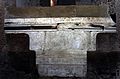
Photo: Rita1234, CC BY-SA 3.0 · Wikimedia Commons
Archaeological site, 77 BC
The official records office of Ancient Rome
The Tabularium was the official records office of ancient Rome and housed the offices of many city officials. Situated within the Roman Forum, it was on the front slope of the Capitoline Hill, below the Temple of Jupiter Optimus Maximus, to the southeast of the Arx.
Within the building were the remains of the Temple of Veiovis. In front of it were the Temples of Vespasian and Concord, as well as the Rostra and the rest of the forum. Presently, the Tabularium is only accessible from within the Capitoline Museums, although it still provides a panoramic view over the forum.
The construction of the Tabularium was ordered around 78 BC by the dictator Lucius Cornelius Sulla. The building was completed by Quintus Lutatius Catulus Capitolinus, consul in 78 BC. This was part of a public works programme for the redevelopment of the Capitoline Hill, which had been damaged by a fire in 83 BC. The construction by Catulus is not mentioned in the ancient literature. It is known through an inscription.
The building itself had a facade of peperino and travertine blocks. The interior vaults are of concrete.
Its great corridor, 67 m (220 ft) long, raised 15 m (49 ft) above the forum on a massive substructure, and is still partly preserved. This corridor was lighted through a series of arches divided by semi-detached columns of the Doric order, the earliest example of this class of decoration, which is in the Theatre of Marcellus, the Colosseum, and all the great amphitheatres throughout the Roman Empire, constituted the decorative treatment of the wall surface and gave scale to the structure.
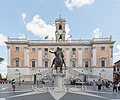
The facade faced the back of the Temple of Concord in the forum and consisted of three levels. The first story was a large and tall fortified wall with a single door and only small windows near the top to light the interior, forum-level rooms. The second story featured a Doric arcade (partially preserved) and the third, no longer extant story, had a high Corinthian order colonnade. The upper floors of this structure were much changed in the 13th century, when the Palazzo dei Senatori was built.
Some scholars, such as Filippo Coarelli, in the past, have suggested that the Tabularium itself is unattested in any literary sources. Furthermore, its function and purpose have been the subject of debate. The unity of the main structure does, however, suggest that the building was at least initially conceived to serve a singular purpose. To illustrate the complexity of the building, Filippo Coarelli has stated that a particular annex of the Aerarium Saturni was constructed specifically to house metal ingots and minted Republican coins.
Recent evidence, in the form of six military diplomas dated from 85 to 88 AD, confirms the existence of the Tabularium in its renowned form.
Coarelli has suggested that the Tabularium can be dated precisely to 78 BC, although construction began many years prior and almost certainly prior to the death of Sulla. The building itself is in many ways intrinsically tied to the politics of Sulla, especially in regard to the temple substructure. …
Nicholas Purcell's article "Atrium Libertatis" is aligned with the view of contemporary historians regarding the epigraphic evidence once present within the Tabularium. In his detailed analysis of the now-lost inscriptions, Purcell makes clear that these inscriptions have compounded our misunderstanding of one of the largest, oldest and best-preserved buildings of the Roman Republic.
The generic terms probatio of a substructio and a Tabularium were recorded by an early Renaissance antiquarian in that order. It is arguable that the identification of the so-called "Tabularium" is incorrect. Purcell draws our attention to the lack of archaeological and epigraphic knowledge on tabularia, suggesting that these inscriptions were not intended to be grandiose in scope, nor did they name the building, which further reflects the prevailing credulity of the structure in question. Purcell's reference to the archaeological research conducted by Theodor Mommsen aligns with his argument and likely indicates that historians must set aside such misunderstandings reflected in the literary sources. As Mommsen stated quite rightly, that Tabularium may refer to any structure associated with administration. Therefore, it is likely that the Tabularium in question, despite the sheer size fronting the Capitoline Hill, was one of many structures built for the purpose of holding records.
Purcell's assessment of the epigraphic evidence once found within the structure in question reaffirms the following view, long held by academics, that the Tabularium is insufficiently documented and the product of scholarly inertia. This, unfortunately, has further compounded our understanding of the Capitoline substructure and, as a result, we are no closer to identifying the extent of its function, let alone its name. …
Text from Wikipedia, the free encyclopedia, under CC BY-SA 4.0. Full article: «Tabularium».
Events and people from Wikidata (CC0).
Distances are as the crow flies, not walking or driving.


Tabularium is in Rome, in the province of Roma (Lazio), Italy. GPS coordinates: 41.89278, 12.48361.
Wikidata dates it to 77 BC.
Nearby you’ll find: Temple of Veiovis (0 m away), Temple of Vespasian and Titus (0 m away), Palazzo Senatorio (0 m away).
Text. Wikipedia, the free encyclopedia (CC BY-SA 4.0).
Data. Wikidata (CC0); opening hours and contacts OpenStreetMap (ODbL).
Photos. Wikimedia Commons, author and licence on every image.
Updated 28 October 2026. All sources and licences