

- UNESCO
- Free 1st Sunday
Photo: Mark Miller ( talk ), Public domain · Wikimedia Commons
Archaeological site
Original open-air public meeting space of Ancient Rome
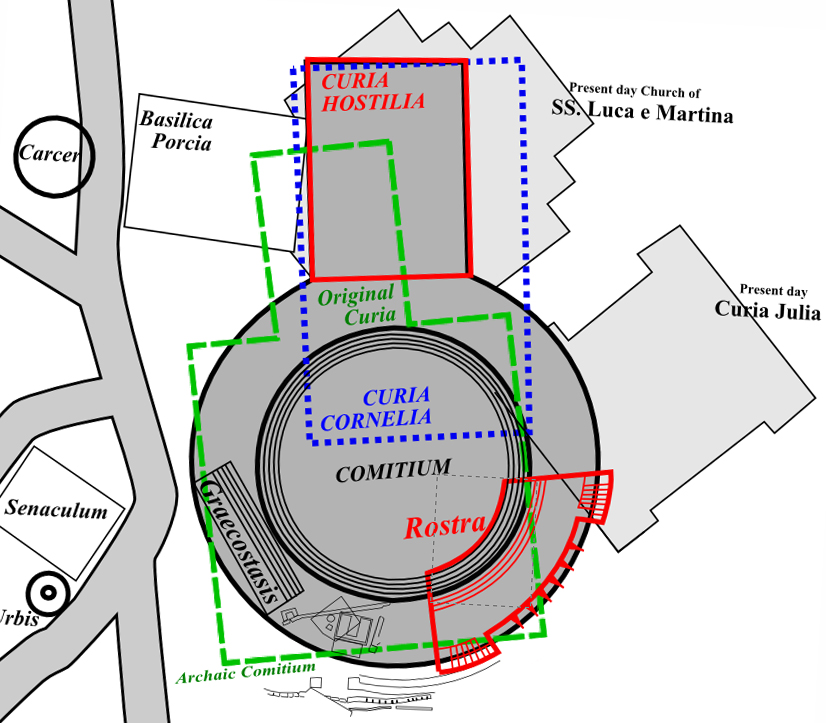
The Comitium (Italian: Comizio) was the original open-air public meeting space of Ancient Rome, and had major religious and prophetic significance. The name comes from the Latin word for "assembly". The Comitium location at the northwest corner of the Roman Forum was later lost in the city's growth and development, but was rediscovered and excavated by archaeologists at the turn of the twentieth century. Some of Rome's earliest monuments, including the speaking platform known as the Rostra, the Columna Maenia, the Graecostasis, and the Tabula Valeria, were part of or associated with the Comitium.
The Comitium was the location for much of the political and judicial activity of Rome. It was the meeting place of the Curiate Assembly, the earliest Popular assembly of organised voting divisions of the Republic. Later, during the Roman Republic, the Tribal Assembly and Plebeian Assembly met there. The Comitium was in front of the meeting house of the Roman Senate – the still-existing Curia Julia and its predecessor, the Curia Hostilia. The Curia Julia is associated with the Comitium by both Livy and Cicero.
The earliest use of the Comitium as a political assembly area, along with the beginnings of Rome itself, is blurred between legend and archaeological discovery. The traditional stories of King Servius Tullius and Romulus have many similarities regarding the origins of the comitia, leading Romulus to be often interpreted as a copy of Tullius. Both were closely related to the God Vulcan, played a role in organizing the comitia, and were depicted as founders of Rome. Other conflicting, or "duel" mythologies include the supposed tomb of Romulus, who was struck and killed during the Sabine conflict and was buried under the Vulcanal. Alternative legends state that he was only wounded and that spot was where Faustulus was killed separating the twins during combat. Many of the legends themselves transferred to the Comitum from the Palatine. For example, the pomeriam where Remus is said to have slept as well as the Ficus Ruminalis and the sculpture of the she-wolf suckling the twins have competing legends. The original Palatine settlement, Roma quadrata, contained the relics of Romulus. An extension of the square city is seen in the "Septimontium", the original seven hills. Ancient stories suggest that Tarpeia was drawing water from a spring here when she saw Tatius for the first time. …
When Rome became a republic, the original altar and Shrine of Vulcan may have served as a podium for senators or political opponents. Next to this spot is where the Rostra has its early beginnings. It is believed that the tradition of speaking to crowds from an elevated platform for political purposes may have begun as early as the first king of Rome. In this area was another raised platform for speakers, with ascending and descending stairs on either side. The first structure to be called "Rostra" was on the south east section of the forecourt of the Curia Hostilia at the edge of the Comitium. As the population grew, not all Romans could fit in the Comitium, and speakers in the later Republic would turn their backs on the Curia and crowds within the Comitium and direct their speech to the crowd in the forum. All of the city's most important decisions and laws were made in the senate. A law required that any bill not approved within an inaugurated and consecrated space was not valid. For this reason all meeting spaces of the senate were temples. Over time as the senate's size and power increased, so did the size of the senate house. In 80 BC the curia was enlarged by Sulla, who also added heating to the building for the first time.
In 55 BC a political war broke out within the city between two factions, one led by Clodius, the other by his adversary Milo. The Rostra became a fortress and was more than once used to throw deadly missiles upon the opposing side. On January 2, 52 BC, Clodius died at the hands of the opponents near Bovillae, setting off a riot as his followers carried the body to the Comitium and cremated it on a funeral pyre improvised with the senatorial seating from the Curia Hostilia. The fire consumed the Curia, destroying it as well as damaging the Basilica Porcia. Faustus Sulla, son of the dictator Sulla, was commissioned by the senate to rebuild the Curia. His structure lasted only seven years until Julius Caesar replaced it with a building of his own design.
The Comitium was open towards the forum. At the boundary were the monuments and statues recording political events and recognizing famous Romans. There were four sacred fig trees in the city, three of which were within the forum. A tree planted near the Temple of Saturn was removed when its root system began undermining a valued statue. In the medio foro a fig tree stood aside an olive tree and a grape vine. Verrius Flaccus, Pliny and Tacitus state that a third tree stood in the Comitium near the statue of the augur Attus Navia who, legend says, split a wet stone with a razor in the Comitium and transferred the Ficus ruminalis or its sacred importance from the base of the Palatine hill to the assembly area. Scholars still refer to the Ficus Navia as the Ficus Ruminalis while accepting the difference. Livy reports that a statue to Publius Horatius Cocles was erected in the Comitium. There existed another grandstand within the Comitium beside the Rostra. The Graecostasis was located on the northwest side of the forum. Beside the Rostra and the Graecostasis was the Columna Maenia. In 338 BC, Consul Gaius Maenius erected a column that some historians believe to be from the atrium of his home which was sold to Cato and Flaccus as mentioned by Pseudo-Asconius (Caec. 50). Pliny states that the accensus consulum announced the supremam horam, the time when the sun had moved downward from the Columna Maenia to the Carcer. This was done from the same location as the call for midday, the Curia. The column was south of the place of observation or on a line which passed from the Rostra and Graecostasis. The Tabula Valeria was one of the first public works of its kind in the city. In 263 BC, Consul Manius Valerius Maximus Corvinus Messalla placed a painting of his victory over Heiro and the Carthaginians in Sicily, on the side of the ancient curia. Samuel Ball Platner states in his book, The topography and monuments of ancient Rome (1911):
A more probable explanation is that the Tabula Valeria was an inscription in bronze or marble, containing the provisions of the famous Valerio-Horatian laws concerning the office of tribune. Such a tablet might very naturally be set up near their subsellia." …
Caesar's rise to power as a military general along with his successful campaigns led to sharing of power within the Republic, known as the First Triumvirate. The shared power did not last and Caesar became dictator for life (and the last Roman dictator). The Comitium was reduced in size twice in consecutive order by Cornelius Sulla and again by Julius Caesar. One of Caesar's many building projects was to remove or replace the Rostra Vetera, level the Comitium and dismantle the curia and realign it with the new Rostra.
An episode that may have contributed to the Liberatores conspiracy against Caesar was on the occasion of the festival of the Lycea, or Lupercalia. Mark Antony, as one of the participants, approached Caesar while he stood in the Comitium on the Rostra. Antony ceremoniously attempted to place a laurel wreath on Caesar's head. Caesar theatrically refused, and received applause from the people. This was done several times until the wreath was finally placed upon the head of a statue of Caesar, which was then immediately torn down by Caesar's enemies.
The Rostra was the most prestigious spot in Rome to speak from. Cicero remarked on the honor in his first speech during his term as praetor. It was the first time Cicero spoke from the Rostra. The Philippics became one of the most popular writings of the orator. The works marked a return to active politics in 43 BC after a long retirement. In them, he attacked Mark Antony as the greatest threat to republican government after Caesar's death. He wrote of the libertas or freedoms that the citizens of Rome had forfeited under Julius Caesar and violently denounced Mark Antony. He made at least one of these epic speeches from the Rostra. When the conspirators had all been defeated, Augustus had tried but failed to keep Cicero's name off the death list. Eventually Antony wins and has the orator's head and hands displayed on the Rostra.
Text from Wikipedia, the free encyclopedia, under CC BY-SA 4.0. Full article: «Comitium».
Distances are as the crow flies, not walking or driving.


Comitium is in Rome, in the province of Roma (Lazio), Italy. GPS coordinates: 41.89278, 12.48500.
Nearby you’ll find: Arch of Septimius Severus (Roman Forum) (0 m away), Vulcanal (0 m away), Rostra (0 m away).
Text. Wikipedia, the free encyclopedia (CC BY-SA 4.0).
Data. Wikidata (CC0); opening hours and contacts OpenStreetMap (ODbL).
Photos. Wikimedia Commons, author and licence on every image.
Updated 28 October 2026. All sources and licences