




- UNESCO
- Free 1st Sunday
Photo: CC BY-SA 3.0 · Wikimedia Commons
Archaeological site
Archeological site in Italy
The Curia Hostilia was one of the original senate houses or "curiae" of the Roman Republic. It was believed to have begun as a temple where the warring tribes laid down their arms during the reign of Romulus (r. c. 771–717 BC). During the early monarchy, the temple was used by senators acting as a council to the king. Tullus Hostilius (r. 673–641 BC) was believed to have replaced the original structure after fire destroyed the converted temple. It may have held historic significance as the location of an Etruscan mundus and altar. The Lapis Niger, a series of large black marble slabs, was placed over the altar (known as the Volcanal) where a series of monuments was found opposite the Rostra. This curia was enlarged in 80 BC by Lucius Cornelius Sulla during his renovations of the Comitium. That building burned down in 52 BC when the supporters of the murdered Publius Clodius Pulcher used it as a pyre to cremate his body.
There has been a meeting house for the people of Rome through most of Rome's history. This one likely began as a temple.
There may have been a small shrine to the god Vulcan from the earliest period, a stone altar with a marble stele inscribed with a dedication from a Latin king. An honorary column was also among the tightly packed items. This spot was separated from the rest of the comitium with a low rising concrete fence to keep pedestrians from walking atop it.
The Curia Hostilia architecture had changed a number of times, but maintained its original form even after a number of refurbishments. The structure was where all of Rome's early political life centered. It is said that the public was always allowed to stroll into the Curia Hostilia to listen to the senators debate.
Relatively little is known about the Curia Hostilia. One feature of the Curia that is mentioned in almost all sources is the "Tabula Valeria", a painting on the exterior of the Curia's western wall. It depicted the victory of Manius Valerius Maximus Corvinus Messalla over Hiero and the Carthaginians in 263 BC. Pliny says that the painting was the first such picture in Rome.
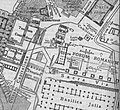
Another detail that most sources agree on is that the Curia Hostilia was located on the north side of the comitium. It is believed that the circular set of stairs of the Comitium, which also doubled as seating for citizens listening to speakers at the Rostra, led up to the Curia's entrance. With regard to the Curia's location, Stambaugh writes, "he Curia Hostilia was built on rising ground so as to dominate the whole space of the Forum Romanum". Given its prominent place in the Forum, it seems that the Curia Hostilia was a symbol of the strength of the Roman Republic. …
Text from Wikipedia, the free encyclopedia, under CC BY-SA 4.0. Full article: «Curia Hostilia».
Distances are as the crow flies, not walking or driving.


Curia Hostilia is in Rome, in the province of Roma (Lazio), Italy. GPS coordinates: 41.89306, 12.48528.
Nearby you’ll find: Curia Julia (0 m away), Temple of Janus (0 m away), Comitium (0 m away).
Text. Wikipedia, the free encyclopedia (CC BY-SA 4.0).
Data. Wikidata (CC0); opening hours and contacts OpenStreetMap (ODbL).
Photos. Wikimedia Commons, author and licence on every image.
Updated 28 October 2026. All sources and licences