



- UNESCO
- Free 1st Sunday
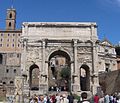
Photo: Peter Paul Rubens, Public domain · Wikimedia Commons
Archaeological site
Destroyed temple in the Roman Forum
The Temple of Janus stood in the Roman Forum near the Basilica Aemilia, along the Argiletum. It was a small temple with a statue of Janus, the two-faced god of boundaries and beginnings inside. Its doors were known as the "Gates of Janus", which were closed in times of peace and opened in times of war. There are many theories about its original purpose; some say that it was a bridge over the Velabrum, and some say it functioned as a gate to the Capitoline.
According to Livy 1.19 the second king of Rome, Numa Pompilius, decided to distract the early, warlike Romans from their violent ways by instilling in them awe and reverence. His projects included promoting religion, certain priesthoods, and the building of temples as a distraction with the beneficial effect of imbuing spirituality. The Janus in the Roman Forum, although not a temple was claimed to be Numa's most famous architectural project.
In the early stages of the city of Rome, the inhabitants lived in separate walled villas. The Janus was the gate from the Forum to the rest of Rome as originally the Forum was the courtyard of the king's villa.
Plutarch, in Life of King Numa, wrote:[Janus] also has a temple at Rome with double doors, which they call the gates of war; for it always stands open in time of war, but is closed when peace has come. The latter was a difficult matter, and it rarely happened, since the realm was always engaged in some war, as its increasing size brought it into collision with the barbarous nations which encompassed it round about. But in the time of Augustus it was closed, after he had overthrown Mark Antony; and before that, when Marcus Atilius and Titus Manlius were consuls, it was closed for a short time; then war broke out again at once, and it was opened.
The Temple of Janus was a small temple just large enough to house a bronze statue of the god. A small portion of the temple's brick structure can be found beside the ruins of the Basilica Aemilia, along the path of the Argiletum in the Roman Forum, so much of what we know about the temple visually comes from Roman scholars and artifacts. The various styles of architecture seen on Roman coins suggest rough dates for the reconstructions; both in the third and fourth centuries BC. As described by the Byzantine scholar Procopius who says "the temple is entirely of bronze and was erected in the form of a square, but it is only large enough to cover the statue of Janus... of bronze and not less than five cubits high". There are also descriptions that can be taken from items from the Roman world most notably coins minted for Emperor Nero. These coins depict the Temple of Janus as a small rectangular building with two doors accompanied by two columns having Ashlar masonry on the outside and only bronze plating on the inside. This shows a discrepancy in the sources, leaving the assumption that it was bronze only on the inside of the Temple. The temple of Athena Chalcioecus in Sparta and Apollo at Delphi are also built this way. The art style of the Temple was inspired by Etruscan architecture and influences from the Near East.
The Gates themselves were the main purpose for the Temple of Janus. The opening and closing of the gates were to symbolize either wartime or peace. The Temple of Janus tied in warfare and religious tradition. It is unanimously held by ancient and modern scholars that the gates were closed in peace and opened in times of war. While its purpose is agreed upon the reasons behind the openings and closings of the gates are much murkier. Both Virgil and Ennius state that the gates held in Discord and Fury inside the temple during times of peace. Ennius's Annales state "After foul Discord has broken open the iron-clad posts and gates of war". Virgil supports this view with "There are twin gates of War... Janus the guard does not withdraw from his threshold". Horace does not use prison imagery but can be interpreted as saying peace, or if Janus himself, is kept locked in the temple. This lack of clarity by the Romans themselves demonstrates the fluctuating nature of their mythos-history. However, a Roman viewed the Temple of Janus's gates as having them shut was a time of celebration and of pride for the rulers of Rome. As demonstrated by Caesar Augustus's accounts of shutting the doors three times.
Text from Wikipedia, the free encyclopedia, under CC BY-SA 4.0. Full article: «Temple of Janus».
Events and people from Wikidata (CC0).
Distances are as the crow flies, not walking or driving.


Temple of Janus is in Rome, in the province of Roma (Lazio), Italy. GPS coordinates: 41.89298, 12.48572.
Nearby you’ll find: Curia Julia (0 m away), Curia Hostilia (0 m away), Forum Nervae (0 m away).
Text. Wikipedia, the free encyclopedia (CC BY-SA 4.0).
Data. Wikidata (CC0); opening hours and contacts OpenStreetMap (ODbL).
Photos. Wikimedia Commons, author and licence on every image.
Updated 28 October 2026. All sources and licences