





Photo: Tournasol7, CC BY-SA 4.0 · Wikimedia Commons
Historic villa / palace
Palazzo dei Conservatori
Historic building in Rome
- Within the UNESCO World Heritage Site “Historic Centre of Rome, the Properties of the Holy See in that City Enjoying Extraterritorial Rights and San Paolo Fuori le Mura”
At a glance
- Style
- Renaissance architecture
- Architect
- Michelangelo Buonarroti
- Commissioned by
- Roma Capitale
- Coordinates
- 41°53′35″ N, 12°28′58″ E
History and description
The Capitolium or Capitoline Hill, between the Forum and the Campus Martius, is one of the Seven Hills of Rome.
The hill was earlier known as Mons Saturnius, dedicated to the god Saturn. The word Capitolium first referred to the Temple of Jupiter Optimus Maximus which was located on the hill; however, the meaning evolved to refer to the whole hill and even other temples of Jupiter on other hills. In an etymological myth, ancient sources connect the name to caput ("head", "summit") because of a tale that stated that when the foundations for the temple were being laid, a man's head was found. The Capitolium was regarded by the Romans as indestructible, and was adopted as a symbol of eternity.
The word Capitolium is a precursor to the English word capitol, and Capitol Hill in Washington, D.C. is widely assumed to be named after the Capitoline Hill.
Ancient history
At this hill, the Sabines, creeping to the Citadel, were let in by the Roman maiden Tarpeia. For this treachery, Tarpeia was the first to be punished by being flung from a steep cliff overlooking the Roman Forum. This cliff was later named the Tarpeian Rock after the Vestal Virgin, and became a frequent execution site. The Sabines, who immigrated to Rome following the Rape of the Sabine Women, settled on the Capitoline.
The Vulcanal (Shrine of Vulcan), an 8th-century BC sacred precinct, occupied much of the eastern lower slopes of the Capitoline, at the head of what later became the Roman Forum. The summit was the site of a temple for the Capitoline Triad, started by Rome's fifth king, Tarquinius Priscus (r. 616–579 BC), and completed by the seventh and last king, Tarquinius Superbus (535–496 BC). It was considered one of the largest and the most beautiful temples in the city, although little now remains. The city legend starts with the recovery of a human skull (the word for head in Latin is caput) when foundation trenches were being dug for the Temple of Jupiter at Tarquin's order. Recent excavations on the Capitoline uncovered an early cemetery under the Temple of Jupiter.
There are several important temples built on Capitoline Hill: the temple of Juno Moneta, the temple of Virtus, and the Temple of Jupiter Optimus Maximus Capitolinus. The Temple of Jupiter Optimus Maximus Capitolinus is the most important of the temples. It was built in 509 BC and was nearly as large as the Parthenon. The hill and the temple of Jupiter became the symbols of Rome, the capital of the world. The Temple of Saturn was built at the foot of Capitoline Hill in the western end of the Forum Romanum.
When the Senones Gauls, who settled in central-east Italy, raided Rome in 390 BC, after the battle of River Allia, the Capitoline Hill was the one section of Rome to evade capture by the barbarians, due to its being fortified by the Roman defenders. According to legend, Marcus Manlius Capitolinus was alerted to the Gallic attack by the sacred Roman geese of Juno. …
Medieval history
The church of Santa Maria in Aracoeli is adjacent to the square, located near where the ancient arx, or citadel, atop the hill it once stood. At its base are the remains of a Roman insula, with more than four storeys visible from the street.
In the Middle Ages, the hill's sacred function was obscured by its other role as the center of the civic government of Rome, revived as a commune in the 12th century. Rome's government was now firmly under papal control, but the Capitoline was the scene of movements of urban resistance, such as the dramatic scenes of Cola di Rienzo's revived republic.
In 1144, a revolt by the citizens against the authority of the Pope and nobles led to a senator taking up his official residence on the Capitoline Hill. The senator's new palazzo turned its back on the ancient forum, beginning the change in orientation on the hill that Michelangelo later accentuated. A small piazza was laid out in front of the senator's palazzo, intended for communal purposes. In the middle of the 14th century, the guilds' court of justice was constructed on the southern end of the piazza. This later housed the Conservatori in the 15th century. As a result, the piazza was already surrounded by buildings by the 16th century.
Michelangelo
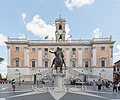
The existing design of the Piazza del Campidoglio and the surrounding palazzi was created by Renaissance artist and architect Michelangelo Buonarroti in 1536–1546. At the height of his fame, he was commissioned by the Farnese Pope Paul III, who wanted a symbol of the new Rome to impress Charles V, who was expected in 1538. This offered him the opportunity to build a monumental civic plaza for a major city as well as to reestablish the grandeur of Rome.
Michelangelo's first designs for the piazza and remodeling of the surrounding palazzi date from 1536. His plan was formidably extensive. He accentuated the reversal of the classical orientation of the Capitoline, in a symbolic gesture turning Rome's civic center to face away from the Roman Forum and instead in the direction of Papal Rome and the Christian church in the form of St. Peter's Basilica. This full half circle turn can also be seen as Michelangelo's desire to address the new, developing section of the city rather than the ancient ruins of the past.
An equestrian statue of Marcus Aurelius was to stand in the middle of the piazza set in a paved oval field. Michelangelo was commissioned to provide a setting for the statue and to bring order to an irregular hilltop already encumbered by two crumbling medieval buildings set at an acute angle to one another. The Palazzo del Senatore was to be restored with a double outer stairway, and the campanile moved to the center axis of the palazzo.
The Palazzo dei Conservatori was to be restored, and a new building, the so-called Palazzo Nuovo, built at the same angle on the north side of the piazza to offset the Conservatori, creating a trapezoidal piazza. A wall and balustrade were to be built at the front of the square, giving it a firm delineation on the side facing the city. A flight of steps was to lead up to the enclosed piazza from below, further accentuating the central axis.
The sequence, cordonata, piazza, and the central palazzo are the first urban introduction of the "cult of the axis" that was to occupy Italian garden plans and reach fruition in France. …
Influence
Influenced by Roman architecture and Roman republican times, the word Capitolium still lives in the English word capitol. The Capitol Hill in Washington, D.C., is widely assumed to be named after the Capitoline Hill.
Text from Wikipedia, the free encyclopedia, under CC BY-SA 4.0. Full article: «Palazzo dei Conservatori».
People
Events and people from Wikidata (CC0).
Photos
Getting there
Roma TerminiTrain, nearest
1.8 km as the crow flies
Palazzo dei Conservatori
Aeroporto di Roma-Ciampino13.8 km
Distances are as the crow flies, not walking or driving.
Loading map…
Nearby
See on the mapMore historic villas and palaces in Lazio

- Free 1st Sunday


Frequently asked questions
Where is Palazzo dei Conservatori?
Palazzo dei Conservatori is in Rome, in the province of Roma (Lazio), Italy. GPS coordinates: 41.89300, 12.48281.
What else is there to see near Palazzo dei Conservatori?
Nearby you’ll find: Capitoline Museums (0 m away), Arch of Scipio Africanus (0 m away), Convent of Aracoeli (100 m away).
Sources and licences
Text. Wikipedia, the free encyclopedia (CC BY-SA 4.0).
Data. Wikidata (CC0); opening hours and contacts OpenStreetMap (ODbL).
Photos. Wikimedia Commons, author and licence on every image.
Credits for the 9 photos
- Palazzo dei Conservatori in Rome (2) — Tournasol7, CC BY-SA 4.0
- Inscription recording the donation of the Lateran bronzes by Sixtus IV (Rome, Palazzo dei Conservatori) — Mark Landon, CC BY 4.0
- Palazzo dei Conservatori, inscription honoring Alessandro Farnese (1588) — Mark Landon ( user:Choliamb ), CC BY 4.0
- Palazzo dei Conservatori, inscription honoring Marcantonio Colonna for the victory at Lepanto (1591) — Mark Landon ( user:Choliamb ), CC BY 4.0
- Roma Campidoglio, Palazzo dei Conservatori, sala Pietro da Cortona — Wilfredor, CC0
- Altaarreliëf met offerscène, GD000319 — Unknown, Public domain
- Busto Luigi Mattei — Unochepassava94, CC BY-SA 4.0
- Monumento Luigi Mattei — Unochepassava94, CC BY-SA 4.0
- P1000172bis — Hugo DK, CC BY-SA 4.0
Updated 28 October 2026. All sources and licences