





- Free 1st Sunday
Photo: Tournasol7, CC BY-SA 4.0 · Wikimedia Commons
Museum, 1471
Municipal museum of the city of Rome, Italy
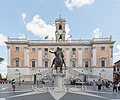
The Capitoline Museums (Italian: Musei Capitolini) are a group of art and archaeological museums located on the Capitoline Hill in Rome, Italy, and constitute the main civic museum complex of the city. Their principal buildings are the Palazzo dei Conservatori and the Palazzo Nuovo, which face each other across Piazza del Campidoglio, the square designed by Michelangelo in 1536 and completed over the course of the following centuries.
The museums are primarily dedicated to the art and history of ancient Rome, with a particular emphasis on Roman sculpture. The collection include celebrated works such as the Equestrian Statue of Marcus Aurelius, the Capitoline Wolf and the Dying Gaul, alongside inscriptions, coins, and other artifacts illustrating the civic and religious life of the city. The museums also include Renaissance and Baroque paintings, as well as the richly frescoed walls of the Conservators' Apartment in the Palazzo dei Conservatori, which depict scenes from Rome's early history.
The Capitoline Museums traces the collection's origins to 1471, when Pope Sixtus IV donated to the people of Rome a collection of ancient bronzes from the Lateran.
The history of the museum can be traced to 1471, when Pope Sixtus IV donated a collection of important ancient bronzes to the people of Rome, until then kept in the Lateran Palace and donated to the Roman people: the Capitoline Wolf, the Camillus (statue), the Boy with Thorn and two fragments of a colossal statue of Domitian (the head and a hand holding a globe). As the inscription preserved in the Palazzo dei Conservatori specifies, it is not a donation but a "restitution": «he judged that these remarkable bronze statues, testimony to the ancient greatness of the Roman people who had them made, had to be returned and donated without reservations»: these works of art had constituted the thesaurus Romanitatis, representing a sort of heritage of the ancient world that the Church had collected and jealously guarded throughout the Middle Ages.
Sixtus IV chose to house the bronzes on the Capitoline Hill, then dominated by the ancient Palazzo Senatorio, also built on the remains of the Tabularium, home of the Roman archives. The Wolf is placed on the facade of the Palazzo dei Conservatori and becomes the symbol of Rome, replacing the group of the Lion slaughtering a horse, present until then, symbol of the legal functions of the senatorial authority and the only sculpture present on the Capitoline Hill before the donation of Sixtus IV. This donation symbolizes the continuity between imperial Rome and the temporal power of the Church, affirming the predominance of papal power on the Capitoline Hill, making this ancient hill the very symbol of the historical memory of Rome, in contrast to the role of driving force of civil autonomy that the Capitoline magistrates later strenuously defended. …
The Capitoline Collection is the oldest public collection in the world, covering an exhibition area of 12,997 m2 (139,900 sq ft).
Among the most famous sculptures kept in the Capitoline Museums is the Equestrian Statue of Marcus Aurelius, originally located in the center of Piazza del Campidoglio and transferred to the museums in 1990, in a specially set up glass room: the Exedra of Marcus Aurelius, which is located where the Roman Garden used to be, between Palazzo dei Conservatori and Palazzo Caffarelli. In the center of the square, in 1996, the statue of Marcus Aurelius was replaced by a copy, perfectly compliant in terms of volumes but not in terms of gilding.
There is also the symbol of the city, the bronze Capitoline Wolf, believed to be an Etruscan work from the 5th century BC; the original statue did not include the twins Romulus and Remus, added in the 15th century and attributed to the sculptor Antonio del Pollaiolo. Recently some restorers have hypothesized that the statue is not ancient, but medieval and that it dates back to the 12th century.
The Colossus of Constantine, visible in the courtyard, dates back to the 4th century. Other masterpieces of bronze sculpture are the Hercules of the Forum Boarium and the Boy with Thorn.
A masterpiece of medieval sculpture is the Portrait of Charles I of Anjou by Arnolfo di Cambio (1277), the first lifelike portrait of a living character sculpted in Europe that has reached us from the post-classical era.
Over time, other and numerous historical collections were exhibited here, such as the Protomoteca (collection of busts and herms of illustrious men transferred from the Pantheon to the Campidoglio by order of Pius VII in 1820); the collection of Cardinal Alessandro Albani; the one donated by Augusto Castellani in the second half of the 19th century, consisting of archaic ceramic materials (from the 8th century BC to the 4th century BC), mainly of Etruscan area, but also of Greek and Italic production.
The connection between the two museum locations, the Palazzo Nuovo and the Palazzo dei Conservatori, is guaranteed by the underground Galleria di conaccordo specially excavated in the 1930s and later used as a Galleria lapidaria, from which it is also possible to access the temple of Veiovis and the gallery of the Tabularium.
On the second floor of the Palazzo dei Conservatori is the Pinacoteca Capitolina, which houses works by Guercino, Caravaggio, Rubens, Titian and Velázquez.
The Capitoline Museums are located on the Capitoline Hill, one of the seven hills of Rome, adjacent to the nearby Piazza Venezia, the Victor Emmanuel II Monument, the Imperial fora, in the heart of the city. The Piazza del Campidoglio which houses the museum is a monumental square located on the top of the Capitoline Hill in Rome, it stands on the Asylum – the depression located between the Arx and the Capitolium, the two summits of the Capitoline Hill – and below it is the Tabularium, visible from the Roman Forum.
Important works were carried out during the pontificate of Nicholas V, but the square took on its current appearance in the 16th century, when Paul III commissioned Michelangelo Buonarroti to completely remodel it on the occasion of the visit to Rome of Emperor Charles V. The project included the renovation of the facades of the Palazzo Senatorio, built a few years earlier on the ruins of the Tabularium, and of the Palazzo dei Conservatori, the construction of the Palazzo Nuovo and the addition of several sculptures and statues, including that of Marcus Aurelius, placed in the center of the square, and those depicting the Tiber and the Nile.
Despite initial abandonment in the early Middle Ages, the Tabularium had already been chosen as the seat of the Municipality of Rome in 1144, making it the oldest town hall in the world.
The three main Renaissance buildings of the Capitoline Museums are:
Palazzo Senatorio, built in the 12th century and modified according to Michelangelo's designs;
Palazzo dei Conservatori, built in the mid-16th century and redesigned by Michelangelo with the first use of the giant order column design; and
Palazzo Nuovo, built in the 17th century with an identical exterior design to the Palazzo dei Conservatori, which it faces across the piazza.
In addition, the 16th century Palazzo Caffarelli-Clementino, located off the piazza adjacent to the Palazzo dei Conservatori, was added to the museum complex in the early 20th century.
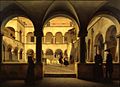
The Palazzo dei Conservatori is located in Piazza del Campidoglio to the right of the Palazzo Senatorio and opposite the Palazzo Nuovo. The Palazzo dei Conservatori owes its name to the fact that it was the seat of the city's elected magistracy, the Conservators, who together with the Senator administered Rome in the Middle-Age. The Palace in this position was erected by Pope Nicholas V. Michelangelo Buonarroti, who had been commissioned to carry out the overall redevelopment of the square, designed the new façade, which he did not, however, see completed as he died during the works (in 1564). His project redesigned the medieval façade of the palace, replacing the portico with two orders: the Corinthian one formed by high pilasters placed on large full-height pedestals, and the Ionic one that supports the vaults of the portico. Between these orders were placed a series of large windows, all of the same size. The works were continued by Guido Guidetti and completed in 1568 by Giacomo Della Porta who followed Michelangelo's designs almost faithfully, deviating from them only to build a larger reception room on the first floor and, consequently, a larger window than all the others on the facade of the palace. There were also transformations inside the palace, both for the construction of a large monumental staircase and for the new redistribution of the rooms of the "Apartment of the Conservators", which led to the destruction of the cycle of frescoes from the early sixteenth century that decorated the rooms overlooking Piazza del Campidoglio. …
Text from Wikipedia, the free encyclopedia, under CC BY-SA 4.0. Full article: «Capitoline Museums».
Events and people from Wikidata (CC0).
Distances are as the crow flies, not walking or driving.


Capitoline Museums is in Rome, in the province of Roma (Lazio), Italy. Address: Piazza del Campidoglio, 1 - Roma. GPS coordinates: 41.89306, 12.48278.
According to OpenStreetMap the opening hours are: Mo-Su 09:30-19:30; Dec 24,31 09:30-14:00; Jan 01 off; May 01 off; Dec 25 off. Always check the official website before your visit.
Wikidata dates it to 1471.
Nearby you’ll find: Palazzo dei Conservatori (0 m away), Arch of Scipio Africanus (0 m away), Convent of Aracoeli (0 m away).
Text. Wikipedia, the free encyclopedia (CC BY-SA 4.0).
Data. Wikidata (CC0); opening hours and contacts OpenStreetMap (ODbL).
Photos. Wikimedia Commons, author and licence on every image.
Updated 28 October 2026. All sources and licences