


- Free 1st Sunday
Photo: ThePhotografer, CC BY-SA 4.0 · Wikimedia Commons
Historic villa / palace, 1450s
Palazzo in Rome, Italy
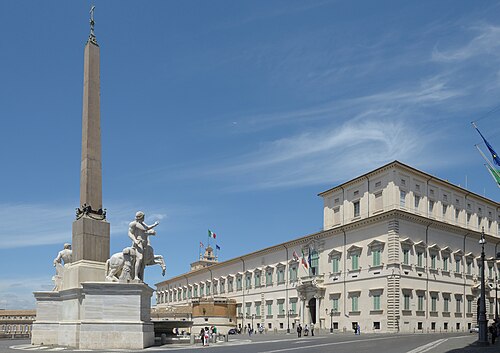
The Palazzo Venezia or Palazzo Barbo, formerly Palazzo di San Marco ('Saint Mark's Palace'), is a large early Renaissance palace in central Rome, Italy, situated to the north of the Capitoline Hill. Today the property of the Italian Republic it houses the National Museum of the Palazzo Venezia. The main (eastern) facade measures 77 metres (253 ft) in length, with a height (excluding tower) of about 31 metres (102 ft). The north wing, containing the "Cibo Apartment", extending westwards, measures 122 metres (400 ft) in length. It covers an area of 1.2 hectares (2.9 acres) and encloses two gardens and the Basilica of Saint Mark. It was built in the present form during the 1450s by Cardinal Pietro Barbo (1417–1471), titular holder of the Basilica of Saint Mark, who from 1464 ruled as Pope Paul II. Barbo, a Venetian by birth as was customary for cardinals of the Basilica of Saint Mark, lived there even as pope and amassed there a great collection of art and antiquities.
It was rebuilt in 1451 when owned by Cardinal Pietro Barbo (1417–1471) who from 1464 ruled as Pope Paul II (1464–1471), a nephew of Pope Eugenius IV. It became a fortified building, composed of a half-basement and a mezzanine which functioned as a piano nobile. In 1455, Pietro Barbo had a commemorative medal struck to mark its construction. The building manifested some of the first Renaissance architectural features in Rome although the overall aspect is of a massive, fortified medieval structure with battlemented parapet. On its west side it adjoins the ancient Basilica of Saint Mark, which is aligned south to north, founded by Pope Marcus in 336 and dedicated to Mark the Evangelist who would become protector of Venice, completely rebuilt in 833, and which underwent frequent reconstructions since then. Much of the stone to build the Palazzo was quarried from the nearby Colosseum, a common practice in Rome until the 18th century. The design is traditionally attributed to Leone Battista Alberti.
Between 1466–1469, Pope Paul II added at the south-east corner a large square three storied cloister enclosing a garden, which structure was known as the Viridarium ("Green Area") or Palazzetto ("Little Palace"). The building was completed after the pope's death in 1471 by his nephew Marco Barbo, Patriarch of Aquileia. This structure was demolished in 1910 and rebuilt on a similar scale and reusing many original materials, 100 metres to the west to fit in with the construction of the massive Victor Emmanuel II Monument on the Capitoline Hill, scheduled for completion in 1911.
The large square tower above the south end of the main block was built in 1470, and encloses a more modest mediaeval predecessor. It is known as the Torre della Biscia ("Biscia Tower"), possibly after the form of an ancient piece of sculpture enclosed within the masonry, or as the Torre di Carlo Muto ("Tower of Carlo Muto"), after the owner of the land purchased by Pietro Barbo. …
The "Museo nazionale del Palazzo di Venezia", housed in the building, contains galleries of art, predominantly pottery, tapestry, statuary from the early Christian era up to early Renaissance.
In 1910, due to the erection of the Victor Emmanuel II Monument, the Italian Government enlarged the Piazza Venezia and built a replica of the Palazzo Venezia in yellow brick on the opposite side of the square. This building hosts now the offices of the Assiscurazioni Generali di Venezia. Also because of that the "Palazzetto di Venezia", which closed the south side of the Piazza, was dismantled and rebuilt southwest of the Palazzo.
In late 2010 Mussolini's unfinished "most secret" bunker was discovered beneath the building.
Text from Wikipedia, the free encyclopedia, under CC BY-SA 4.0. Full article: «Palazzo Venezia».
Events and people from Wikidata (CC0).
Distances are as the crow flies, not walking or driving.


Palazzo Venezia is in Rome, in the province of Roma (Lazio), Italy. Address: Piazza Venezia, 1, 00186 Roma. GPS coordinates: 41.89620, 12.48150.
According to OpenStreetMap the opening hours are: Tuesday to Sunday: 8:30–19:30; Monday: Closed; 1 January: Closed; 1 May: Closed; 25 December: Closed. Always check the official website before your visit.
There is an admission charge. Up-to-date prices are on the official website.
According to OpenStreetMap data, the site is wheelchair accessible.
Wikidata dates it to 1450s.
Nearby you’ll find: Palazzo Bonaparte (100 m away), Palazzo Grazioli (100 m away), Palazzo Verospi Vitelleschi (100 m away).
Text. Wikipedia, the free encyclopedia (CC BY-SA 4.0).
Data. Wikidata (CC0); opening hours and contacts OpenStreetMap (ODbL).
Photos. Wikimedia Commons, author and licence on every image.
Updated 28 October 2026. All sources and licences