


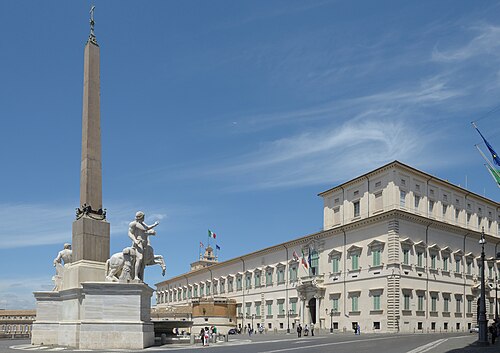
Photo: DellaGherardesca, CC BY 4.0 · Wikimedia Commons
Historic villa / palace, 1580
Palazzo Chigi
Building in Rome, Italy
- Within the UNESCO World Heritage Site “Historic Centre of Rome, the Properties of the Holy See in that City Enjoying Extraterritorial Rights and San Paolo Fuori le Mura”
At a glance
- Period
- Renaissance, 1580
- Styles
- Renaissance architecture, baroque architecture, Mannerist architecture
- Architect
- Giacomo Della Porta
- Commissioned by
- Aldobrandini family
- Protection
- Italian national heritage
- Coordinates
- 41°54′04″ N, 12°28′47″ E
- Address
- Piazza Colonna 370, Roma
History and description
The Chigi Palace is a palace and former noble residence in Rome which is the seat of the Council of Ministers and the official residence of the prime minister of Italy. It is located in the Piazza Colonna, next to Palazzo Montecitorio, seat of the Chamber of Deputies.
Since 22 October 2022, the tenant of the Chigi Palace has been Prime Minister Giorgia Meloni.
History
The architectural history of Chigi Palace spans more than three centuries during which several projects and continuous adaptations to the ever-changing needs of the palace have followed. The palace, overlooking the Piazza Colonna and the Via del Corso, was begun in 1562 by Giacomo della Porta. On 28 January 1578, the consistorial lawyer Pietro Aldobrandini, brother of the future Pope Clement VIII, purchased a house on Via del Corso. The architect Matteo Bartolini from Città di Castello was entrusted with the project. Aldobrandini already owned a property along the road that borders the so-called "Colonna island", connecting via del Corso with Montecitorio, he intended to unite the two properties. At the death of Pietro Aldobrandini, his son sold the properties to Paolo Fossano, who continued the work on the side of Via del Corso.
In 1616, cardinal Pietro Aldobrandini, nephew of Clement VIII, repurchased the family home, resuming construction and incorporating various houses adjacent to the wing facing the future square. In 1659 it was purchased by the House of Chigi, a rich family of bankers from Siena. It was then remodelled by Felice della Greca and Giovanni Battista Contini. It has five floors, a broad stairway that leads to the living rooms, and a courtyard decorated with a fountain, designed by Giacomo della Porta. The fountain has been copied in many sites in Rome and other Italian cities.
After a couple of centuries in which the building has served mainly as the home of important families of papal Rome, starting from the end of the 1700s, the building was used as the seat of Spanish embassy in Rome.
On 20 April 1770, Wolfgang Amadeus Mozart gave a concert there in the presence of Charles Edward Stuart. In 1878 it became the residence of the Austro-Hungarian Ambassador to Italy. During this period the palace was nicknamed the "Austrian-Vatican mole". At the beginning of the 20th century, the palace was hit by frequent irredentist demonstrations, asking for the independence of Trento and Trieste.
In 1916 it was bought by the Kingdom of Italy and became the seat of the Minister for Colonial Affairs, the ministry responsible for the government of the country's colonial possessions and the direction of their economies. …
Art
The Library Hall was commissioned by Agostino Chigi at the end of the 17th century to house the enormous library of cardinal Flavio Chigi. The project was realized by Giovanni Battista Contini.
The Chigi library or Chigiana contained thousands of valuable manuscripts, in large part based on the personal library of Pope Alexander VII, a member of the Chigi family. From the time of Pope Benedict XV, the Vatican attempted to acquire this library, but lacked the necessary funds. Eventually, Pietro Tacchi Venturi was tasked by Pope Pius XI to negotiate the purchase with the newly formed fascist government of Benito Mussolini. Venturi managed to convince Mussolini to donate the library to the Vatican free of charge.
Text from Wikipedia, the free encyclopedia, under CC BY-SA 4.0. Full article: «Palazzo Chigi».
Timeline
- 1580Built and opened
Events and people from Wikidata (CC0).
Photos
Getting there
FlaminioTrain, nearest
1.3 km as the crow flies
Palazzo ChigiPiazza Colonna 370, Roma
Aeroporto di Roma-Ciampino14.7 km
Distances are as the crow flies, not walking or driving.
Loading map…
Nearby
See on the mapMore historic villas and palaces in Lazio

- Free 1st Sunday


Frequently asked questions
Where is Palazzo Chigi?
Palazzo Chigi is in Rome, in the province of Roma (Lazio), Italy. Address: Piazza Colonna 370, Roma. GPS coordinates: 41.90123, 12.47977.
How old is Palazzo Chigi?
Wikidata dates it to 1580.
What else is there to see near Palazzo Chigi?
Nearby you’ll find: Temple of Marcus Aurelius (0 m away), Palazzo Wedekind (0 m away), Palazzo Ferrajoli (100 m away).
Sources and licences
Text. Wikipedia, the free encyclopedia (CC BY-SA 4.0).
Data. Wikidata (CC0); opening hours and contacts OpenStreetMap (ODbL).
Photos. Wikimedia Commons, author and licence on every image.
Credits for the 8 photos
- Palazzo Chigi - esterno — DellaGherardesca, CC BY 4.0
- 2016 Palazzo Chigi (Rome) — Jordiferrer, CC BY-SA 4.0
- Colonna - Madonna di Palazzo Chigi 1060188 — Lalupa, CC BY-SA 3.0
- Palazzo Chigi - Roma (2010) — jimmyweee, CC BY 2.0
- Palazzo Chigi (1860941389) — Simone Ramella from Roma, Italy, CC BY 2.0
- Palazzo Chigi (governo) - panoramio — Dora Dragoni, CC BY 3.0
- Palazzo Chigi Roma giugno 2024 — Blackcat, CC BY-SA 4.0
- Palazzo Chigi Sep 2017 — ScareCriterion12, CC BY-SA 4.0
Updated 28 October 2026. All sources and licences