


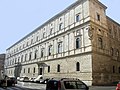

Photo: Chabe01, CC BY-SA 4.0 · Wikimedia Commons
Historic villa / palace
Museo di Roma
Museum in Rome
- Within the UNESCO World Heritage Site “Historic Centre of Rome, the Properties of the Holy See in that City Enjoying Extraterritorial Rights and San Paolo Fuori le Mura”
At a glance
- Protection
- Italian national heritage
- Coordinates
- 41°53′50″ N, 12°28′22″ E
- Address
- Piazza di San Pantaleo, 10, 00186 Roma
History and description
The Museo di Roma is a museum in Rome, Italy, part of the network of Roman civic museums. The museum was founded in the Fascist era with the aim of documenting the local history and traditions of the "old Rome" that was rapidly disappearing, but following many donations and acquisitions of works of art is now principally an art museum. The collections initially included 120 water-colours by the nineteenth-century painter Ettore Roesler Franz of Roma sparita, "vanished Rome", later moved to the Museo di Roma in Trastevere.
History
The museum was founded by the art historian Antonio Muñoz, who was director of the Antichità e Belle Arti ("antiquities and fine arts department") of the government of Rome. It was the first civic museum of the city. It was housed in the Pastificio Pantanella, a large former pasta factory in Piazza Bocca della Verità, overlooking the Circo Massimo in the via dei Cerchi, in the Ripa rione of the city. The factory building also housed the Museo dell'Impero Romano, and was renamed "Palazzo dei Musei". The Museo di Roma opened on 21 April 1930; Muñoz was its first director. When the Second World War began in 1939, the museum closed.
The museum re-opened only in 1952, in a new political climate and in a new location at Palazzo Braschi, a Neoclassical palace near Piazza Navona, built in the early years of the nineteenth century by Luigi Braschi Onesti, which since 1949 had already housed the new Galleria Comunale d'Arte Moderna.
Collections
The collection of the museum was at first intended only to illustrate and document the past. Thanks to numerous bequests, donations and acquisitions – among them a collection of some 5000 drawings, engravings and old illustrated books belonging to Antonio Muñoz – the holdings of the museum now include many works of art, and it has become primarily an art museum. Artists represented include Pompeo Batoni, Giuseppe Bottani, Ippolito Caffi, Antonio Canova, Giuseppe Ceracchi, Giuseppe Bartolomeo Chiari, Lievin Cruyl, Felice Giani, Pietro Labruzzi, Francesco Mochi, Giovanni Paolo Panini, Bartolomeo Pinelli, Giovanni Battista Piranesi, Joshua Reynolds and Nicola Salvi (designer of the Trevi Fountain).
Text from Wikipedia, the free encyclopedia, under CC BY-SA 4.0. Full article: «Museo di Roma».
Timeline
- 1930Opened
Events and people from Wikidata (CC0).
Photos
Getting there
Roma San PietroTrain, nearest
1.5 km as the crow flies
Museo di RomaPiazza di San Pantaleo, 10, 00186 Roma
Aeroporto di Roma-Ciampino14.7 km
Distances are as the crow flies, not walking or driving.
Loading map…
Nearby
See on the mapMore historic villas and palaces in Lazio

- Free 1st Sunday


Frequently asked questions
Where is Museo di Roma?
Museo di Roma is in Rome, in the province of Roma (Lazio), Italy. Address: Piazza di San Pantaleo, 10, 00186 Roma. GPS coordinates: 41.89729, 12.47285.
What are the opening hours of Museo di Roma?
According to OpenStreetMap the opening hours are: Tu-Su 10:00-19:00; Jan 01 11:00-19:30; Dec 24,31 10:00-14:00; Jan 01 off; Mo off; May 01 off; Dec 25 off. Always check the official website before your visit.
How much does it cost to visit Museo di Roma?
There is an admission charge. Up-to-date prices are on the official website.
Is Museo di Roma wheelchair accessible?
According to OpenStreetMap data, the site is wheelchair accessible.
What else is there to see near Museo di Roma?
Nearby you’ll find: Palazzo Braschi (0 m away), Odeon of Domitian (0 m away), Museo di Scultura Antica Giovanni Barracco (100 m away).
Sources and licences
Text. Wikipedia, the free encyclopedia (CC BY-SA 4.0).
Data. Wikidata (CC0); opening hours and contacts OpenStreetMap (ODbL).
Photos. Wikimedia Commons, author and licence on every image.
Credits for the 6 photos
- Palais Braschi - Rome (IT62) - 2021-08-29 - 3 — Chabe01, CC BY-SA 4.0
- Berlina di gala, 1776 ca, fatta costruire da sigismondo chigi per le nozze con m. giovanna medici d'ottaviano — Francesco Bini, CC BY-SA 4.0
- Nicola salvi e carlo camporese, modello della fontana di trevi, 1733-35 (le statue sono repliche 3d di originali a palazzo venezia) 01 — Francesco Bini, CC BY-SA 4.0
- Polidoro da caravaggio e maturino da firenze, affreschi dalla facciata del demolito casino del bufalo presso via del tritone, 1525 ca., perseo libera andromeda 01 — Francesco Bini, CC BY-SA 4.0
- Roma, palazzo braschi, interno, alcova torlonia, 1837, dal palazzo torlonia distrutto in piazza venezia, 01 — Francesco Bini, CC BY-SA 4.0
- Roma, palazzo braschi, interno, gipsoteca di pietro tenerani 01 — Francesco Bini, CC BY-SA 4.0
Updated 28 October 2026. All sources and licences