

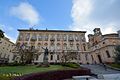


Photo: Alexdechi, CC BY-SA 4.0 · Wikimedia Commons
Historic villa / palace
Palazzo Cornazzani
Medieval palace in Pavia, Lombardy, Italy
At a glance
- Style
- Gothic architecture
- Coordinates
- 45°11′00″ N, 9°09′47″ E
History and description
Palazzo Cornazzani is a palace in Pavia, in Lombardy, where, between 1895 and 1896, Albert Einstein lived.
History
The palace belonged to the noble Cornazzani family and was built in the 15th century, incorporating the remains of previous buildings, in late Gothic style. Originally the building had belonged to the aristocratic Beccaria family and passed to the Cornazzani in the 16th century through marriage; the Cornazzani were a lineage of Parma origin who served Filippo Maria Visconti for a long time first and then the Sforza, thus obtaining Milanese citizenship, and of which a branch settled in Pavia. Prominent personalities often stayed in the house, such as the governor of Milan Antonio de Guzmán or Cardinal Michele Bonelli, who apparently stayed more than a year in the Pavia palace.
Ugo Foscolo also resided there, in the company of his friend Giulio Gabrielli di Montevecchio, in the years in which he was a university professor in Pavia, which is why the building is now also called "Casa del Foscolo"; later the street where the building is located was named after the famous poet. Later the building was inhabited, at different times, by the professor Contardo Ferrini, by the poet Ada Negri and by a young Albert Einstein; the latter stayed there with his family between 1895 and 1896, a period in which his father Hermann ran a factory manufacturing electric machines in Pavia.
In the palace he wrote a short essay with the title "On the Investigation of the State of the Ether in a Magnetic Field".
Architecture
The palace is structured on two courtyards: the first, dating back to the 15th century, has a late Gothic look, with a portico equipped with typical octagonal granite columns, very common in Lombard construction of the period, and enriched by numerous frescoes. The northern side of the portico retains a Gothic-style loggia, supported on the balcony by wooden columns. The second, where the Cornazzani coat of arms is frescoed in the lunettes, was added during the seventeenth century. On the facade, plastered in the modern age, there is a fifteenth-century terracotta tile depicting the Nativity. Inside, it preserves rich fifteenth-century coffered ceilings, Baroque frescoes and a neoclassical wing
Text from Wikipedia, the free encyclopedia, under CC BY-SA 4.0. Full article: «Palazzo Cornazzani».
Photos
Getting there
Pavia Porta GaribaldiTrain, nearest
300 m as the crow flies
Palazzo Cornazzani
Aeroporto di Milano-Linate30.2 km
Distances are as the crow flies, not walking or driving.
Loading map…
Nearby
See on the mapMore historic villas and palaces in Lombardy


Frequently asked questions
Where is Palazzo Cornazzani?
Palazzo Cornazzani is in Pavia, in the province of Pavia (Lombardy), Italy. GPS coordinates: 45.18340, 9.16305.
What else is there to see near Palazzo Cornazzani?
Nearby you’ll find: Santa Maria delle Cacce (100 m away), Palazzo Mezzabarba (300 m away), Ghislieri College (300 m away).
Sources and licences
Text. Wikipedia, the free encyclopedia (CC BY-SA 4.0).
Data. Wikidata (CC0); opening hours and contacts OpenStreetMap (ODbL).
Photos. Wikimedia Commons, author and licence on every image.
Credits for the 6 photos
- Palazzo Cornazzani, Casa del Foscolo — Alexdechi, CC BY-SA 4.0
- Cornazzani palazzo pavia — Markkv, CC BY-SA 4.0
- Cornazzani1 palazzo pavia — Markkv, CC BY-SA 4.0
- Palazzo cornazzani — FabioRomanoni, CC BY-SA 4.0
- Palazzo cornazzano1 — FabioRomanoni, CC BY-SA 4.0
- Casa foscolo — Markkv, CC BY-SA 4.0
Updated 28 October 2026. All sources and licences