


Photo: Paolobon140, CC BY-SA 4.0 · Wikimedia Commons
At a glance
- Style
- Neoclassical architecture
- Architects
- Giuseppe Piermarini, Piero Portaluppi
- Commissioned by
- Maria Theresa of Austria
- Protection
- Italian national heritage
- Coordinates
- 45°27′47″ N, 9°11′28″ E
- Address
- Piazzetta Reale
History and description
The Royal Palace of Milan (Italian: Palazzo Reale di Milano) was the seat of government in the Italian city of Milan for many centuries. Today, it serves as a cultural centre and it is home to international art exhibitions.
It spans through an area of 7,000 square meters and it regularly hosts modern and contemporary art works and famous collections in cooperation with notable museums and cultural institutions from across the world. More than 1,500 masterpieces are on display annually.
It was originally designed to include two courtyards but these were later dismantled to make room for the Duomo.
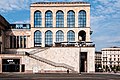
The palazzo is located to the right of the Duomo's façade, opposite to Galleria Vittorio Emanuele II. The façade of the palazzo creates a recess in Piazza del Duomo which functions as a courtyard, known as the Piazzetta Reale (literally, a "Small Royal Square").
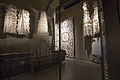
The famous Hall of Caryatids can be found on the main floor of the building, heavily damaged by World War II's air raids. After the war the palazzo remained abandoned for over two years and its condition further deteriorated. Many of the palazzo's neoclassical interiors were lost in this period.
History
The royal palace has ancient origins. It was first called "Palazzo del Broletto Vecchio", and it was the seat of city's government during the period of medieval communes in the Middle Ages.
The palace became a key political centre under the Torriani, Visconti and Sforza households. After the construction of the Duomo Cathedral, the palazzo was heavily renovated thanks to the efforts of Francesco I Sforza's government.
Until the early 16th century, the Dukes of Milan had their official residence in Castello Sforzesco. When the Sforza dynasty ended and the French invaded Milan, this castle became progressively more a fortress apt for warfare rather than an elegant noble residence. It was therefore under the French rule of Louis XII and of Francis I that the court was moved to Palazzo Reale.
The palazzo flourished under Governor Ferrante Gonzaga, who took permanent residence in Milan in 1546. The Gonzaga family refurbished and transformed the ducal court into a palace suitable for a governor, with expanded and newly inaugurated rooms dedicated to official functions. To pursue these expansions, governor Gonzaga demolished the old church of Sant'Andrea al Muro Rotto, annexing its land to the palazzo's complex. An interior passageway in an enclosed courtyard was created to connect the royal palace to the Church of San Gottardo, which became at this time the official church of the court.
At the end of the 16th century, Governor Antonio de Guzman y Zúñiga, Marquis of Ayamonte, recruited Pellegrino Tibaldi to conduct further renovation at the royal palace. Tibaldi, Archbishop Charles Borromeo's trusted architect, was at the time already working on the Duomo, on the Archbishop's Palace and on Cortile dei Canonici. Between 1573 and 1598 he coordinated work at the royal palace which completed overhauled the pictorial decorations of the apartments' porticoes, of the private chapel and of the Church of San Gottardo. Several major artists of the time attended to this work: Aurelio Luini, Giovanni Ambrogio Figino, Antonio Campi and naturally Pellegrino Tibaldi himself. Some stuccoes and Gothic works were created by Valerio Profondavalle, a Flemish artist-impresario who had also worked on the windows of the Duomo. …
The Museum of the Palace
At the beginning of the 21st century, more than fifty years after its destruction, Palazzo Reale found a new central role in the social and cultural life of Milan. Three phases of restoration were completed, even if the palace did not fully recover its original magnificence. The original purpose of the restorations was to create a "Palace Museum" to show the four historical seasons the Palazzo went through: the Neoclassical era, Napoleon's period, the Restoration and the Unification of Italy. The first phase of restoration undertook the complex task of refurbishing of the original furniture, to provide a stylistic representation of the life of the Ducal Court. Then the neoclassical halls were restored, to bring back the vision of Giuseppe Piermarini and the splendor of the "enlightened" era, when the city had a major role in Europe. The third phase focused on the old Apartment of Reserve, to portray the life of 19th century Austrian royalty. Unfortunately the original idea was abandoned and the Museum of the Palace was never inaugurated, despite the completion of its third phase of restoration in 2008.
Cultural centre
The Royal Palace is now a cultural centre in the heart of Milan, coordinated in conjunction with three other exhibition venues: Rotonda della Besana, Palazzo della Ragione and Palazzo dell'Arengario.
The building plays an important role within Milanese artistic life, having hosted in recent years prestigious exhibitions including works by Claude Monet, Pablo Picasso and other internationally renowned painters and sculptors. Turn-point for its prestige as exhibition hall was the 2009 show to celebrate Futurism's centenary.
Since November 4, 2013 a wing of the palace was repurposed to host the Great Museum of Milan Cathedral.
Text from Wikipedia, the free encyclopedia, under CC BY-SA 4.0. Full article: «Royal Palace of Milan».
People
Events and people from Wikidata (CC0).
Photos
Getting there
Milano CadornaTrain, nearest
1.4 km as the crow flies
Royal Palace of MilanPiazzetta Reale
Aeroporto di Milano-Linate6.5 km
Distances are as the crow flies, not walking or driving.
Loading map…
Nearby
See on the mapMore historic villas and palaces in Lombardy


Frequently asked questions
Where is Royal Palace of Milan?
Royal Palace of Milan is in Milan, in the province of Milano (Lombardy), Italy. Address: Piazzetta Reale. GPS coordinates: 45.46305, 9.19115.
What are the opening hours of Royal Palace of Milan?
According to OpenStreetMap the opening hours are: Tu-We, Fr-Su 10:00-19:30; Th 10:00-22:30; Mo off. Always check the official website before your visit.
Is Royal Palace of Milan wheelchair accessible?
According to OpenStreetMap data, the site is partly wheelchair accessible.
What else is there to see near Royal Palace of Milan?
Nearby you’ll find: Salone Margherita (0 m away), Teatro Regio Ducal (0 m away), Duomo di Milano Museum (0 m away).
Sources and licences
Text. Wikipedia, the free encyclopedia (CC BY-SA 4.0).
Data. Wikidata (CC0); opening hours and contacts OpenStreetMap (ODbL).
Photos. Wikimedia Commons, author and licence on every image.
Credits for the 8 photos
- Veduta di tre quarti del Palazzo Reale di Milano — Paolobon140, CC BY-SA 4.0
- 5436 - Milano - Mongolfiera per Carnevale - Foto Giovanni Dall'Orto 17-Feb-2007 — G.dallorto, Attribution
- 5437 - Milano - Mongolfiera per Carnevale - Foto Giovanni Dall'Orto 17-Feb-2007 — G.dallorto, Attribution
- Cerchia dei navigli, Milano, Italy - panoramio (42) — Anton Nikiforov, CC BY 3.0
- Facciata di Palazzo Reale a Milano — Sandra Grampa, CC BY-SA 4.0
- Lampada antica all'interno di Palazzo Reale Milano — Sandra Grampa, CC BY-SA 4.0
- Luce Reale — Denismelidali, CC BY-SA 4.0
- Mi palazzo reale notturno — Bramfab, CC BY-SA 4.0
Updated 28 October 2026. All sources and licences