




Photo: Sailko, CC BY 3.0 · Wikimedia Commons
Historic villa / palace, 1536
Palazzo del Te
Palace in the suburbs of Mantua, Italy
At a glance
- Period
- Renaissance, 1536
- Style
- Mannerist architecture
- Architect
- Giulio Romano
- Commissioned by
- Federico II Gonzaga, Duke of Mantua
- Protection
- Italian national heritage
- Coordinates
- 45°08′51″ N, 10°47′12″ E
- Address
- viale Te, 13
History and description
Palazzo del Te, or simply Palazzo Te, is a palace in the suburbs of Mantua, Italy. It is an example of the mannerist style of architecture, and the acknowledged masterpiece of Giulio Romano.
History
Palazzo del Te was constructed 1524–34 for Federico II Gonzaga, Marquess of Mantua, as a palace of leisure. The site chosen was that of the family stables which he had built at Isola del Te, on the edge of the marshes just outside Mantua's city walls, as early as in 1502.
Giulio Romano, a pupil of Raphael, was commissioned to design the building. The shell of the palazzo, erected within eighteen months, is basically a square house containing a cloistered courtyard. A formal garden complemented the house, enclosed by colonnaded outbuildings ending in a semicircular colonnade known as the Exedra or Esedra.
Once the shell of the building was completed, for ten years a team of plasterers, carvers, and fresco painters laboured until barely a surface in any of the loggias or salons remained undecorated. Under Romano's direction, local decorative painters such as Benedetto Pagni and Rinaldo Mantovano worked extensively on the frescos.
In July 1630, during the War of the Mantuan Succession (1628–31), Mantua and the palace were sacked over three days by an Imperial army of 36,000 Landsknecht mercenaries. The remaining populace fell victim to one of the worst plagues in history that the invaders had brought with them. The Palazzo was looted from top to bottom and remained an empty shell with nymphs, gods, goddesses, and giants adorning the walls of the empty, echoing rooms.
Description
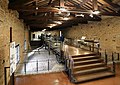
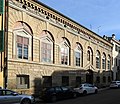
Like the Villa Farnesina in Rome, the suburban location allowed for a mixing of both palace and villa architecture. The four exterior façades have flat pilasters against rusticated walls, the fenestration indicating that the piano nobile is the ground floor, with a secondary floor above. The East façade differs from the other three by having Palladian motifs on its pilaster and an open loggia at its centre rather than an arch to the courtyard. The facades are not so symmetrical as they appear and the spans between the columns are irregular. The centers of the North and South facades are pierced by two-storey arches without portico or pediment, simply a covered way leading to the interior courtyard.
Few windows overlook the inner courtyard ("cortile"); the colonnaded walls are decorated on all sides by deep niches and blind windows, and the intervening surfaces are spattered by spezzato (broken and blemished plaster) giving life and depth to the surfaces.
The frescoes are a feature of the Palazzo. The subjects range from Olympian banquets in the Sala di Psiche ("Hall of Psyche") and stylised horses in the Sala dei Cavalli ("Hall of the Horses") to giants and grotesques around the walls of the Sala dei Giganti ("Hall of the Giants").
These rooms, once used by the ducal court of the Gonzaga family, were viewed by the Emperor Charles V, who, when visiting in 1530, elevated his host Federico II of Gonzaga from Marquess to Duke of Mantua.
One of the most evocative parts of the lost era of the palazzo is the Casino della Grotta ("Lodge of the Grotto"), a small suite of intimate rooms arranged around a grotto and loggetta (covered balcony) where courtiers once bathed in the small cascade that splashed over the pebbles and shells encrusted in the floor and walls.
Part of the Palazzo today houses the Museo Civico del Palazzo Te (Civic Museum of Palazzo del Te), endowed by the publisher Arnoldo Mondadori. It contains a collection of Mesopotamian art.
Text from Wikipedia, the free encyclopedia, under CC BY-SA 4.0. Full article: «Palazzo del Te».
Timeline
- 1536Built
People
Events and people from Wikidata (CC0).
Photos
Getting there
MantovaTrain, nearest
1.3 km as the crow flies
Palazzo del Teviale Te, 13
Escursioni in barca7.2 km
Aeroporto Valerio Catullo di Verona-Villafranca28.8 km
Distances are as the crow flies, not walking or driving.
Loading map…
Nearby
See on the mapMore historic villas and palaces in Lombardy


Frequently asked questions
Where is Palazzo del Te?
Palazzo del Te is in Mantua, in the province of Mantova (Lombardy), Italy. Address: viale Te, 13. GPS coordinates: 45.14755, 10.78658.
What are the opening hours of Palazzo del Te?
According to OpenStreetMap the opening hours are: Monday: 13:00–18:30; Tuesday to Sunday: 9:00–18:30; 25 December: Closed. Always check the official website before your visit.
How much does it cost to visit Palazzo del Te?
There is an admission charge. Up-to-date prices are on the official website.
Is Palazzo del Te wheelchair accessible?
According to OpenStreetMap data, the site is wheelchair accessible.
How old is Palazzo del Te?
Wikidata dates it to 1536.
What else is there to see near Palazzo del Te?
Nearby you’ll find: Museo di Palazzo Te (200 m away), MACA - Mantova Collezioni Antiche (300 m away), Casa del Mantegna (400 m away).
Sources and licences
Text. Wikipedia, the free encyclopedia (CC BY-SA 4.0).
Data. Wikidata (CC0); opening hours and contacts OpenStreetMap (ODbL).
Photos. Wikimedia Commons, author and licence on every image.
Credits for the 8 photos
- Palazzo te, loggia di david 03 — Sailko, CC BY 3.0
- Anselmo Guazzi e Agostino da Mozzanica 'Orfeo ed Euridice di fronte a Plutone e Proserpina' - Mantova — Capricornis crispus, CC BY-SA 4.0
- Baccio Baldini 'I figli del pianeta Venere' - Mantova — Capricornis crispus, CC BY-SA 4.0
- Cesare Ripa 'Venvstà' - Mantova — Capricornis crispus, CC BY-SA 4.0
- Francesco Primaticcio 'Il carro del Sole e il carro della Luna' - Mantova — Capricornis crispus, CC BY-SA 4.0
- Giulio Romano e aiuti 'Ariete, costellazione della Nave. I navigatori' - Mantova — Capricornis crispus, CC BY-SA 4.0
- Giulio Romano e aiuti 'Psiche scopre Amore' - Mantova — Capricornis crispus, CC BY-SA 4.0
- Il R. Palazzo del T. fuori Mantova — De Vegni, Leonardo (Incisore), CC BY 4.0
Updated 28 October 2026. All sources and licences