

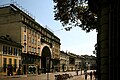


Photo: Paolobon140, CC BY-SA 4.0 · Wikimedia Commons
Historic villa / palace, 1838
Museo Civico di Storia Naturale di Milano
Milan Natural History Museum, Italy
At a glance
- Period
- Modern era, 1838
- Style
- Eclectic architecture
- Architect
- Giovanni Ceruti
- Protection
- Italian national heritage
- Coordinates
- 45°28′22″ N, 9°12′09″ E
- Address
- Corso Venezia, 55, 20121 Milano
History and description
The Museo Civico di Storia Naturale di Milano (Milan Natural History Museum) is a museum in Milan, Italy dedicated to the study of animals, plants, and the natural environment, including geology. Exhibits include dinosaurs and Italy's largest collection of dioramas of ecosystems.
Museum
The museum was founded in 1838 when the naturalist Giuseppe de Cristoforis donated his collections to the city. Its first director was the taxonomist Giorgio Jan.
The museum is housed in a 19th-century building in the Indro Montanelli Garden, near the historic city gate of Porta Venezia. It was built between 1888 and 1893 in Neo-Romanesque style with Gothic elements.
Collections
The museum is divided into five different permanent sections: Mineralogy (with a large collection of minerals from all over the world); Paleontology (with several fossils of dinosaurs and other prehistoric organisms); Natural History of Man (dedicated to the origins and evolution of humans with a particular attention to the relationship of the latter with the environment); Invertebrate Zoology (dedicated to mollusks, arthropods and entomology); and Vertebrate Zoology (dedicated to vertebrates, both exotic and European).
The museum exhibits the largest Italian collection of over 100 full-size dioramas. These allow visitors to observe many aspects of faraway ecosystems.
The mineralogy section showcases several minerals from all over the world, including the world's largest sulfur crystal (from the province of Pesaro-Urbino) and an 8,000-carat Brazilian topaz crystal. Also displayed are examples of londonite, quartz, phosgenite, fluorite, malachite and other minerals.
The palaeontology section explains the basics of paleozoology and palaeobotany. Displays include fossils of several plants and animals. Among the most valuable pieces are a Spinosaurus snout, the skeletons of two pygmy elephants (Palaeoloxodon falconeri) from Sicily and the only existing fossil of the coelurosaurian theropod Scipionix samniticus. The museum also houses several other casts of dinosaur skeletons such as Allosaurus, Stegosaurus, Dromaeosaurus, Plateosaurus, and Stan (dinosaur), the fifth most complete Tyrannosaurus ever found.
The natural history of man section is dedicated to the origins of humans from early primates to Homo sapiens. Human evolution is described from the phylogenetic, morphological and ecological points of view with several archaeological objects and realistic plastic models. One of the most valuable pieces is the cast of an Australopithecus afarensis skeleton. …
Text from Wikipedia, the free encyclopedia, under CC BY-SA 4.0. Full article: «Museo Civico di Storia Naturale di Milano».
Timeline
- 1838Built
- 1893Opened
Events and people from Wikidata (CC0).
Photos
Getting there
Milano Porta VeneziaTrain, nearest
600 m as the crow flies
Museo Civico di Storia Naturale di MilanoCorso Venezia, 55, 20121 Milano
Aeroporto di Milano-Linate6.2 km
Distances are as the crow flies, not walking or driving.
Loading map…
Nearby
See on the mapMore historic villas and palaces in Lombardy


Frequently asked questions
Where is Museo Civico di Storia Naturale di Milano?
Museo Civico di Storia Naturale di Milano is in Milan, in the province of Milano (Lombardy), Italy. Address: Corso Venezia, 55, 20121 Milano. GPS coordinates: 45.47278, 9.20246.
What are the opening hours of Museo Civico di Storia Naturale di Milano?
According to OpenStreetMap the opening hours are: Tu-Su 10:00-17:30; Jan 01, Dec 25, May 01 off. Always check the official website before your visit.
How much does it cost to visit Museo Civico di Storia Naturale di Milano?
There is an admission charge. Up-to-date prices are on the official website.
Is Museo Civico di Storia Naturale di Milano wheelchair accessible?
According to OpenStreetMap data, the site is wheelchair accessible.
How old is Museo Civico di Storia Naturale di Milano?
Wikidata dates it to 1838.
What else is there to see near Museo Civico di Storia Naturale di Milano?
Nearby you’ll find: Casa Toschi Cornegliani (100 m away), Palazzo della società Buonarroti-Carpaccio-Giotto (100 m away), Palazzo Saporiti (100 m away).
Sources and licences
Text. Wikipedia, the free encyclopedia (CC BY-SA 4.0).
Data. Wikidata (CC0); opening hours and contacts OpenStreetMap (ODbL).
Photos. Wikimedia Commons, author and licence on every image.
Credits for the 9 photos
- Veduta del Museo civico di storia naturale di Milano — Paolobon140, CC BY-SA 4.0
- 9187 - Milano, Museo storia naturale - Amigdale paleolitiche - Foto Giovanni Dall'Orto 22-Apr-2007 — G.dallorto, Attribution
- Centipede- Museo civico di storia naturale Milano — Gyik Toma (Tommy), CC BY 2.0
- Chilopodi scolopendromorfi - Museo civico di storia naturale (Milan) — Stefano Stabile, CC BY-SA 3.0
- Endoceras spp Svezia Museo Milano 2 — Antonov, CC0
- M S Naturali orme fossili — Bramfab, CC BY-SA 4.0
- MI civico museo scienze naturali (8) Latimeria — Bramfab, CC BY-SA 4.0
- MI M S N Artifatti primitivi (1) — Bramfab, CC BY-SA 4.0
- MI M S N Artropodi (1) — Bramfab, CC BY-SA 4.0
Updated 28 October 2026. All sources and licences