





Photo: Alexdechi, CC BY-SA 4.0 · Wikimedia Commons
Historic villa / palace, 1561
Collegio Borromeo
Building in Pavia, Italy
At a glance
- Period
- Renaissance, 1561
- Style
- Mannerist architecture
- Architect
- Pellegrino Tibaldi
- Protection
- Italian national heritage
- Coordinates
- 45°10′49″ N, 9°09′41″ E
- Address
- Piazza Collegio Borromeo, 8-9
History and description
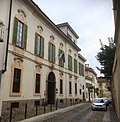
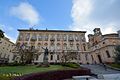
The Almo Collegio Borromeo is a private university hall of residence (collegio) in Pavia, region of Lombardy, Italy. It is classified as a "highly qualified cultural institute" by the Ministry of Education, Universities and Research and is the oldest such institution remaining in operation in Italy. Together with Collegio Ghislieri – with which a sharp goliardic rivalry has developed during the centuries – it is one of two colleges in Pavia with historical heritage. The building that houses the college was designed by Pellegrino Tibaldi, and overlooks the Ticino, surrounded by landscaped gardens and the Borromeo Gardens. Vasari described it as a "palace of knowledge" ("palazzo per la Sapienza").
The college selects students of the University of Pavia through a rigorous public competition based on tests taken annually.
History
Collegio Borromeo was founded in 1561 by the estate of cardinal St. Charles Borromeo which aimed to create an institution to accommodate young promising students experiencing economic hardship. This is still the aim of the Fondazione Collegio Borromeo. On May 10, 2009, the Women's Section was opened in the presence of Minister Mariastella Gelmini and Cardinal Dionigi Tettamanzi; it is intended to accommodate approximately fifty of the most deserving female students from the University of Pavia.
Rooms
The student rooms are divided according to the sides of the building: "Piazza" ("Square") on the western side, facing Piazza Borromeo, "Giardino" ("Garden") on the south side, "Vicolo" ("Lane") on the north side, looking onto Via Cardinal Tosi. The east side is called "Richini", as it is situated on a seventeenth-century garden designed by Francesco Maria Richini, and houses two auditorium-style rooms ("White Room" and "Mural Room") with private upstairs rooms for guests. The rooms are also divided into several levels: "Mezzanino" (mezzanine), "Nobile" (piano nobile), "Paradiso" (second mezzanine) and "Iperuranio" (attic). Also on the south side are "Sangiovannino alto" and "basso" ("Upper" and "Lower"), saved from the Church of San Giovanni in Borgo before demolition in the nineteenth century.
State rooms
The White Room, located on the main floor, on the Francesco Maria Richini side of the College, is used for seminars and conferences. It seats about 100 people and is characterized by high eighteenth-century wooden doors in pastel green and gold foil. Paintings of the patrons of the College, members of the Borromeo family, decorate the walls.
The Hall of frescoes, adjacent to the white room, takes its name from a series of frescoes that illustrate different moments in the life of Carlo Borromeo, founder of the College. It has a capacity of about 200 people and is used for congresses, conventions and concerts. On the eastern and western walls, which are not frescoed, hang a series of paintings representing cardinals of the Borromeo family from various eras. The frescoes, due to Cesare Nebbia, Federico Zuccari and aides, were made at the beginning of the 17th century on commission by Federico Borromeo; they cover the entrance wall (North), the back wall (South) and the ceiling of the hall. The larger wall frescoes refer to the cardinal appointment of Charles Borromeo and to various episodes relating to the plague of 1576–1577, known as the "plague of Saint Charles".
Chapel
The Chapel, dedicated to St. Justina, the patron saint of the Borromeo family, and to Saint Charles Borromeo, was completed in 1581 and is regularly officiated. Externally it has an important seventeenth-century marble portal, surmounted by the bust of Saint Charles. The barrel vault is decorated with the oldest frescoes in the Palace, made by the painter Giovanni Battista Muttoni in 1579, in late Mannerist style, and represent four scenes from the Old Testament, inserted in perspective squares and multiple and exuberant frames, full of geometric ornaments, fruit and vegetable borders and grotesque decorations. The walls are frescoed in 1909 by Manlio Oppio, Osvaldo Bignami: the patron saints of the college and university students face the four rounds. The floor is the original sixteenth-century one, in Lombard terracotta, with the typical two-tone veins reminiscent of wood, while the choir was added in the nineteenth century.
Text from Wikipedia, the free encyclopedia, under CC BY-SA 4.0. Full article: «Collegio Borromeo».
Timeline
- 1561Built
Events and people from Wikidata (CC0).
Photos
Getting there
Pavia Porta GaribaldiTrain, nearest
600 m as the crow flies
Collegio BorromeoPiazza Collegio Borromeo, 8-9
Aeroporto di Milano-Linate30.6 km
Distances are as the crow flies, not walking or driving.
Loading map…
Nearby
See on the mapMore historic villas and palaces in Lombardy


Frequently asked questions
Where is Collegio Borromeo?
Collegio Borromeo is in Pavia, in the province of Pavia (Lombardy), Italy. Address: Piazza Collegio Borromeo, 8-9. GPS coordinates: 45.18028, 9.16131.
How old is Collegio Borromeo?
Wikidata dates it to 1561.
What else is there to see near Collegio Borromeo?
Nearby you’ll find: Palazzo Cornazzani (400 m away), Palazzo Bellisomi Vistarino (400 m away), Palazzo Belcredi (400 m away).
Sources and licences
Text. Wikipedia, the free encyclopedia (CC BY-SA 4.0).
Data. Wikidata (CC0); opening hours and contacts OpenStreetMap (ODbL).
Photos. Wikimedia Commons, author and licence on every image.
Credits for the 9 photos
- Almo Collegio Borromeo 2 — Alexdechi, CC BY-SA 4.0
- Almo Collegio Borromeo Università di Pavia — F125d, CC BY-SA 4.0
- Almo Collegio Borromeo — Alexdechi, CC BY-SA 4.0
- Cesare Nebbia, Federico Zuccari, salone degli affreschi, Collegio Borromeo Pavia — FabioRomanoni, CC BY-SA 4.0
- Collegio Borromeo (Pavia) — Giorgio Gonnella, CC BY-SA 3.0
- Collegio borromeo 14 — FabioRomanoni, CC BY-SA 4.0
- Cortile collegio borromeo — FabioRomanoni, CC BY-SA 4.0
- Giardino collegio Borromeo pavia — FabioRomanoni, CC BY-SA 4.0
- Giardino Collegio Borromeo — FabioRomanoni, CC BY-SA 4.0
Updated 28 October 2026. All sources and licences