


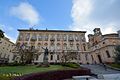


Photo: Giorgio Gonnella, CC BY-SA 3.0 · Wikimedia Commons
Historic villa / palace, 1567
Ghislieri College
University in Pavia, Italy
At a glance
- Period
- Renaissance, 1567
- Style
- Mannerism
- Architect
- Pellegrino Tibaldi
- Protection
- Italian national heritage
- Coordinates
- 45°11′10″ N, 9°09′42″ E
- Address
- Piazza Collegio Ghislieri, 4-5
History and description
The Ghislieri College (Italian: Collegio Ghislieri), founded in 1567 by Pope Pius V, is the second-oldest college in Pavia and co-founder of the IUSS in Pavia as well.
History
Collegio Ghislieri is a 450-year-old Italian institution committed to promote university studies on the basis of merit, hosting around 200 pupils (males and females) who attend all faculties in the University of Pavia, offering them logistic and cultural opportunities such as scholarships, lectures, conferences, a 130,000-volume library (the third-largest private library in Northern Italy), and foreign-language courses. Each year about 40 new students from all over the country are selected by public competition. Founded by Pope Pius V (Antonio Ghislieri) in 1567, and secularly managed since the 18th century, the college is now under the High Patronage of the Presidency of the Italian Republic. It is classified among high qualifying institutions by the Italian Ministry for Education and University. Student expenses are subsidized by the college as the required fees are proportional to parental income; many places are granted for free. Among its alumni are Carlo Goldoni, Michele Rajna, and several Italian statesmen, scientists, and scholars of the last two centuries.
The palace
The construction of the building intended to house the Ghislieri college was undertaken in 1571 under the direction of Pellegrino Tibaldi, one of the greatest architects of the time, who followed the works until 1585, the year in which he was called to Spain by Philip II. The austere spirit of the Counter-Reformation pervades the whole building, starting with the severe façade which has the sumptuous Roman school portal and the lantern tower as the only ornaments. Interpreting the spirit of Pope Pius V, the architect designed an imposing building yet functional to the community life for which it was intended. From this purpose derives the centrality of the four-sided portico, with columns combined and reinforced at the corners by a pillar, and of the large corridor on the main floor, overlooked by the students' rooms and which receives light from two large loggias. Towards the middle of the eighteenth century the building was significantly enlarged with the addition of a new wing to the south, the so-called Crimea.
The chapel
The college chapel was designed by Pellegrino Tibaldi and only finished at the beginning of the seventeenth century, following the intervention of another famous architect of the time, Alessandro Mollo. The atrium, through which you enter the chapel, is dedicated to St. Pius V and preserves numerous paintings of the sixteenth century and in particular: The miracles of St. Pius V by Luigi Pellegrini Scaramuccia, San Pio frees the possessed by Giovanni Peruzzini and vision of the battle of Lepanto by Giovanni Battista del Sole. The oratory, with a central plan, is surmounted by a dome with eight segments with a lantern; on the altar, the altarpiece of the Nativity, Saint Jerome and Pius V (about 1620), by Guglielmo Caccia, stands out. The chapel is accessed through an atrium dedicated to St. Pius, whose miracles are celebrated in seventeenth-century paintings. The glory of the founder is celebrated, in the College, by numerous portraits (among which the painting by Scipione Pulzone, kept in the premises of the College's Administration and the Rector's apartment) and by sculptural works is noteworthy. Among the latter is the bronze statue signed by Francesco Nuvoloni and dated to 1692 which stands out in the center of Piazza Ghislieri: the work, cast in Rome by Francesco Ferreri, can be counted among the masterpieces of sculpture of the period and resumes tone and energy the grandeur of Bernini, whose manner Nuvoloni, a native of the Canton of Ticino, had made his own.
The castle of Lardirago
In 1569 Pope Pius V ordered the attribution to the college of the fiefdom of Lardirago, with its early medieval castle, and of the fiefdom of Gerenzago, formerly owned by the abbey of San Pietro in Ciel d'Oro: the necessary revenues were thus guaranteed to fulfill Ghislieri's institutional tasks, and an autonomy of management that has never ceased over the centuries.The castle of Lardirago, born in the twelfth and thirteenth centuries as a defensive structure, became a noble residence in the Visconti-Sforza era. The result of successive building phases, it assumed its present structure in the fourteenth century starting from the original Romanesque nucleus of the chapel. The Ghislieri college has promoted and financed the restoration of the castle as a venue for multiple cultural activities: congresses and conferences, specialization and refresher courses, scientific seminars and exhibitions.
Text from Wikipedia, the free encyclopedia, under CC BY-SA 4.0. Full article: «Ghislieri College».
Timeline
- 1567Built
Events and people from Wikidata (CC0).
Photos
Getting there
Pavia Porta GaribaldiTrain, nearest
500 m as the crow flies
Ghislieri CollegePiazza Collegio Ghislieri, 4-5
Aeroporto di Milano-Linate29.9 km
Distances are as the crow flies, not walking or driving.
Loading map…
Nearby
See on the mapMore historic villas and palaces in Lombardy


Frequently asked questions
Where is Ghislieri College?
Ghislieri College is in Pavia, in the province of Pavia (Lombardy), Italy. Address: Piazza Collegio Ghislieri, 4-5. GPS coordinates: 45.18624, 9.16165.
How old is Ghislieri College?
Wikidata dates it to 1567.
What else is there to see near Ghislieri College?
Nearby you’ll find: Collegio Cairoli (200 m away), Santa Maria delle Cacce (200 m away), Palazzo Cavagna (200 m away).
Sources and licences
Text. Wikipedia, the free encyclopedia (CC BY-SA 4.0).
Data. Wikidata (CC0); opening hours and contacts OpenStreetMap (ODbL).
Photos. Wikimedia Commons, author and licence on every image.
Credits for the 9 photos
- Collegio Ghislieri (Pavia) — Giorgio Gonnella, CC BY-SA 3.0
- Collegio Ghislieri cortile interno — FabioRomanoni, CC0
- Collegio Ghislieri cortile — FabioRomanoni, CC BY-SA 4.0
- Collegio Ghislieri Pavia — FabioRomanoni, CC BY-SA 4.0
- Collegio Ghislieri Università di Pavia — F125d, CC BY-SA 4.0
- Collegio ghislieri11 — FabioRomanoni, CC BY-SA 4.0
- Pavia Meridiana Piazza del Collegio Ghislieri — RicciSpeziari Photographer: Riccardo Speziarii, CC BY-SA 3.0
- Statua Pio V Collegio Ghislieri Pavia — Paolobon140, CC BY-SA 4.0
- Sundial (Pza Collegio Ghislieri, Pavia) — Giorgio Gonnella, CC BY-SA 3.0
Updated 28 October 2026. All sources and licences