
Vicenza · Veneto
Things to see in Vicenza
In Vicenza the atlas lists 130 historic places: 77 historic villas and palaces, 18 fortresses and towers, 14 museums, 9 abbeys and monasteries, 7 archaeological sites, 4 historic theatres and 1 castle.
Of these, 6 list opening hours and 6 are part of a UNESCO World Heritage Site.
Don’t miss: Palazzo Chiericati Art Gallery (1855), art museum hosted in Palazzo Chiericati, Vicenza, Italy.
By date of construction, the most common period is the Renaissance (40% of dated places) and the Modern era (33% of dated places).
- 130historic places
- 109,823inhabitants
- 39 maltitude
The town
Vicenza is a medium-sized city in Veneto, in northeastern Italy, and the capital of the namesake province. The city and the surrounding countryside and hills are particularly famous for the many works, and particularly the villas, by Andrea Palladio; a group of Palladio buildings are a UNESCO World Heritage Site.
Text from Wikivoyage, CC BY-SA, abridged · Wikivoyage
130 places
Villas and palaces 77
-


- UNESCO


Show all 56 places
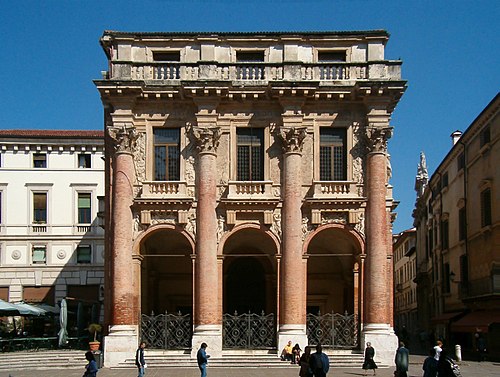 Palazzo del Capitaniato
 Villa Almerico Capra (La Rotonda)
 Casa Cogollo
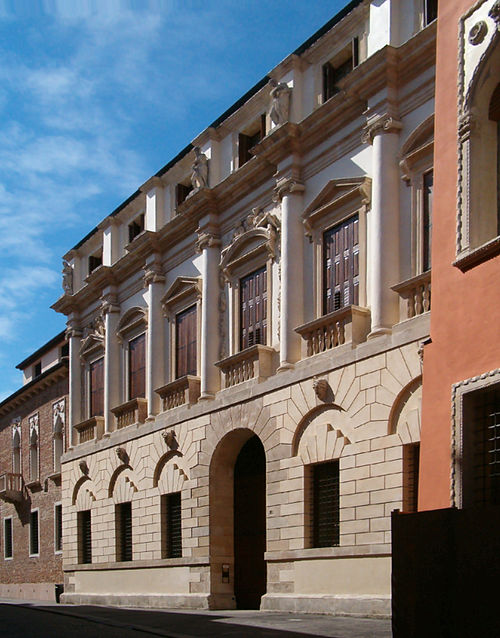 Palazzo Porto
 Palazzo Civena
 Villa Gazzotti Grimani
 Villa Trissino
 Palazzo Porto in piazza Castello
 Palazzo Thiene Bonin Longare
 Palazzo Cordellina
 Palazzo Valmarana
 Palazzo Pojana
 Palazzo Schio
 Palazzo Alidosio Conti
 Palazzo Trissino al Duomo
 Palazzo San Giacomo
 Villa Bonini Matteazzi
 Ca' Impenta
 Palazzo Angaran
 Palazzo Piovene
 Casa Pigafetta
 Palazzo Costantini
 Ca' d'Oro
 Palazzo del Monte di Pietà
 Palazzo delle Opere sociali
 Palazzo Godi Arnaldi Segala
 Palazzo Regaù
 Palazzo Sesso Zen
 Palazzo vescovile
 Palazzo Volpe Cabianca
 Palazzo Franceschini Folco
 Palazzo Garzadori
 Palazzo Pojana a San Tomaso
 Palazzo Valle
 Palazzo Bissari Arnaldi
 Palazzo Squarzi
 Villa Ghislanzoni
 Palazzetto Scroffa in contrà Piancoli
 Palazzo Arnaldi Della Torre Palazzo Arnaldi Tretti
 Palazzo Roma
 Palazzo Sangiovanni
 Palazzo da Porto Breganze
 Palazzo Da Monte
 Palazzo Barbieri
 Palazzo Godi Nievo
 Palazzo Loschi Zileri Dal Verme
 Palazzo Repeta
 Palazzo Stecchini Villa Franco ai Nani
Fortresses and towers 18


Museums 14


Abbeys and monasteries 9


Archaeological sites 7


Historic theatres 4


Castles 1

Getting there
By train: The train station is at the end of Viale Roma, on the southern part of the town. Piazza Castello and the old town are a 5-minute walk from the station. The station is on the line connecting Milan to Venice. There are also a number of trains to other major cities and destinations such as Bologna to the south, Bolzano to the north, and Trieste to the east via connections Verona, Padova, Venice, and Trento.
Trains to the towns and cities around Vicenza depart daily (times provided are for regional trains). The most common are to Verona (1 hour), Padova (25 minutes), Venice (1 hour 15 minutes). Trains also depart for Bassano del Grappa, Treviso, Castelfranco, Rovigo, Sirmione, and Ferrara.
Taking international trains from Vicenza is possible, but it could be slower and/or more expensive since the city is not a major station for train transit. Instead, it is highly recommended to book a train to France, Spain or Switzerland from Milan; Austria and Germany from Verona; and Eastern Europe from Venice. Book a separate (cheap) ticket to these cities and make your connection from there.
More info on Trenitalia. When booking overseas train tickets, make sure to ask for the "Smart" special deal, which provides up to a 50% discount. The deal is especially good for destinations in Eastern Europe such as Budapest or Belgrade, where tickets could cost as little as €15 one-way (instead of €50 and above).
Text from Wikivoyage, CC BY-SA, abridged · Wikivoyage
What to see, according to Wikivoyage
Landmarks: Basilica Palladiana (Palazzo della Ragione). Despite its name, the Basilica has always been a civic, rather than religious, building, housing the local government. It became famous for its extensive and long-lasting (1549-1617) redesign and reconstruction by the local architect Andrea Palladio, who added a renaissance outer shell to the partially collapsed Gothic original structure. Being his first large-scale work, it provided the income and recognition needed for him to become the famous name throughout the region, Italy and the world. Palladio called the redesigned civic building basilica per Roman tradition, and also posthumously lent his name as a descriptive adjective. Adjoining the building still is the old and leaning clock tower constructed and reconstructed between the 11th and 15th centuries. Loggia del Capitanio. Right in front of Basilica Palladiana on Piazza dei Signori. Also made by Palladio around 1571, but in red brick without any stucco. Built later in Palladio's career, this building's Neoclassical style stands in great juxtaposition to the Basilica across it and is a testament to Palladio's artistic development.
Text from Wikivoyage, CC BY-SA, abridged · Wikivoyage · Underlined names link to our own pages.