

Photo: Didier Descouens, CC BY-SA 4.0 · Wikimedia Commons
Historic theatre
Olympic Theatre
Theatre in Vicenza, Italy, designed by Andrea Palladio
- Within the UNESCO World Heritage Site “City of Vicenza and the Palladian Villas of the Veneto”
At a glance
- Type
- Historic theatre
- Style
- Renaissance architecture
- Architect
- Andrea Palladio
- Area
- 1,000 m²
- Protection
- Italian national heritage
- Coordinates
- 45°32′60″ N, 11°32′57″ E
- Address
- Piazza Giacomo Matteotti 11, 36100 Vicenza
History and description
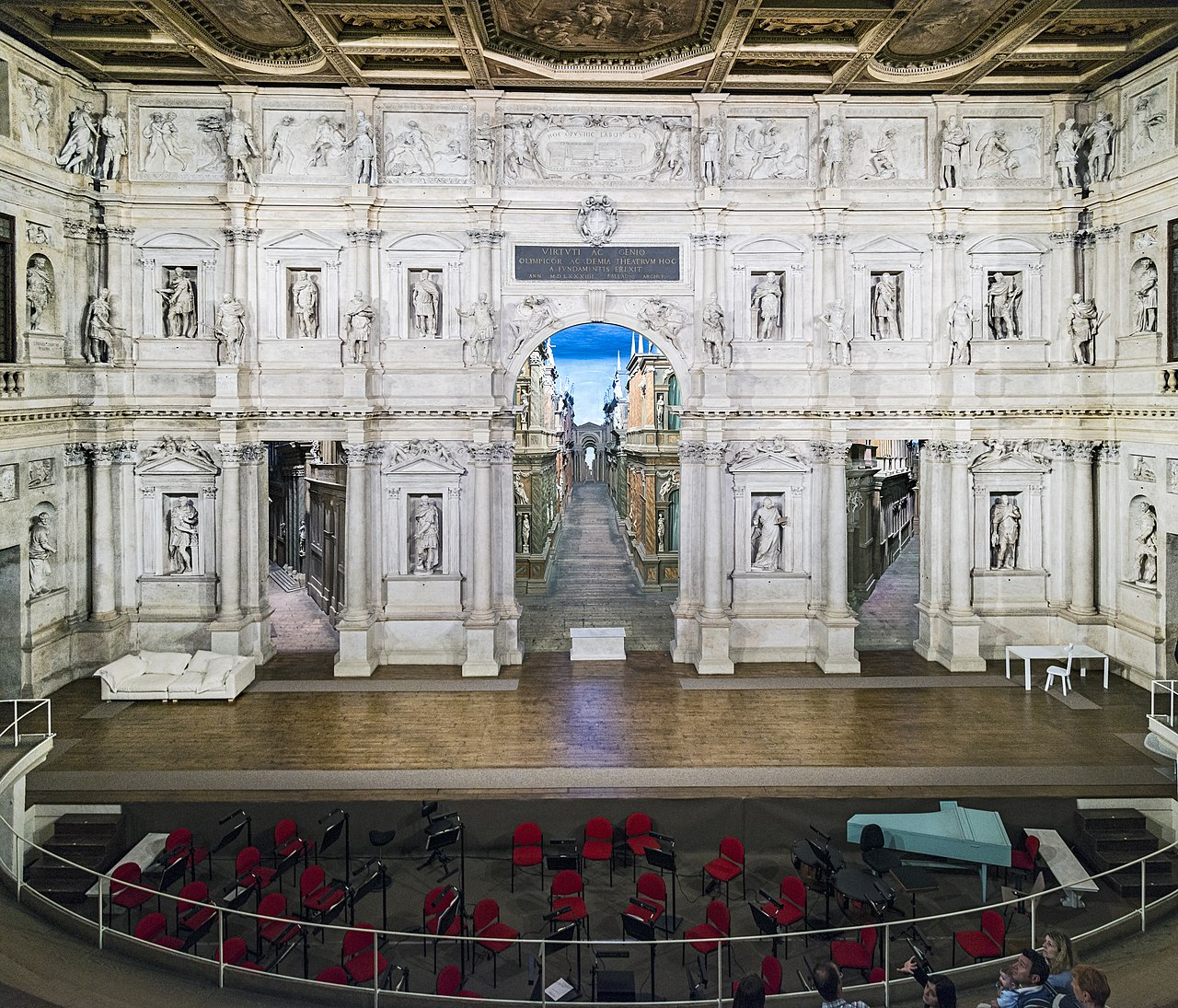
The Teatro Olimpico ("Olympic Theatre") is a theatre in Vicenza, northern Italy, constructed in 1580–1585. It was the final design by the Italian Renaissance architect Andrea Palladio and was not completed until after his death. The trompe-l'œil onstage scenery, designed by Vincenzo Scamozzi to give the appearance of long streets receding to a distant horizon, was installed in 1585 for the first performance held in the theatre, and is the oldest surviving stage set still in existence. The full Roman-style scaenae frons back screen across the stage is made from wood and stucco imitating marble. It was the home of the Accademia Olimpica, which was founded there in 1555.
The Teatro Olimpico is, along with the Teatro all'antica in Sabbioneta and the Teatro Farnese in Parma, one of only three Renaissance theatres remaining in existence. Both these theatres were based, in large measure, on the Teatro Olimpico. It is still used several times a year.
Since 1994 the Teatro Olimpico, together with other Palladian buildings in and around Vicenza, has been part of the UNESCO World Heritage Site "City of Vicenza and the Palladian Villas of the Veneto".
Design and construction
The Teatro Olimpico is the last work by Palladio, and ranks amongst his highest masterworks. The Vicentine architect had returned to his native city in 1579, bringing with him a lifetime of detailed study into all aspects of ancient Roman architecture, and a more detailed understanding of the architecture of classical theatre than any other living person. Palladio had illustrated Daniele Barbaro's Italian translation of Vitruvius' De architectura; the prints for this edition include floor plans for Roman theatres and an elevation for the scaenae frons of Vicenza's ruined Roman theatre, the Teatro Berga. As well, Palladio's papers include plans for the imagined reconstruction of the ruined Roman theatres in Pola and Verona.
Palladio, a founder of the Olympic Academy (the Accademia Olimpica, created in 1555), had already designed temporary theatre structures at various locations in the city. The most notable of these had been erected some seventeen years previously in the great hall of the Basilica Palladiana.
In 1579, the academy obtained the rights to build a permanent theatre in an old fortress, the Castello del Territorio, which had been turned into a prison and powder magazine before falling into disuse. Palladio was asked to produce a design, and despite the awkward shape of the old fortress, he decided to use the space to recreate an academic reconstruction of the Roman theatres that he had so closely studied. In order to fit a stage and seating area into the wide, shallow space, it was necessary for Palladio to flatten the semicircular seating area of the Roman theatre into an ellipse.
Palladio died in August 1580, only six months after construction had started on the theatre. Still, construction continued with Palladio's sketches and drawings serving as a guide, and Palladio's son, Silla, taking charge of the project. Soon, the other prominent Vicentine architect, Vincenzo Scamozzi, was called upon to complete the project.
Scamozzi had already stepped in to complete Palladio's other great unfinished project, the villa just east of Vicenza that is today known as Villa Capra "La Rotonda". It is a mark of Scamozzi's genius that both these projects are today regarded as being among Palladio's most successfully executed works. …
History
The theatre was inaugurated on 3 March 1585 with a production of Sophocles' Oedipus Rex, with music by Andrea Gabrielli. However, the theatre was virtually abandoned after only a few productions. The scenes, which had been created in wood and stucco for Oedipus Rex, and which were meant to represent the streets of Thebes, were never removed: despite bombings and other vicissitudes, they have miraculously preserved into modern times. The original lighting system of glass oil lamps, designed by Scamozzi, heightened the illusion of space, has been used only a few times because of the high cost and the risk of fire. Scamozzi's lighting system was used when, in 1997, the theatre was again employed for a production of Oedipus Rex.
The Teatro Olimpico is still used for plays and musical performances, but audience sizes are limited to 400, for conservation reasons. Performances take place in two theatre seasons:classical plays in the autumn and the festival Il Suono dell'Olimpico in the spring. It is not equipped with heating or air conditioning, which could damage the delicate wooden structures.
The Theatre has been used as a filming location for films such as Don Giovanni (1979) and Casanova (2005).
The Teatro Olimpico hosts the awards ceremony of Dedalo Minosse International Prize for commissioning a building.
Vicenza American High School, a military base located on Caserma Ederle in Vicenza, on occasions used the theater for commencement exercises for the graduating classes for a number of years, including, but not limited to the late 1970s and early 1980s. However, as class sizes significantly increased, they have stopped using the theater for graduation ceremonies.
Precursors
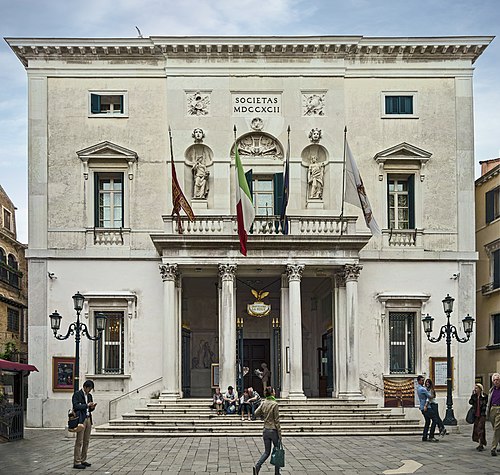
Some authors have incorrectly stated that when the Teatro Olimpico was constructed in 1580–85, it was the first purpose-built theatre in Europe in over a thousand years. In reality, the theatre was one of a number of new permanent theatres being constructed at the time. Records show that permanent theatres were constructed in Ferrara (1531), Rome (1545), Mantua (1549), Bologna (1550), Siena (1561), and Venice (1565). This last theatre was designed by Palladio himself, for the Compagnia della Calza.
Influence
Over the centuries, the Teatro Olimpico has had many admirers, but relatively few imitators. One critic has observed: "In the history of theatre design, the Teatro Olimpico was a temporary hiatus, for succeeding generations adopted the proscenium arch and painterly stage sets. Palladio's ideas are closer to the spirit of the modern theatre, which favors the relationship of audience to action." Another notes: "The rigid form of the scenic arrangements of the Teatro Olimpico [...] precluded any further development," and that the theatre was, in a sense, a prisoner of its creators' emphasis on "considerations of archaeology" and truthfulness to the Roman model. The successful completion of Palladio's experiment in reconstructing the ancient model meant that there was no longer any need to pursue the objective of recovering the Roman past; it was now possible to start making innovations, starting with eliminating the rigid and unchangeable scaenae frons and the unchanging perspective views.
The first theatre to draw inspiration from the Teatro Olimpico, and the one in which its influence is the most obvious, is the Teatro all'antica in Sabbioneta. This theatre, which was designed by Vincenzo Scamozzi, is sometimes also referred to, somewhat confusingly, as the "Teatro Olimpico", and some of its design elements, including most notably the colonnade behind the seating area and the self-conscious references to ancient Rome, are clearly drawn from the original Teatro Olimpico. However, the elaborate scaenae frons is absent in Sabbioneta, and only a single perspective view, along a single street, is employed onstage. As well, the seating area departs radically from Palladio's elliptical plan (perhaps as a result of the much narrower shape of the building in which the theatre is housed).
The English architect Inigo Jones visited the Teatro Olimpico shortly after its completion, and took careful notes, in which he expressed particular admiration for the perspective views: "he chief artifice was that whear so ever you sat you saw one of thes Prospects..."
Text from Wikipedia, the free encyclopedia, under CC BY-SA 4.0. Full article: «Olympic Theatre».
Timeline
- 1580Construction
- 1585Opened
Events and people from Wikidata (CC0).
Photos
Getting there
VicenzaTrain, nearest
1.2 km as the crow flies
Olympic TheatrePiazza Giacomo Matteotti 11, 36100 Vicenza
Distances are as the crow flies, not walking or driving.
Loading map…
Nearby
See on the mapMore historic theatres in Veneto


Frequently asked questions
Where is Olympic Theatre?
Olympic Theatre is in Vicenza, in the province of Vicenza (Veneto), Italy. Address: Piazza Giacomo Matteotti 11, 36100 Vicenza. GPS coordinates: 45.54998, 11.54923.
What else is there to see near Olympic Theatre?
Nearby you’ll find: Casa Cogollo (100 m away), Palazzo Chiericati (100 m away), Ponte degli Angeli (100 m away).
Sources and licences
Text. Wikipedia, the free encyclopedia (CC BY-SA 4.0).
Data. Wikidata (CC0); opening hours and contacts OpenStreetMap (ODbL).
Photos. Wikimedia Commons, author and licence on every image.
Credits for the 9 photos
- Interior of Teatro Olimpico (Vicenza) scena — Didier Descouens, CC BY-SA 4.0
- Il Teatro Olimpico — Rolfdus, CC BY-SA 4.0
- Teatro Olimpico in Vicenza (1) — Krzysztof Golik, CC BY-SA 4.0
- Teatro Olimpico — Sandra Grampa, CC BY-SA 4.0
- Vicenza - Teatro Olimpico - 2024-09-29 21-28-54 001 — Viaggiamocela, CC BY-SA 4.0
- Vicenza - Teatro Olimpico - 2025-09-29 19-19-32 001 — Annika_of_Nine, CC BY-SA 4.0
- Vicenza - Teatro Olimpico - 2025-09-29 19-24-21 001 — Annika_of_Nine, CC BY-SA 4.0
- Piazza Matteotti Vicenza 2015 (24191709980) — Elitre from Italia, CC BY-SA 2.0
- Vicenza, World Heritage List — Pottercomuneo, CC BY-SA 3.0
Updated 28 October 2026. All sources and licences