



Photo: Didier Descouens, CC BY-SA 4.0 · Wikimedia Commons
Historic theatre, 1792
Teatro La Fenice
Opera house in Venice, Italy
- Within the UNESCO World Heritage Site “Venice and its Lagoon”
At a glance
- Type
- Historic theatre
- Period
- Early modern period, 1792
- Style
- Italian theater
- Architects
- Giannantonio Selva, Tommaso Meduna, Giovanni Battista Meduna
- Coordinates
- 45°26′01″ N, 12°20′02″ E
- Address
- Campo San Fantin, 1965, 30124 Venezia
History and description
Teatro La Fenice is a historic opera house in Venice, Italy. It is one of "the most famous and renowned landmarks in the history of Italian theatre" and in the history of opera as a whole. Especially in the 19th century, La Fenice became the site of many famous operatic premieres at which several works by the four major bel canto era composers—Rossini, Bellini, Donizetti, and Verdi—were performed.
Its name reflects its role in permitting an opera company to "rise from the ashes" despite losing the use of three theatres to fire, the first in 1774 after the city's leading house was destroyed and rebuilt but not opened until 1792; the second fire came in 1836, but rebuilding was completed within a year. The third fire was the result of arson, and destroyed the house in 1996 leaving only the exterior walls; it was rebuilt and re-opened in November 2004. In order to celebrate this event, the tradition of the Venice New Year's Concert started.
History
Seven old theaters were active in Venice at the end of the eighteenth century, two for the production of plays and the others for music. The grandest of these was the Teatro San Benedetto, which stood on the site currently occupied by the Rossini cinema. Built by the Grimani family in 1755, it was subsequently assigned to the Nobile Società di Palchettisti (Noble Association of Box-holders). However, following a judicial ruling in 1787, this association was expelled and forced to give up the opera house to the noble Venier family, the owners of the land on which it was built.
The association immediately proposed building a larger and more sumptuous opera house than the one it had lost, which would become the symbol of their changing fortunes and their capacity for ′rebirth′. It was therefore to be called La Fenice, like the mythical, immortal bird able to rise out of its own ashes, to symbolise the association's splendid rebirth after its misfortunes.
The piece of land between Contrada Santa Maria Zobenigo and Contrada Sant'Angelo was bought for the purpose in 1790 and the private houses on it were demolished. A competition was then announced for the design of the opera house, and the committee of experts selected the work of the architect Giannantonio Selva from the 29 plans submitted.
Work began in 1791 and was completed just 18 months later, in April 1792.
La Fenice immediately made its mark as one of the leading opera houses, noted in Italy and Europe both for the high artistic quality of its work and the splendour of its building. But, almost as if the name were the bearer of bad omens, on the night of 13 December 1836 the opera house was devastated by a first fire caused by a recently installed Austrian heater. The newspapers said it took three days and three nights to put out the fire and that various hotspots were still smouldering among the debris 18 days later. The flames entirely destroyed the house, and only the foyer and the Sale Apollinee were saved. …
Artistic notes
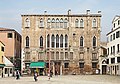
Built in 1792 to a plan by the architect Giannantonio Selva, the façade of the building is the only element to have completely survived the two fires that almost entirely destroyed the opera house in 1836 and 1996.
Unlike the other theaters in the city, whose entrances are in secluded places like alleys and small squares, La Fenice is the only historic Venetian theatre facing onto an open space, Campo San Fantin. It is also the only one to feature a colonnade in neo-classical style in its façade. This bears the theatre's insignia in the centre portraying the phoenix that rises from the flames, carved in 1837 to design by Giambattista Meduna. The façade features two statues in niches representing the muses of tragedy and dance: Melpomene and Terpsichore. Above them are the masks of Comedy and Tragedy, thought to be by Domenico Fadiga.
The first sculptures that adorned the entrance to the opera house, in terracotta and carved in Baroque style, were attributed to either Giuseppe Bernardi or his nephew Giovanni Ferrari, both of whom taught Canova.
They were replaced in 1875 as they were in an advanced state of decay and were in any case thought incompatible, if restored, with the classical style of the façade. The two new statues were made in Custoza stone by Augusto Benvenuti in a new style that better suited the building. All trace of the original sculptures was lost after the theatre management sold them to Benvenuti in 1876.
Two commemorative stelae were placed in the entrance vestibule after the 1837 reconstruction. The one on the right, sculpted in that year by Antonio Giaccarelli to an original design by Giambattista Meduna, is attributed to the architect Giannantonio Selva. The one on the left, in honour of the playwright Carlo Goldoni, is by Luigi Zandomeneghi and was moved from the atrium where it had been dedicated on 26 December 1830. The new sign of the opera house, in gold and blue, again to a design By Meduna, was also placed above the entrance in 1837.
Escaping entirely unharmed from the first fire that destroyed the original La Fenice Opera House on the night of December 1836, the entrance, by Selva, was enlarged in 1937 as part of the upgrading works directed by the engineer Eugenio Miozzi. …
New rooms
"As it was, where it was", the motto for reconstruction of La Fenice, called for the opera house to be rebuilt as it was before the 1996 fire.
This principle, however, was seen applying only to the rooms of particular historic and artistic importance.
The opportunity was therefore taken to redesign the parts of the building that did not come into this category, resulting in the creation of three new rooms.
Text from Wikipedia, the free encyclopedia, under CC BY-SA 4.0. Full article: «Teatro La Fenice».
Timeline
- 1790Start of construction
- 1792Built and opened
- 1836Conflagration
- 1837Architectural reconstruction
- 1996Conflagration
- 2003Architectural reconstruction
Events and people from Wikidata (CC0).
Photos
Getting there
Venezia Santa LuciaTrain, nearest
1.3 km as the crow flies
Teatro La FeniceCampo San Fantin, 1965, 30124 Venezia
Giglio300 m
Aeroporto Marco Polo di Venezia7.9 km
Distances are as the crow flies, not walking or driving.
Loading map…
Nearby
See on the mapMore historic theatres in Veneto


Frequently asked questions
Where is Teatro La Fenice?
Teatro La Fenice is in Venice, in the province of Venezia (Veneto), Italy. Address: Campo San Fantin, 1965, 30124 Venezia. GPS coordinates: 45.43370, 12.33390.
Is Teatro La Fenice wheelchair accessible?
According to OpenStreetMap data, the site is not wheelchair accessible.
How old is Teatro La Fenice?
Wikidata dates it to 1792.
What else is there to see near Teatro La Fenice?
Nearby you’ll find: Ateneo Veneto (0 m away), Palazzo Salvadori Tiepolo (100 m away), Palazzo Molin del Cuoridoro (100 m away).
Sources and licences
Text. Wikipedia, the free encyclopedia (CC BY-SA 4.0).
Data. Wikidata (CC0); opening hours and contacts OpenStreetMap (ODbL).
Photos. Wikimedia Commons, author and licence on every image.
Credits for the 9 photos
- Teatro La Fenice (Venice) - Facade — Didier Descouens, CC BY-SA 4.0
- Giudecca Rio delle Convertite barcone Teatro La Fenice Venezia — This Photo was taken by Wolfgang Moroder. Feel free to use my photos, but please mention me as the author and send me a message. This image is not in the public domain. Please respect the copyright…, CC BY-SA 3.0
- P1030298 Teatro La Fenice 01 — Abxbay, CC BY-SA 4.0
- RWVI dinner at Teatro La Fenice, Venice 2019 — Derek Williams, CC BY 4.0
- Teatro La Fenice (6907668215) — Christine Zenino from Chicago, US, CC BY 2.0
- Venice - Teatro La Fenice - outside 01 — Remi Mathis, CC BY-SA 3.0
- Venice at night-Teatro La Fenicemsu-2021-5834- — Matthias Süßen, CC BY-SA 4.0
- Igor Strawinsky. The Rake's progress. La Biennale di Venezia. XIV festival internazionale di musica contemporanea. Prima esecuzione mondiale dell' opera diretta dall'autore e presentata dal complesso del teatro alla... - btv1b53221601f — Public domain
- La fenice rear entry — Abxbay, CC BY-SA 3.0
Updated 28 October 2026. All sources and licences