


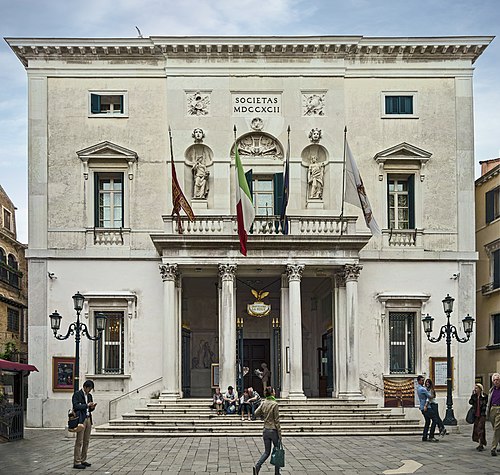
Photo: Dimitris Kamaras from Athens, Greece, CC BY 2.0 · Wikimedia Commons
Historic theatre, 1622
Teatro Goldoni
Theatre in Venice, Italy
- Within the UNESCO World Heritage Site “Venice and its Lagoon”
At a glance
- Type
- Historic theatre
- Period
- Early modern period, 1622
- Coordinates
- 45°26′11″ N, 12°20′07″ E
- Address
- San Marco, 4650/B, 30124 Venezia
History and description
Teatro Goldoni, formerly Teatro San Luca and Teatro Vendramin di San Salvatore, is one of the opera houses and theatres of Venice which today is the home of the Teatro Stabile del Veneto. The theatre building is located near the Rialto Bridge in the historic center of Venice.
History
All the main Venetian theatres were owned by important patrician families; combining business with pleasure in the Italian city with the most crowded and competitive theatrical culture. When most opera in Europe was still being put on by courts, "economic prospects and a desire for exhibitionistic display", as well a decline in their traditional overseas trading, attracted the best Venetian families to invest in the theatre during the 17th century. Europe's first dedicated public and commercial opera house was the Teatro Tron from 1637.
The Grimani, with whom the Vendramin often inter-married, were dominant, owning what is now called the Teatro Malibran, then called the Teatro San Giovanni Grisostomo, as well as the Teatro San Benedetto and other houses. The Veniers owned La Fenice, still the main opera house.
The Vendramin owned the important Teatro di San Luca or Teatro Vendramin or Teatro San Salvatore, founded in 1622 in the San Salvatore, or in Venetian dialect San Salvador district, later renamed the Teatro Apollo, and since 1875 called the Teatro Goldoni, which still thrives as the city's main theatre for plays, now in a building of the 1720s. The Teatro San Luca was rebuilt in the 1720s and renamed the Teatro Apollo. This building survives today. In the age of Carlo Goldoni, the greatest Venetian dramatist, only the San Luca and the Malibran still put on spoken drama, and his desertion of the Grimani for the Vendramins at San Luca in 1752 was a major event in the theatrical history of the period, ushering in perhaps his finest period, in which as well as his comedies, he played a significant role in the development of the opera buffa. The Vendramins, who had considerable direct involvement in the management of the theatre, had a sometimes uneasy relationship with him, arguing over money and the style of his plays, until he left for Paris in 1761, as a result of a dispute with his rival, Carlo Gozzi. However the Vendramin did not take their involvement as far as Vincenzo Grimani, who was a cardinal and opera librettist. …
Text from Wikipedia, the free encyclopedia, under CC BY-SA 4.0. Full article: «Teatro Goldoni».
Timeline
- 1622Built
- 1720Architectural reconstruction
Events and people from Wikidata (CC0).
Photos
Getting there
Venezia Santa LuciaTrain, nearest
1.2 km as the crow flies
Teatro GoldoniSan Marco, 4650/B, 30124 Venezia
Rialto "B"100 m
Aeroporto Marco Polo di Venezia7.6 km
Distances are as the crow flies, not walking or driving.
Loading map…
Nearby
See on the mapMore historic theatres in Veneto


Frequently asked questions
Where is Teatro Goldoni?
Teatro Goldoni is in Venice, in the province of Venezia (Veneto), Italy. Address: San Marco, 4650/B, 30124 Venezia. GPS coordinates: 45.43640, 12.33530.
How old is Teatro Goldoni?
Wikidata dates it to 1622.
What else is there to see near Teatro Goldoni?
Nearby you’ll find: Scuola Grande di San Teodoro (100 m away), Palazzo Bembo (100 m away), Palazzo Nervi-Scattolin (100 m away).
Sources and licences
Text. Wikipedia, the free encyclopedia (CC BY-SA 4.0).
Data. Wikidata (CC0); opening hours and contacts OpenStreetMap (ODbL).
Photos. Wikimedia Commons, author and licence on every image.
Credits for the 9 photos
- Teatro Goldoni, Venice (25327145799) — Dimitris Kamaras from Athens, Greece, CC BY 2.0
- Teatro Comunale (7256874872) — Tony Hisgett from Birmingham, UK, CC BY 2.0
- Teatro Comunale Door 1 (7256887226) — Tony Hisgett from Birmingham, UK, CC BY 2.0
- Teatro Comunale Door 2 (7256900072) — Tony Hisgett from Birmingham, UK, CC BY 2.0
- Teatro Comunale Door 3 (7256909644) — Tony Hisgett from Birmingham, UK, CC BY 2.0
- Carnevale Venezia — Baeringrid, CC BY-SA 4.0
- Venezia teatr szyld — Andrzej Otrębski, CC BY-SA 3.0
- Venice 0O3A9631 (10246789964) — amberapparently from Sydney, CC BY 2.0
- Venice, Italy (2025) - 483 — Another Believer, CC BY-SA 4.0
Updated 28 October 2026. All sources and licences