


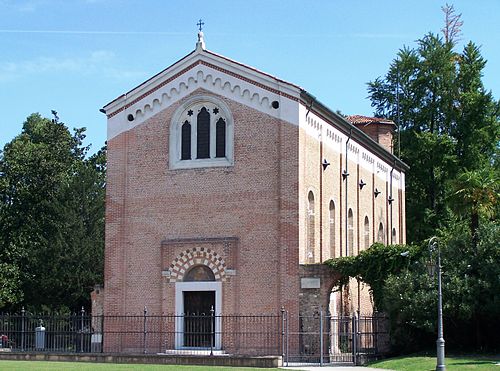
Photo: Didier Descouens, CC BY-SA 4.0 · Wikimedia Commons
Museum, 13th century
Santa Corona
Church building in Vicenza, Italy
- Within the UNESCO World Heritage Site “City of Vicenza and the Palladian Villas of the Veneto”
At a glance
- Type
- Museum
- Period
- Middle Ages, 13th century
- Style
- Renaissance architecture
- Protection
- Italian national heritage
- Coordinates
- 45°32′57″ N, 11°32′52″ E
- Address
- Contra' Santa Corona 2, 36100 Vicenza
History and description
The Santa Corona complex in Vicenza comprises one of the city’s most important churches—constructed in the second half of the 13th century and enriched over the centuries with numerous works of art—and the cloisters of the former convent of the Dominicans. It forms part of the city’s museum network. The Church of Santa Corona houses Renaissance paintings and the Valmarana Chapel, designed by Andrea Palladio, while the former convent serves as the home of the Naturalistic Archaeological Museum.
History
The church was built at the behest of the Municipality of Vicenza, which, in October 1260, decided to erect a grand temple to house one of the thorns from the crown of Christ. This relic had been gifted to the blessed Bartholomew of Breganze, bishop of Vicenza from 1259 to 1270, by King Louis IX of France in Paris. The bishop aimed to bring about a profound political and religious renewal in the city. Following the tyrannical rule of Ezzelino III da Romano, the free Commune of Vicenza had been restored, and Bishop Bartholomew sought to counter, through the Dominicans—of which he was a member—the heresies prevalent in the city, particularly the well-established Cathar church, as well as civic issues such as family disputes and widespread usury. Consequently, Bishop Bartholomew entrusted the management of the church to his Dominican friars.
The construction of the church was supported by the enthusiasm of the entire population. Its location, rich in symbolic meaning, was chosen in the contrà del Collo, where the Cathar church and Ezzelino’s fortified seat, the Castrum Thealdum, had once stood. The Commune acquired land and rights on the slope descending toward the Bacchiglione River, and private citizens donated houses and palaces. Thus, the church was built—exceptionally large for its time and clearly derived from the Lombard prototypes of Cistercian abbeys—starting in 1261 and completed in less than a decade, at least in its essential parts.
However, the political climate soon changed: in 1264, Vicenza was subjugated by Padua, and Bartholomew lost much of his influence, spending his final years in distress and disappointment. He even requested Pope Clement IV to relieve him of his diocesan duties, but the pope did not accept his resignation. Bartholomew died in 1270 in Vicenza, after designating the Dominican convent of Santa Corona, then under construction, as the universal heir of his possessions. He was buried in the church, which was by then completed. …
Description and works of art
The facade is gabled, constructed in exposed brick like the entire building, and vertically divided by pilasters in the central section. It is crowned by a tall, multi-banded decorated cornice resting on a series of blind arches, which in turn supports five pinnacles with metal crosses. The facade features a large rose window flanked by two oculi, positioned above the entrance portal, which is characterized by a pronounced splay. On the lateral sections, above the naves, there are two monoforas and, below, two very tall windows containing slender biforas.
The interior plan distinctly reflects the layout typical of mendicant orders, derived from Cistercian models. It is a Latin cross with a high transept and divided into three naves; the two lateral naves end in rectangular apses, respectively the Holy Thorn Chapel on the left and the Thiene Chapel on the right, while the central apse ends in the rounded and elongated main chapel, extended in the late 15th century. The first pillars are round with capitals shaped as "cubes," with corners softened by a leaf and characteristic semicircular hanging folds.
On the right, an interesting early 16th century fresco depicts the Madonna of Mercy protecting the faithful of the Turchini Confraternity, attributed to Marcello Fogolino but likely by Alessandro Verla, who also painted the nearby fresco of the Dominican blessed Isnardo da Chiampo. To the left of the door, a funerary urn of Giulia, wife of Simone da Porto, from the same period; above, two large mid-18th century paintings depict the Madonna protecting the members of the Turchini Confraternity—testifying to the persistence of this association three centuries later—and the Killing of Saint Peter Martyr.
The crypt was built by Lorenzo da Bologna concurrently with the main chapel above it. It is accessed by descending two narrow staircases located on either side of the presbytery steps; in the left staircase, the tombstone of Andrea Palladio’s family is embedded. The crypt’s low pavilion vault rests on hanging capitals: on four of these—as well as at the center of the vault, painted in gold, red, and blue—is the Valmarana family crest, which funded its construction. …
Text from Wikipedia, the free encyclopedia, under CC BY-SA 4.0. Full article: «Santa Corona».
Timeline
- 13th centuryFounded
Events and people from Wikidata (CC0).
Photos
Getting there
VicenzaTrain, nearest
1.0 km as the crow flies
Santa CoronaContra' Santa Corona 2, 36100 Vicenza
Distances are as the crow flies, not walking or driving.
Loading map…
Nearby
See on the mapMore museums in Veneto

- Free 1st Sunday


- Free 1st Sunday

- UNESCO
Frequently asked questions
Where is Santa Corona?
Santa Corona is in Vicenza, in the province of Vicenza (Veneto), Italy. Address: Contra' Santa Corona 2, 36100 Vicenza. GPS coordinates: 45.54926, 11.54769.
How old is Santa Corona?
Wikidata dates it to the 13th century.
What else is there to see near Santa Corona?
Nearby you’ll find: Museo di Santa Corona (100 m away), Casa Cogollo (100 m away), Palazzo Leoni Montanari, Vicenza (100 m away).
Sources and licences
Text. Wikipedia, the free encyclopedia (CC BY-SA 4.0).
Data. Wikidata (CC0); opening hours and contacts OpenStreetMap (ODbL).
Photos. Wikimedia Commons, author and licence on every image.
Credits for the 6 photos
- Santa Corona (Vicenza) — Didier Descouens, CC BY-SA 4.0
- Chiesa di Santa Corona veduta 31 — Sirleonidas, CC BY-SA 4.0
- Vicenza - Chiesa di Santa Corona - 2024-09-29 21-34-53 001 — Viaggiamocela, CC BY-SA 4.0
- Vicenza - chiesa di Santa Corona - 2026-09-26 17-53-21 001 — CyranoVI73, CC BY-SA 4.0
- Vicenza - chiesa di Santa Corona - 2026-09-26 — Marcok, CC BY-SA 4.0
- Corso Palladio Muro S. Corona-1 — Claudio Gioseffi, CC BY-SA 4.0
Updated 28 October 2026. All sources and licences