


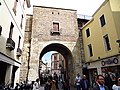


Photo: Andrea Piroddi, CC BY-SA 3.0 · Wikimedia Commons
Museum, 1305
Scrovegni Chapel
Chapel in Padua, Italy
At a glance
- Type
- Museum
- Period
- Middle Ages, 1305
- Style
- Gothic architecture
- Dedicated to
- Mary
- Founder
- Enrico degli Scrovegni
- Commissioned by
- Enrico degli Scrovegni
- Protection
- Part of UNESCO World Heritage Site
- UNESCO World Heritage
- Padua’s fourteenth-century fresco cycles
- Coordinates
- 45°24′43″ N, 11°52′46″ E
- Address
- Piazza Eremitani 8, 35121 Padova
History and description
The Scrovegni Chapel, also known as the Arena Chapel, is a small church, adjacent to the Augustinian monastery, the Monastero degli Eremitani in Padua, region of Veneto, Italy. The chapel and monastery are now part of the complex of the Musei Civici di Padova.
The chapel contains a fresco cycle by Giotto, completed around 1305 and an important masterpiece of Western art. In 2021, the chapel was declared part of the UNESCO World Heritage Site of 14th-century fresco cycles composed of 8 historical buildings in Padua city centre. The Scrovegni Chapel contains the most important frescoes that marked the beginning of a revolution in mural painting and influenced fresco technique, style, and content for a whole century.
Description
Giotto and his team covered all the internal surfaces of the chapel with frescoes, including the walls and the ceiling. The nave is 20.88 metres (68.5 ft) long, 8.41 metres (27.6 ft) wide, and 12.65 metres (41.5 ft) high. The apse area is composed of a square area (4.49 meters deep and 4.31 meters wide) and a pentagonal area (2.57 meters deep). The largest element is extensive cycles showing the Life of Christ and the Life of the Virgin. The wall at the rear of the church, through which the chapel is entered, has a large Last Judgement. There are also panels in grisaille (monochrome) showing the Vices and Virtues.
The church was dedicated to Santa Maria della Carità at the Feast of the Annunciation, 1303, and consecrated in 1305. Much of Giotto's fresco cycle focuses on the life of the Virgin Mary and celebrates her role in human salvation. A motet by Marchetto da Padova appears to have been composed for the dedication on 25 March 1305. The chapel is also known as the Arena Chapel because it was built on land purchased by Enrico Scrovegni that abutted the site of a Roman arena. The space was where an open-air procession and sacred representation of the Annunciation to the Virgin had been played out for a generation before the chapel was built.
History
The Arena Chapel was commissioned to Giotto by the affluent Paduan banker, Enrico Scrovegni. In the early 1300s Enrico purchased from Manfredo Dalesmanini the area on which the Roman arena had stood. Here he had his luxurious palace built, as well as a chapel annexed to it. The chapel's project was twofold: to serve as the family's private oratory and as a funerary monument for himself and his wife. Enrico commissioned Giotto, the famous Florentine painter, to decorate his chapel. Giotto had previously worked for the Franciscan friars in Assisi and Rimini, and had been in Padua for some time, working for the Basilica of Saint Anthony in the Sala del Capitolo and in the Blessings's Chapel.
A number of 14th-century sources (Riccobaldo Ferrarese, Francesco da Barberino, 1312–1313) testify to Giotto's presence at the Arena Chapel's site. The fresco cycle can be dated with a good approximation to a series of documentary testimonies: the purchase of the land took place on 6 February 1300; the bishop of Padua, Ottobono dei Razzi, authorised the building some time prior to 1302 (the date of his transferral to the Patriarcato of Aquileia); the chapel was first consecrated on 25 March 1303, the feast day of the Annunciation; on 1 March 1304 Pope Benedict XI granted an indulgence to whoever visited the chapel; one year later on 25 March 1305 the chapel received its definitive consecration. Giotto's work thus falls in the period from 25 March 1303 to 25 March 1305.
Giotto, who was born around 1267, was 36–38 years old when he worked at Enrico Scrovegni's chapel. He had a team of about 40 collaborators, and they calculated that 625 work days (giornate) were necessary to paint the chapel. A "work day" meant that portion of each fresco that could be painted before the plaster dried and was no longer "fresh" (fresco in Italian). …
In literature
Giotto's painting of Charity is frequently cited in Remembrance of Things Past by Marcel Proust. Mr. Swann likens the kitchen maid to this painting and it becomes something of a joke between him and the narrator.
Amongst those artists who derived inspiration from the Chapel, British painter Sir Stanley Spencer (1891–1959) is known to have based the scale and narrative sequence for the Sandham Memorial Chapel at Burghclere, near Newbury, England (1924–1932).
Text from Wikipedia, the free encyclopedia, under CC BY-SA 4.0. Full article: «Scrovegni Chapel».
Timeline
- 1305Founded
Events and people from Wikidata (CC0).
Photos
Getting there
PadovaTrain, nearest
700 m as the crow flies
Scrovegni ChapelPiazza Eremitani 8, 35121 Padova
Aeroporto di Treviso-Sant'Angelo35.9 km
Distances are as the crow flies, not walking or driving.
Loading map…
Nearby
See on the mapMore museums in Veneto

- Free 1st Sunday


- Free 1st Sunday


Frequently asked questions
Where is Scrovegni Chapel?
Scrovegni Chapel is in Padua, in the province of Padova (Veneto), Italy. Address: Piazza Eremitani 8, 35121 Padova. GPS coordinates: 45.41182, 11.87954.
Is Scrovegni Chapel wheelchair accessible?
According to OpenStreetMap data, the site is wheelchair accessible.
How old is Scrovegni Chapel?
Wikidata dates it to 1305.
What else is there to see near Scrovegni Chapel?
Nearby you’ll find: Museum for Nature and Men (100 m away), Civic Museums of Padua (100 m away), Palazzo Cavalli alle Porte Contarine (100 m away).
Sources and licences
Text. Wikipedia, the free encyclopedia (CC BY-SA 4.0).
Data. Wikidata (CC0); opening hours and contacts OpenStreetMap (ODbL).
Photos. Wikimedia Commons, author and licence on every image.
Credits for the 5 photos
- La Cappella degli Scrovegni — Andrea Piroddi, CC BY-SA 3.0
- Leopoldo Toniolo - Dante visita Giotto nella Cappella degli Scrovegni — Creator:Leopoldo Toniolo, Public domain
- Padova - Cappella degli Scrovegni - 2026-09-30 21-25-02 001 — Terragio67, CC BY-SA 4.0
- Padova - cappella degli Scrovegni - 2026-09-30 22-16-44 001 — Terragio67, CC BY-SA 4.0
- Scrovegni pisano02 pushkin — shakko, CC BY 3.0
Updated 28 October 2026. All sources and licences