
- UNESCO

Photo Didier Descouens, CC BY-SA 4.0
Padova · Veneto
In Padua the atlas lists 140 historic places: 58 historic villas and palaces, 37 museums, 25 fortresses and towers, 8 archaeological sites, 6 abbeys and monasteries, 4 historic theatres and 2 castles.
Of these, 11 list opening hours, 2 have free entry and 7 are part of a UNESCO World Heritage Site.
Don’t miss: Ragione Palace, building in Padua, Italy.
By date of construction, the most common period is the Modern era (42% of dated places) and the Middle Ages (25% of dated places).
Padua (Italian: Padova, Venetian: Pàdova) is a city in north eastern Italy. Padua is famous for its historic University of Padua, founded in 1222, and for its UNESCO World Heritage sites, including the Botanical Garden and the 14th-century frescoes.
Padua is the capital of the province of the same name. It is located centrally in the Veneto region, between Venice on one side and Vicenza and Verona on the other. The city has 209,000 inhabitants (2026).
Padua is sits about 40 km west of Venice. It lies along the Bacchiglione River and is an important economic and cultural centre. The city is associated with Galileo Galilei, who conducted important astronomical observations there.
The climate of Padua is moderately continental, with cold, damp winters and hot, muggy summers.
Text from Wikivoyage, CC BY-SA, abridged · Wikivoyage


 Reggia Carrarese
 Town hall
 Palazzo Liviano
 Palazzo Selvatico Luzzato Dina
 Casa della Dogana
 Casa Olzignani
 Palazzo Cavalli alle Porte Contarine
 Palazzo dei Podestà Forestieri
 Palazzo Capodilista
 Palazzo Zabarella
 Bishop's palace
 Palazzo Montorsi
 Palazzo Zacco
 Palazzo Mussato, Padua
 Palazzo Papafava dei Carraresi
 Palazzo Trieste
 Palazzo Angeli
 Palazzo Cappello
 Palazzo Grimani
 Palazzo Maldura
 Palazzo Trevisan-Mion
 Palazzo delle Debite
 Villa Marcello
 Villa Ottoboni
 Palazzo Buzzaccarini
 Palazzo Ca' Borin
 Palazzo De Claricini
 Palazzo del Capitanio
 Palazzo Dottori
 Palazzo Michiel Contarini
 Palazzo Romanin Jacur
 Palazzo Sala
 Palazzo Storione
 Palazzo Wollemborg Palazzo Basadonna Manin Palazzo Zacco di Santa Sofia Palazzo del Monte di Pietà Vecchio


 Geography Museum
 Museo veneto del giocattolo
 MUSME
 Civic Museums of Padua
 Museo antoniano Diocesan Museum of Padua
 Museo del Risorgimento e dell'età contemporanea
 Esapolis
 Museum Bottacin
 Museo Botanico-Erbario
 Museo della Padova Ebraica
 Museo di Scienze Archeologiche e d'Arte
 Museo di Paleontologia
 Museo di Macchine Enrico Bernardi Museum for Nature and Men Collezione privata Safilo Museo Morgagni di anatomia Museo dell'Educazione Oratorio di San Michele


By train: Padua is a central railway node in the Veneto area. Many lines converge into the city central station, notably from
Venezia (Venice, Trieste, and points East) - Venice is only a 30-minute ride away
Bologna (Bologna, Ferrara, Rovigo, Rome, Florence) one hour and half ride
Milano (Milan, Brescia, Verona, Vicenza) two hours and half minute ride
Castelfranco (Belluno, Calalzo, Feltre) 45 minute ride
All kinds of trains pass through Padua: Eurostar, InterCity, EuroCity, InterRegionale, Regionale, InterCityNight, EuroNight, Espresso. More info is available on the Trenitalia website.
Padova railway station (Stazione di Padova), Piazzale Stazione 1.
By plane: Padua “Gino Allegri” Airport (QPA IATA). For private planes and with no direct commercial connections.
However, there are three international airports nearby
Venezia Marco Polo (VCE IATA), 50 km, lot of destinations throughout Europe.
by bus: direct and frequent connections to Padua, 1h
by train: bus to Venezia Mestre station, then train.
Treviso (TSF IATA), 42 km, low-cost airport with Ryanair and other carriers. Destinations: Dublin, London, Frankfurt, Brussels, Barcelona, Paris
by bus: direct and frequent connections to Padua, 1h10 - see SITA website - choose Linee Regionale, then Veneto, then Orari Linee Veneto; last bus leaves airport around 20.00 or 20.25 depending on day of week.
Text from Wikivoyage, CC BY-SA, abridged · Wikivoyage
The Padua Card allows you to visit most churches and all museums as well as use the public transport for €16.
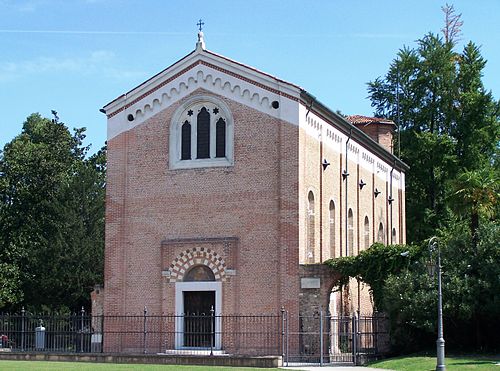
Landmarks: Saint Anthony's cathedral (Basilica di Sant'Antonio). Saint Anthony's Basilica is the best-known tourist site in Padova - millions of pilgrims visit every year. Built immediately after "The Saint's" death in the 1200s, it houses his tomb and notable relics. The statues and crucifix on the main altar are by Donatello, as is the statue of horse and rider in the square in front of the church (called "Gattamelata" - "the honeyed cat"). Free entrance. Oratorio de San Giorgio. A beautiful, frescoed, and generally empty hall on the south side of the piazza next to the Basilica di Sant'Antonio. The paintings were done by two of Giotto's students, and though they are not as magnificent as those in the Capella degli Scrovegni, you can sit down and gaze at them undisturbed for as long as you like. Scrovegni Chapel (Cappella degli Scrovegni). The Chapel is in the north of the city center, not far from the bus and train stations. The walls and ceilings are covered in frescos by Giotto, completed in 1303-1305. The chapel has been well preserved and the art is very impressive.
Text from Wikivoyage, CC BY-SA, abridged · Wikivoyage · Underlined names link to our own pages.


