


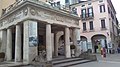


Photo: Didier Descouens, CC BY-SA 4.0 · Wikimedia Commons
Historic villa / palace
Ragione Palace
Building in Padua, Italy
At a glance
- Protection
- Part of UNESCO World Heritage Site
- UNESCO World Heritage
- Padua’s fourteenth-century fresco cycles
- Coordinates
- 45°24′26″ N, 11°52′31″ E
- Address
- Piazza Delle Erbe, 35122 Padova
History and description
The Palazzo della Ragione is a medieval market hall, town hall and palace of justice building in Padua, in the Veneto region of Italy. The upper floor was dedicated to the town and justice administration; while the ground floor still hosts the historical covered market of the city.
The palace separates the two market squares of Piazza delle Erbe from Piazza dei Frutti. It is popularly called il Salone ("the big hall"). It is included in the UNESCO World Heritage Site inscribed as "Padua’s fourteenth-century fresco cycles" in 2021.
Description
The building, with its great hall on the upper floor is believed to be one of the largest medieval halls still extant. The ground plan of the hall is not rectangular, but a parallelogram with a length of 81.5 m by 27 m, with a height 24 m. The building stands on arches, and the upper storey is flanked by an open loggia, not unlike that which surrounds the Basilica Palladiana in Vicenza, that was indeed inspired by Padua's Palazzo della Ragione.
The walls are entirely covered with allegorical frescoes. The gigantic wooden horse on the western side of the hall was built in 1466 and is modelled on Donatello's Equestrian statue of Gattamelata which is placed in front of the Saint Antony Basilica.
In the northeast corner of the hall is situated a particular tool: the pietra del vituperio ("stone of flout"). It is a stool of black stone which was located in the middle of the hall in the Middle Ages and was used to publicly humiliate insolvent debtors, who were obliged to sit there as in the stocks.
The ground floor has hosted the market hall of the city for 800 years and is likely the oldest in the European Union. Originally dedicated to the commerce of a wide selection of food, clothes, spices, and jewels; it is today mostly active in the food and beverage sector.
History
The Palazzo was begun in 1172 and completed in 1219. Originally there were three roofs, spanning the three separate chambers into which the hall was divided. In 1306, Fra Giovanni, an Augustinian friar, covered the whole building with a single roof. The internal partition walls remained until the fire of 1420, when the Venetian architects who undertook the restoration removed them, throwing all three spaces into one and forming the present great hall, the Salone.
Giotto had been the first painter to fresco the walls. The reconstructed space was frescoed anew by Nicolò Miretto and Stefano da Ferrara, working from 1425 to 1440 to cover the surface of more than 2000 m2. Some of the frescoes depict the astrological theories of Pietro d'Abano, a professor at Padua University in the 13th century.
A tornado destroyed the roof and damaged the building on 17 August 1756.
The frescoes
In the great hall (il Salone), all four walls are entirely occupied by frescoes. The decoration consists of more than three hundred different scenes divided into two sections: the upper area, dating back to the fifteenth century, contains scenes that develop over three levels and shows that each month of the year corresponds to certain signs of the zodiac, trades and character traits. The lower area is less densely decorated and contains parts of the 14th-century frescoes. These are probably related to the frescoes in the upper zone, though it should be taken into consideration that they were painted according to the functions of the different spaces in which the hall was divided. For example, there are frescoes separated by traces left by the tribunal benches which once lined the walls, and by symbols associated with them. This is a reminder of the original function of the Palazzo della Ragione as a court of law.
On the southern wall is a relief showing a golden sun. At midday, a ray of sunlight passes through its mouth and strikes the floor along a meridan line. This feature was created by Bortolomeo Ferracina in 1761.
Text from Wikipedia, the free encyclopedia, under CC BY-SA 4.0. Full article: «Ragione Palace».
Photos
Getting there
PadovaTrain, nearest
1.2 km as the crow flies
Ragione PalacePiazza Delle Erbe, 35122 Padova
Aeroporto di Treviso-Sant'Angelo36.5 km
Distances are as the crow flies, not walking or driving.
Loading map…
Nearby
See on the mapMore historic villas and palaces in Veneto

- Free 1st Sunday


- UNESCO
- Free 1st Sunday
- UNESCO

- UNESCO
Frequently asked questions
Where is Ragione Palace?
Ragione Palace is in Padua, in the province of Padova (Veneto), Italy. Address: Piazza Delle Erbe, 35122 Padova. GPS coordinates: 45.40722, 11.87528.
What are the opening hours of Ragione Palace?
According to OpenStreetMap the opening hours are: Sunday and Monday: Closed; Tuesday to Saturday: 9:00–19:00. Always check the official website before your visit.
How much does it cost to visit Ragione Palace?
There is an admission charge. Up-to-date prices are on the official website.
Is Ragione Palace wheelchair accessible?
According to OpenStreetMap data, the site is wheelchair accessible.
What else is there to see near Ragione Palace?
Nearby you’ll find: Palazzo delle Debite (100 m away), Torre degli Anziani (100 m away), Palazzo dei Podestà Forestieri (100 m away).
Sources and licences
Text. Wikipedia, the free encyclopedia (CC BY-SA 4.0).
Data. Wikidata (CC0); opening hours and contacts OpenStreetMap (ODbL).
Photos. Wikimedia Commons, author and licence on every image.
Credits for the 7 photos
- Exterior of Palazzo della Ragione (Padua) — Didier Descouens, CC BY-SA 4.0
- Interno del Palazzo della Ragione - Il Salone e il ciclo astrologico — Memi26, CC BY-SA 4.0
- Loggia del Palazzo della Ragione - Padova — Memi26, CC BY-SA 4.0
- Luce dorata su Palazzo della Ragione e Palazzo delle Debite — Memi26, CC BY-SA 4.0
- Padova - palazzo della Ragione - 2026-09-22 23-36-45 001 — Maiacard, CC BY-SA 4.0
- Padova - palazzo della Ragione - 2026-09-22 23-37-41 001 — Maiacard, CC BY-SA 4.0
- Padova - palazzo della Ragione - 2026-09-23 00-11-04 001 — Maiacard, CC BY-SA 4.0
Updated 28 October 2026. All sources and licences