



Photo: Marcok / it.wikipedia, CC BY-SA 3.0 · Wikimedia Commons
Historic villa / palace
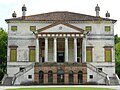
Villa Badoer
Villa in Fratta Polesine, Veneto, Italy
Fratta Polesine (RO), Veneto
At a glance
- Style
- Palladian architecture
- Architect
- Andrea Palladio
- Area
- 14,100 m²
- Protection
- Part of UNESCO World Heritage Site
- UNESCO World Heritage
- City of Vicenza and the Palladian Villas of the Veneto
- Coordinates
- 45°01′49″ N, 11°38′23″ E
- Address
- Via Giovanni Tasso - Fratta Polesine
History and description
Villa Badoer is a villa in Fratta Polesine, in the Veneto region of northern Italy. It was designed in 1556 by Italian Renaissance architect Andrea Palladio for the Venetian noble Francesco Badoer, and built between 1557 and 1563 on the site of a medieval castle, which guarded a bridge across a navigable canal. This was the first time Palladio used his fully developed temple pediment in the façade of a villa.
Villa Badoer has been part since 1996 of the UNESCO World Heritage Site "City of Vicenza and the Palladian Villas of the Veneto".
The building is open to the public and one of the wings houses the Museo archeologico nazionale di Fratta Polesine, opened in 2009.
History
In 1554, on the southern border of the Venetian Republic’s territories, in the flat and foggy country of Polesine, Palladio designed a villa for the Venetian noble Francesco Badoer, intended to become the epicentre of the vast agricultural estate of almost five hundred fields that he had inherited six years previously.
Constructed and inhabited in 1556, the villa therefore functioned for the management of the fields and was simultaneously a visible sign of the “feudal” presence, so to speak, of Badoer in the territory: it is not coincidental that the building rises on the site of an ancient medieval castle. Palladio succeeded in uniting within one effective synthesis these dual meanings, joining the majestic manor house to the two barchesse (farm wings) bent into semicircles, which screen the stables and other agricultural annexes.
The project by Palladio
There are no surviving drawings by Palladio relating to Villa Badoer, nor any building accounts, except those published by the architect in his I quattro libri dell'architettura (1570).
Probably as a result of exploiting the substructures of the medieval castle, the manor house of the villa rises on a high basement, and recalls precedents like the Villa Medici at Poggio a Caiano by Giuliano da Sangallo, and the not far distant Villa dei Vescovi at Luvigliano by Giovanni Maria Falconetto. Building on the old foundations saved money, and gave a slightly raised setting to the building. This manoeuvre rendered necessary a scenographic staircase of several flights leading to the front door of the villa, the main descending to the courtyard and the two lateral ones connecting with the gable-ends of the barchesse. Thus, the ensemble recalls the structures of an antique, terraced temple complex.
The elegant curvilinear barchesse are the only ones that were realised by Palladio from the many projected (for example, those for the Villa Mocenigo on the Brenta, the Villa Thiene at Cicogna or the Villa Trissino at Meledo) and their shape – as Palladio writes – recalls arms opening to receive the visitor; the relevant antique source was very probably the exedrae of the Temple of Augustus in Rome. These originally housed agricultural activities, for this was a working villa, like Villa Emo and most of the villas by Palladio. Unusual among Palladio's completed works, the wings here do not touch the villa, and they are set slightly in front of it. Vasari thought that they were beautiful, and even fantastic. …
Interiors and decoration
The piano nobile retains its original fresco decoration. All the rooms are covered by flat ceilings and on the walls a certain "Giallo Fiorentino" designed complex combinations of allegorical figures, whose significance remains partially obscure. Palladio referred to these frescoes as being "grottesche di bellissima inventione" by a certain Giallo Fiorentino, whose real identity has remained uncertain. Milanesi's identification as Jacopo Giallo, a Florentine illuminator to whom some manuscript work has been assigned, was eliminated by Lionello Puppi's archival discovery that Jacopo Giallo was dead by 1545, thirteen years before the villa was built; Puppi offered instead a certain fresco painter "Giallo Fiorentino", an assistant to Giuseppe Salviati for exterior frescoes at Palazzo Loredan at San Stefano. More recently, Pier Francesco di Jacopo Foschi has been suggested.
Architectural critics such as Witold Rybczynski think that the interior is relatively small and unimpressive, compared to the grandiose exterior.
Conservation
The building passed to the public in the 1960s (initially to the Ville Venete Institute, then to the Province of Rovigo) and was completely restored.
In 1996, UNESCO designated Villa Badoer as part of the World Heritage Site "City of Vicenza and the Palladian Villas of the Veneto".
The building is open to the public. Since 21 February 2009 the northern barchesse of the Villa houses the Museo archeologico nazionale di Fratta Polesine (National archaeological museum of Fratta Polesine).
Text from Wikipedia, the free encyclopedia, under CC BY-SA 4.0. Full article: «Villa Badoer».
Timeline
- 1557Construction
Events and people from Wikidata (CC0).
Photos
Getting there
Fratta PolesineTrain, nearest
900 m as the crow flies
Villa BadoerVia Giovanni Tasso - Fratta Polesine
Distances are as the crow flies, not walking or driving.
Loading map…
Nearby
See on the mapMore historic villas and palaces in Veneto

- Free 1st Sunday


- UNESCO

- UNESCO

- UNESCO
Frequently asked questions
Where is Villa Badoer?
Villa Badoer is in Fratta Polesine, in the province of Rovigo (Veneto), Italy. Address: Via Giovanni Tasso - Fratta Polesine. GPS coordinates: 45.03035, 11.63986.
What are the opening hours of Villa Badoer?
According to OpenStreetMap the opening hours are: Thursday, Saturday and Sunday: 10:00–12:00, 15:30–18:30; Friday: Closed. Always check the official website before your visit.
Can I visit Villa Badoer for free?
Yes: entry is free on the first Sunday of every month, under the Italian “Domenica al museo” scheme.
What else is there to see near Villa Badoer?
Nearby you’ll find: Museo archeologico nazionale (100 m away), Villa Loredan Grimani Avezzù (100 m away), Museo etnografico della civiltà e del lavoro in Polesine (200 m away).
Sources and licences
Text. Wikipedia, the free encyclopedia (CC BY-SA 4.0).
Data. Wikidata (CC0); opening hours and contacts OpenStreetMap (ODbL).
Photos. Wikimedia Commons, author and licence on every image.
Credits for the 9 photos
- Villa Badoer Fratta Polesine facciata by Marcok 2009-08-16 n08 — Marcok / it.wikipedia, CC BY-SA 3.0
- Colonna dei Martiri (Fratta Polesine) 01 — Threecharlie, CC BY-SA 4.0
- Fratta Polesine, Villa Badoer, facciata — Bluteo, CC BY-SA 4.0
- Villa Badoer 1 — Salisburgensis, CC BY 3.0
- Villa Badoer Fratta Polesine barchesse by Marcok 2009-08-16 n01 — Marcok / it.wikipedia, CC BY-SA 3.0
- Villa Badoer Fratta Polesine facciata by Marcok 2009-08-16 n01 — Marcok / it.wikipedia, CC BY-SA 3.0
- Villa Badoer Fratta Polesine facciata posteriore by Marcok 2009-08-16 n01 — Marcok / it.wikipedia, CC BY-SA 3.0
- Villa Badoer Fratta Polesine giardino retro by Marcok 2009-08-16 n01 — Marcok / it.wikipedia, CC BY-SA 3.0
- Villa Badoer Fratta Polesine loggia by Marcok 2009-08-16 n03 — Marcok / it.wikipedia, CC BY-SA 3.0
Updated 28 October 2026. All sources and licences