


Photo: joergens.mi, edited by MenkinAlRire, CC BY-SA 3.0 · Wikimedia Commons
Museum, 1426
Scuola del Santo
Historic place Padua, Italy
At a glance
- Type
- Museum
- Period
- Middle Ages, 1426
- UNESCO World Heritage
- Padua’s fourteenth-century fresco cycles
- Coordinates
- 45°24′04″ N, 11°52′49″ E
History and description
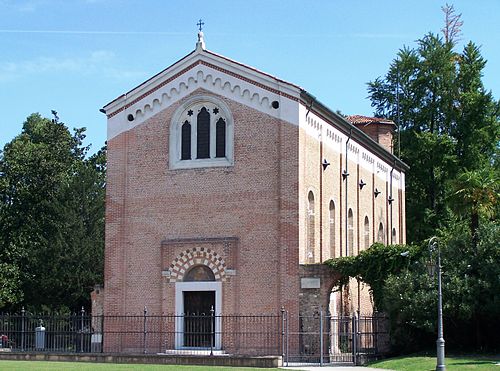
The Scuola del Santo or Scoletta was the headquarters of the Archconfraternity of St Anthony of Padua. It overhangs the churchyard of Basilica of Saint Anthony of Padua, next door to the St. George's Oratory.
The Confraternity built the Scoletta in 1427 and it was expanded in 1504 with an upper floor consisting of the Sala Priorale (prior's room) decorated with a cycle of fifteen frescoes and three canvases, which were worked on by the young Titian between 1510 and 1511. He was entrusted with three frescos of miracles performed by Anthony of Padua, The Miracle of the Newborn, The Miracle of the Healed Foot and The Miracle of the Jealous Husband. The three large frescoes were painted by him between April and December 1511 in the main room of the Scuola del Santo – they were his first large-scale independent work. The raised arm of the wife in Husband is sculpted in relief rather than painted illusionistically.
History
The Archconfraternity began a few years after St Anthony's death and grew rapidly. During the 13th century its brothers used the Sala del Capitolo as their meeting room, then the Cappella della Madonna Mora. In the 15th century it decided to construct a new building on the edges of the churchyard of the Basilica of Sant'Antonio.
Today's Scuola is made up of the chapel on the ground floor (1427–1431) and the meeting room upstairs (1504).
In 1736 the architect Giovanni Gloria built a small building linking the Scuola to the Oratory, with an elegant staircase connecting it to the meeting room. Visiting Padua Pope Pius VI in 1782, Pius VII in 1800, and John Paul II in 1982 blessed the crowd from the small balcony overlooking Piazza del Santo. On the landing is a 15th century tempera on panel painting by an unknown artist showing St Anthony Intending to Write, in poor condition. The Sala priorale has a coffered ceiling by Giovanni Cavalieri, painted by Domenico Bottazzo between 1506 and 1510, making it contemporary with the wooden wall paneling, the wardrobes and drawers by Girolamo da Piacenza. Gilded wooden frames subdivide the painted scenes.
List of works
North wall, counter-clockwise
down below, next to the door: Francesco Vecellio, brother of Titian (attributed to), Nicola da Stra, Guardian of the Archconfraternity, handing out blessed bread (1511)
Titian, Miracle of the Newborn (1511)
Francesco Vecellio (attributed to), Saint Anthony Reveals the Usurer's Heart Inside the Strongbox (1512)
Gerolamo Tessari (attributed to), The Mule Prostrating Itself Before the Blessed Sacrament (1515)
West wall
Filippo da Verona, Sant'Antonio Appears to the Blessed Luca Belludi, Preaching the Immediate Liberation of Padua from the Rule of Ezzelino
Giovanni Antonio Requesta detto il Corona, Saint Anthony confronts the tyrant Ezzelino in Verona (1510–1511)
Domenico Campagnola, Saints Anthony and Francesco (1520), reworked by Domenico Frezelin. On the altar: Briosco, polychromed terracotta Madonna and Child (1533)
Giovanni Antonio Requesta (il Corona), Saint Anthony Reaches Padua, Where He Brought Peace Among the Citizens by the Force and Sweetness of his Preaching (1509)
East wall
Titian, Miracle of the Jealous Husband (to the right is the penitent man kneeling at the saint's feet) (1511)
Titian, Miracle of the Healed Foot (1511)
Gerolamo Tessari (attributed to), Saint Anthony Raises from the Dead a Child Who Had Fallen into Boiling Water (1524, divided in two parts by the window)
Bartolomeo Montagna (attributed to), Resurrection of a Young Man Assassinated for Attesting to the Innocence of his Father (16th century)
Antonio Buttafuoco, Death of St Anthony (1775)
Domenico Campagnola (attributed to), Resurrection of a Drownd Girl (16th century)
Giovan Maria Frangipane (attributed to), St Anthony Raises a Drowned Child from the Dead (1511)
Text from Wikipedia, the free encyclopedia, under CC BY-SA 4.0. Full article: «Scuola del Santo».
Photos
Getting there
PadovaTrain, nearest
1.9 km as the crow flies
Scuola del Santo
Aeroporto di Treviso-Sant'Angelo36.8 km
Distances are as the crow flies, not walking or driving.
Loading map…
Nearby
See on the mapMore museums in Veneto

- Free 1st Sunday


- Free 1st Sunday

- UNESCO
Frequently asked questions
Where is Scuola del Santo?
Scuola del Santo is in Padua, in the province of Padova (Veneto), Italy. GPS coordinates: 45.40105, 11.88017.
How old is Scuola del Santo?
Wikidata dates it to 1426.
What else is there to see near Scuola del Santo?
Nearby you’ll find: Basilica of Saint Anthony of Padua (0 m away), Museo antoniano (100 m away), Museo Botanico-Erbario (200 m away).
Sources and licences
Text. Wikipedia, the free encyclopedia (CC BY-SA 4.0).
Data. Wikidata (CC0); opening hours and contacts OpenStreetMap (ODbL).
Photos. Wikimedia Commons, author and licence on every image.
Credits for the 9 photos
- Basilica di Sant´ Antonio di Padova jm56946-ed-c — joergens.mi, edited by MenkinAlRire, CC BY-SA 3.0
- Oratorio di San Giorgio si Scuola del Santo din Padova-edit — Cezar Suceveanu, edited by MenkinAlRire, CC BY-SA 4.0
- Oratorio di San Giorgio si Scuola del Santo din Padova — Cezar Suceveanu, CC BY-SA 4.0
- Padova - Scuola del Santo - 2025-09-23 22-37-52 001 — Annika_of_Nine, CC BY-SA 4.0
- Padova, piazza del santo, oratorio di san giorgio e scuola del santo — sailko, CC BY 2.5
- Padova, piazza del santo, scuola del santo e oratorio della scoletta del santo — sailko, CC BY 2.5
- Padova, scuola del santo — sailko, CC BY 2.5
- Padua, Scuola del Santo, staircase — Armin Kleiner, CC BY-SA 4.0
- Scuola del Santo — Tiefkuehlfan, CC BY-SA 4.0
Updated 28 October 2026. All sources and licences