


- Free 1st Sunday
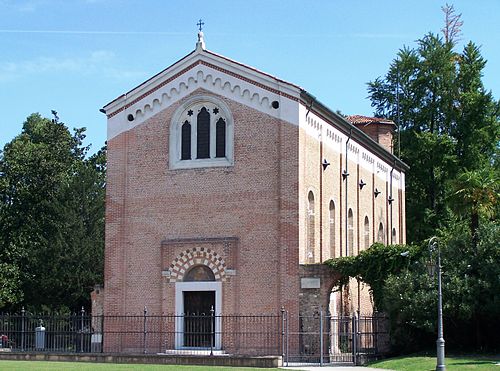
Photo: G.dallorto, Attribution · Wikimedia Commons
The Museo Correr is a museum in Venice, northern Italy. Located in St. Mark's Square, Venice, it is one of the 11 civic museums run by the Fondazione Musei Civici di Venezia. The museum extends along the southside of the square on the upper floors of the Procuratorie Nuove. With its rich and varied collections, the Museo Correr covers both the art and history of Venice.
The Museo Correr originated with the collection bequeathed to the city of Venice in 1830 by Teodoro Correr. A member of a traditional Venetian family, Correr was a meticulous and passionate collector, dedicating most of his life to the collection of both works of art and documents or individual objects that reflected the history of Venice. Upon his death, all this material was donated to the city, together with the family's Grand Canal palace which then housed it. The nobleman also left the city funds to be used in conserving and extending the collections and in making them available to the public.
The period when he was gathering his collections was a very particular one: the Republic of Venice had fallen in 1797 and for decades thereafter the city would be under French and Austrian rulers. Out of real necessity, many Venetian families were eager to sell off their valuable collections. Several collections ended up being bought by foreigners, but in the early decades of the 19th century there were still many pieces on the market. An insatiable collector, Correr, from his youth bought all sorts of objects and dedicated all his resources in putting together an incredible amount of material. Correr would reveal himself to have a sharp eye, putting together a collection that was undoubtedly very original. He was explicit about his intention that the collections should be made available to the public, and the museum was finally open in 1836.
Over the years, the contents of the museum would be catalogued and organized to provide scholars with a study facility and the general public with the opportunity to see the best from each individual collection. Subsequent bequests, donations and acquisitions would be added to the collection, ultimately leading to various pieces being housed on other venues.
Among the new pieces were the collections donated by several important Venetian families, such as the Molin, the Zoppetti, the Tironi, the Sagredo, and the Cicogna, and these included significant paintings, maiolica, glass pieces, and bronzes. In 1887, the enlarged collection was moved from Palazzo Correr to the nearby Fondaco dei Turchi, where it was laid out in a new display. However, in 1922, the Museo Correr was moved again to its present location in Piazza San Marco. …
The building that encloses the far end of the Piazza San Marco is known as the Napoleonic Wing. The design and early building works date from the period when Venice was part of the Kingdom of Italy (1806–1814), in which Napoleon was represented by the vice-regent Eugène de Beauharnais. The two long wings that run the length of the square are the Procuratie Vecchie and the Procuratie Nuove, which had housed the offices and residences of some of the main individuals of the Venetian Republic.
When the city came under Napoleonic rule, the French emperor and his court realized that public representation of imperial power posed certain logistical and political problems. Having rejected the Doge's Palace because of its complex past, these turned to the Procuratie Nuove, the former residence of the Procurators of Saint Mark, along the southern edge of the square. Designed in 1582 by Vincenzo Scamozzi, this structure itself had at the time been intended to complete the vast project for the reorganization of the Piazza San Marco, which had begun with Sansovino in the mid-16th century. From 1586 to 1596, works were complete on the ten arcades that extended beyond Sansovino's Library, and then, around 1640, the rest of the Procuratie Nuove was completed by Baldassarre Longhena. And this was the building which, by January 1807, Napoleon decreed should become the Imperial Palace.
All the interiors within the Procuratie Nuove were changed, with the re-decoration reflecting the taste for Neoclassicism, together with the Napoleonic Wing – which now stands opposite St. Mark's Basilica – which was designed by Giuseppe Soli and Lorenzo Santi and incorporated into the palace.
When Venice came under Austrian dominion in 1814, the palace served as a residence of the House of Habsburg, and Emperor Francis I would stay there in 1815.
In 1866, after Venice became part of unified Italy, the palace passed to the House of Savoy. In 1919, Victor Emmanuel III, king of Italy, handed it over to the State for use by the Ministry of Education. Hence, in 1920, part of the building was used to house the Museo Archeologico Nazionale, and then in 1922 another area became home to the Museo Correr. …
Text from Wikipedia, the free encyclopedia, under CC BY-SA 4.0. Full article: «Museo Correr».
Events and people from Wikidata (CC0).
Distances are as the crow flies, not walking or driving.



Museo Correr is in Venice, in the province of Venezia (Veneto), Italy. Address: Piazza San Marco 52, 30124 Venezia. GPS coordinates: 45.43393, 12.33713.
According to OpenStreetMap the opening hours are: 10:00-19:00; Nov-Mar 10:00-17:00. Always check the official website before your visit.
There is an admission charge. Up-to-date prices are on the official website.
According to OpenStreetMap data, the site is wheelchair accessible.
Wikidata dates it to 1836.
Nearby you’ll find: Museo Archeologico Nazionale, Venice (100 m away), Teatro San Gallo (100 m away), Fonteghetto della Farina (200 m away).
Text. Wikipedia, the free encyclopedia (CC BY-SA 4.0).
Data. Wikidata (CC0); opening hours and contacts OpenStreetMap (ODbL).
Photos. Wikimedia Commons, author and licence on every image.
Updated 28 October 2026. All sources and licences