



Photo: Simona Iacobbe, CC BY-SA 4.0 · Wikimedia Commons
At a glance
- Style
- Rationalism
- Architect
- Gio Ponti
- Commissioned by
- University of Padua
- Protection
- Italian national heritage
- Coordinates
- 45°24′29″ N, 11°52′17″ E
- Address
- Piazza Capitaniato, 7 - 35139 Padova PD
History and description
The Liviano Palace a.k.a. (Palazzo Liviano) is a building in Padua of the twentieth century, located in the capital of the old area of the city: it was built incorporating in its structure the remains of the Capitanio palace. Named in honor of the historian Livy, it now houses the School of Humanities, Social and Cultural Heritage and the Department of Cultural Heritage: Archeology, Art History, Film and Music of ' University of Padua and the Museum of Archaeological and Artistic Sciences. It is also connected with the Giants Room, an ancient frescoed structure that hosts concerts and conventions today.
It is currently in the western part of Piazza Capitaniato, an ancient courtyard of the Carrara Palace restored at the time of Venetian domination, when the seat of one of the two Venetian captains who ruled Padua was built.
History
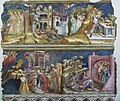
The palace was built on the initiative of Carlo Anti, rector of the University of Padua from 1932 to 1943, who in that period renovated many of the university buildings by inviting some of the major national artists to Padua. Structure of the metaphysical style, Liviano was built by the architect Gio Ponti in Milan, who also worked on various details of interior decoration. The fresco made in the atrium by Massimo Campigli between 1937 and 1940 depicts archeology, a heritage of Italian culture. In 2009 the frescoes of the palace had been restored. The sculpture of the atrium depicting Livy, chined and thoughtful, was made by Arturo Martini in 1942.
In 1937, the Museum of Archaeological and Artistic Sciences was built on the third floor of the palace, which still preserves important sculptural evidence of antiquity and Renaissance. The archaeological finds dating back to the Etruscans, the Greeks and the Romans are prominent. There are also anti-aircraft shelters in Liviano's underground, which have never been used.
The palace is directly linked to the famous Giant's Hall, where conventions and concerts are currently held. This salon, which is accessed via a staircase next to the current Liviano Palace, has its name for its frescoes that represent heroes and great characters of antiquity in size. The theme of the frescoes, which dates back to the early '500, resembles that of previous frescoes decorating a room now lost in the ancient Carrara Palace. The original frescoes were inspired by a work by Petrarch, then guest of the Padua lords.
Text from Wikipedia, the free encyclopedia, under CC BY-SA 4.0. Full article: «Palazzo Liviano».
People
Events and people from Wikidata (CC0).
Photos
Getting there
PadovaTrain, nearest
1.3 km as the crow flies
Palazzo LivianoPiazza Capitaniato, 7 - 35139 Padova PD
Aeroporto di Treviso-Sant'Angelo36.7 km
Distances are as the crow flies, not walking or driving.
Loading map…
Nearby
See on the mapMore historic villas and palaces in Veneto

- Free 1st Sunday


- UNESCO

- UNESCO
- Free 1st Sunday

- UNESCO
Frequently asked questions
Where is Palazzo Liviano?
Palazzo Liviano is in Padua, in the province of Padova (Veneto), Italy. Address: Piazza Capitaniato, 7 - 35139 Padova PD. GPS coordinates: 45.40798, 11.87128.
What else is there to see near Palazzo Liviano?
Nearby you’ll find: Museo di Scienze Archeologiche e d'Arte (0 m away), Reggia Carrarese (100 m away), Palazzo del Monte di Pietà Nuovo (100 m away).
Sources and licences
Text. Wikipedia, the free encyclopedia (CC BY-SA 4.0).
Data. Wikidata (CC0); opening hours and contacts OpenStreetMap (ODbL).
Photos. Wikimedia Commons, author and licence on every image.
Credits for the 9 photos
- Ingresso Palazzo Liviano — Simona Iacobbe, CC BY-SA 4.0
- Entrata Palazzo Liviano — Piergiorgiof, CC BY-SA 4.0
- Interno di Palazzo Liviano - scala di Gio Ponti — Simona Iacobbe, CC BY-SA 4.0
- Interno di Palazzo Liviano — Simona Iacobbe, CC BY-SA 4.0
- Padova - Palazzo Liviano - 202209301804 2 — Francysss, CC BY-SA 4.0
- Padova - Palazzo Liviano - 202209301804 — Francysss, CC BY-SA 4.0
- Padova - Palazzo Liviano - 2023-09-14 21-24-36 001 — Fabior04, CC BY-SA 4.0
- Scultura di Arturo Martini raffigurante Tito Livio — Simona Iacobbe, CC BY-SA 4.0
- University dress code 2 — LeoMaPa, CC BY-SA 4.0
Updated 28 October 2026. All sources and licences