




- UNESCO
Photo: Claudio Gioseffi, CC BY-SA 4.0 · Wikimedia Commons
Abbey / Monastery
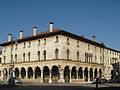
Church building in Vicenza, Italy
The church and monastery of San Pietro, which gave its name to the district of the same name in the city of Vicenza, were the main administrative center of the abbey of San Pietro until 1810. This was the oldest and most important Benedictine convent in the Vicenza area. The church became a parish church, while the former monastery is now a care home for the elderly.
The foundation of the church of San Pietro is very ancient. Finds have been made there (fragments of a sarcophagus, parts of foundations) dating from the 7th to the 9th century but, although various interpretations have been given over the years, none of them can, due to their characteristics and location, indicate precisely when the church was built.
It has also been hypothesized that the name of the church's patron, St. Peter, could indicate the moment of opposition by the Roman Catholic Church to the occupation of the Arian Lombards, or the period of their conversion to Catholicism, but these are also suppositions.
Accepting the interpretation given by Domenico Bortolan, which is based on an inscription preserved in the church next to the altar of Our Lady of Sorrows, the Vicenza historian Giovanni Mantese states that the monastery could have been founded in the year 827, which doesn't exclude the possibility that the church already existed.
Taking into account what is known about rural churches from the first millennium - such as those of San Michele in Caldogno, Santa Maria in Favrega and San Zeno in Costabissara, San Martino near Ponte del Marchese and San Giorgio in Gogna in Vicenza - it can be assumed that the early church was a small, extremely simple rectangular building with no significant architectural elements, and a single apse.
This first monastery, probably Benedictine and for men only, had a difficult existence; almost certainly - like the other one of Saints Felix and Fortunatus - it suffered the raids of the Hungarians at the end of the 9th and beginning of the 10th centuries, and was perhaps destroyed. In any case it was on the point of ruin when, in 977, the privilege of bishop Rodolfo defined it as “almost annihilated and devoid of any monastic cult and divine office”. A privilege granted by bishop Astolfo in 1033 and a diploma of protection from emperor Henry the Lion in 1055 proved to be of little use.
There are different opinions about when it became a convent. According to Mantese it was already a convent in the first half of the 11th century, according to others it became one a few decades later. …
The church is preceded by a large parvise which is accessed via a stairway with ramps on two sides; from the parvise four steps lead to the simple portal, rebuilt in the early 19th century by Bartolomeo Malacarne, at the time of the renovation of the monastery.
Raised above the level of the square in the 15th century, later than its foundation, the church is in late Gothic style but has a classical façade, built in 1597 by Camillo Mariani, the Albanese family or Domenico Groppino.
Four Corinthian lesenes divide the smooth, simple façade, where the space between the columns is interrupted by two vertical windows; the size of the windows, the door and the columns create the harmonious balance of the façade.
Above, the façade is surmounted by a tympanum, where a bas-relief with the papal coat of arms of the keys of St. Peter stands out, flanked by two allegorical figures representing the theological virtues of Hope and Faith. The tympanum is crowned by three statues: St. Peter on top with St. Paul (on the left) and St. Andrew (on the right) on either side. All the sculptures can be attributed to the Vicenza period of Camillo Mariani.
To the right of the entrance an ancient Gothic tombstone commemorates the burial place of Elica, founder of the original monastery.
The interior has a rectangular plan, with three truncated naves separated by two rows of four limestone columns with capitals decorated with angular volutes and acanthus leaves, supporting very wide semicircular arches.
The recently restored 19th-century painting above the central nave, St. Peter in Glory Among Angels, is the work of Lorenzo Giacomelli. The four altars in the naves are the work of the Albanese workshop, as is the main altar in the apse. While the Albanese family left important architectural and sculptural works, the Maganza family filled St. Peter's with their paintings and had the family tomb in the church, as commemorated by a plaque in the left aisle.
Counter-façade …
Text from Wikipedia, the free encyclopedia, under CC BY-SA 4.0. Full article: «San Pietro».
Distances are as the crow flies, not walking or driving.


San Pietro is in Vicenza, in the province of Vicenza (Veneto), Italy. GPS coordinates: 45.54904, 11.55295.
Nearby you’ll find: Palazzo Regaù (100 m away), Ponte degli Angeli (200 m away), Palazzo Angaran (200 m away).
Text. Wikipedia, the free encyclopedia (CC BY-SA 4.0).
Data. Wikidata (CC0); opening hours and contacts OpenStreetMap (ODbL).
Photos. Wikimedia Commons, author and licence on every image.
Updated 28 October 2026. All sources and licences