




- UNESCO
Photo: Andreas Tille, CC BY-SA 4.0 · Wikimedia Commons
Abbey / Monastery
Building in Verona, Italy
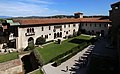
The Abbey of San Zeno was erected in the 9th century on the remains of a preexisting monastery, whose origins date back to the 4th century. Of the abbey, the abbey tower of San Zeno and several cloisters that are now part of the Basilica of San Zeno survive. It was very important both for the history of Verona and for the relations the German emperors had with Italy.
Historians have ascertained the presence of an early Christian sacellum from the 4th century in the cloisters, now called the sacellum of St. Benedict, however, the construction of the abbey proper was given impetus in the 9th century in the Carolingian era and developed at the behest of the Veronese archdeacon Pacifico, Bishop Rotaldo and the Frankish king Pepin, son of Charlemagne. According to images from the period and recent findings, there was a second tower located to the northeast and the Abbot's palace, adjacent to the abbey tower.
There are no sources to trace the foundation of the monastery of St. Zeno in Verona, but it has been speculated that its origin may date as far back as the fourth century, when the saint himself was alive. According to what is recounted in the "Chronicle" of the Veronese notary Coronato, upon the death of St. Zeno (371), an initial church was erected on the site of his tomb, from which the present basilica later developed. According to reports by Giovanni Battista Biancolini beginning in 750 the complex served as an episcopal see for the diocese of Verona until 804, when church and monastery were destroyed "ab infidelibus hominibus," perhaps Huns or Avars but more likely Frankish insubordinates or Arian survivors.
Two years later, King Pepin of Italy and Bishop Ratoldo decided that a new, larger and more worthy building should be built on the site to house the saint's remains. According to what can be read on an inscription placed inside the Verona cathedral, this building was to be overseen, at least in part, by the Archdeacon Pacifico. In the Codice Diplomatico Veronese it is stated that it was Charlemagne himself who confirmed the work. The monastery of San Zeno had in its possession: the monastery of S. Pietro di Mauriatica, the churches of S. Lorenzo di Ostiglia and SS. Firmus and Rusticus. …
The Benedictine monastery of San Zeno was already richly endowed in the ninth century, but in the following century it greatly increased its holdings and proceeded on most of them to encastellation. A privilege of Emperor Henry II the Holy in 1014 allows one to know the exact extent of the territories over which the abbey had jurisdiction at that time: the villages of Ostiglia and Villimpenta with adjacent woods, the castles of Moratica (today in the municipality of Sorgà), Erbé, Trevenzuolo, Vigasio and Romagnano, plus several scattered properties, even substantial ones, such as in Bardolino. Two other diplomas of the same century also confirmed the properties of the castles of Montecchio di Fumane, Pastrengo, Capavo (in the municipality of Negrar) and "Isola Nonense." Around the basilica, moreover, came to form over time the settlement of the same name over which Emperor Henry IV, in 1084, gave full jurisdiction to the monastery; the territory was much larger than just the village but extended from the (destroyed) church of San Martino Acquario, on which Castelvecchio would later be built, to Chievo.
Less prosperous was the 13th century, when a deep crisis hit the monastery, from which it managed to emerge owing to the interventions of the princes of Verona, the Della Scala family, and the abbot Giuseppe della Scala, who undertook to reconstitute the patrimony and reorganize the administration of the estates. In spite of this, towards the end of the 14th century, when the Della Scala seigniory came to an end, the lands subject to the abbey were now a small part compared to those of the communal age. In the fifteenth century the situation did not change substantially, however San Zeno still managed to hold jurisdiction over Erbé, Roncolevà, Trevenzuolo, Moratica, Pigozzo, Romagnano and Cellore, though from this century on the jurisdictions, better known as vicariates, no longer allowed the abbot to possess a political, administrative and military role, as had been the case in previous centuries, instead remaining simply a source of income, limited by the Venetian government and the interference of the municipality of Verona. …
The present church, built on the site where at least five other religious buildings had previously stood, maintains its medieval origin substantially unaltered, representing an example of Veronese Romanesque architecture. The interior has a basilica plan with the hall divided into three naves by two rows of mighty pillars with a cruciform section alternating with columns. The ceiling is wooden in the shape of a ship's hull with refined decorations and was made between 1385 and 1389. Originally the interior walls were to be entirely covered with frescoes, of which only portions remain today. Critics mostly tend to attribute them to a first and a second "master of San Zeno", actually two groups of fresco painters working in the city in the second quarter and second half of the 14th century, respectively. The painters Martino da Verona and Altichiero da Zevio, or at least pupils of their school, have been proposed as the authors of additional frescoes. On the right aisle is an altarpiece by Francesco Torbido.
The chancel is located at a higher level than the nave and is accessed by two stairways that pass a rood screen decorated with statues. Behind the high altar, made by reusing the sarcophagus of Saints Lupicino, Lucillus, and Crescentianus, is the altarpiece of St. Zeno by the Mantuan painter Andrea Mantegna. In the small left apse there is, on the other hand, a statue of St. Zeno laughing, dated around the 13th century, which has aroused interest among critics because of its original depiction of the subject. Below the chancel, at the lowest level of the entire building, there is a large crypt whose ceiling consists of 54 rib vaults supported by arches resting on 49 columns. …
Text from Wikipedia, the free encyclopedia, under CC BY-SA 4.0. Full article: «Abbazia di San Zeno (Verona, Italy)».
Distances are as the crow flies, not walking or driving.


Abbazia di San Zeno (Verona, Italy) is in Verona, in the province of Verona (Veneto), Italy. GPS coordinates: 45.44310, 10.97920.
According to OpenStreetMap the opening hours are: Every day: 9:00–18:30. Always check the official website before your visit.
Nearby you’ll find: Torre abbaziale di San Zeno (100 m away), Mezzo bastione della Catena Superiore (300 m away), Torre Catena (300 m away).
Text. Wikipedia, the free encyclopedia (CC BY-SA 4.0).
Data. Wikidata (CC0); opening hours and contacts OpenStreetMap (ODbL).
Photos. Wikimedia Commons, author and licence on every image.
Updated 28 October 2026. All sources and licences