


Photo: Hans A. Rosbach, CC BY-SA 3.0 · Wikimedia Commons
Historic villa / palace
Palazzo Schio
Palace in Vicenza, Italy
- Within the UNESCO World Heritage Site “City of Vicenza and the Palladian Villas of the Veneto”
At a glance
- Style
- Renaissance architecture
- Architect
- Andrea Palladio
- Coordinates
- 45°33′06″ N, 11°32′37″ E
- Address
- Contra' San Marco, 36100 Vicenza
History and description
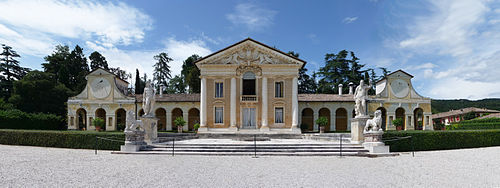
Palazzo Schio (also known as Palazzo Schio Vaccari Lioy Angaran) is a patrician palace of the 16th century in Vicenza, northern Italy, whose facade was designed by the Italian Renaissance architect Andrea Palladio in 1565.
History
In 1565, Palladio designed for Bernardo Schio the facade of his house in Vicenza, in the neighbourhood of the Ponte Pusterla. Since Palladio was occupied in these years with a series of Venetian projects which required his almost permanent presence in the capital of the Venetian Republic, his supervision of the building works on the Palazzo Schio became so distracted that the master-mason charged with its execution interrupted works for want of any clear instructions.
After Bernardo's death, his widow showed no interest in concluding the works, which were only completed by Bernardo's brother Fabrizio in 1574–75, after the stones and other construction materials had long lain piled up in the villa's courtyard.
After the Schio house, the building was acquired by other noble houses of Vicenza: Vaccari, then Lioy, and later Angaran.
Description
The representative facade of the building along the street is relatively narrow. For the piano nobile, Palladio opts for its division into three arches of equal width, divided by four half-columns with Corinthian capitals, free at three-quarters of the wall height and whose base is integrated with the hanging of the socket.
The spaces between the columns are occupied by three windows with an overhanging balcony, each surmounted by a triangular pediment in strong projection. Intended to illuminate the barn, three windows cut into the frame architrave, and closed in 1825, occupied the upper end. The facade is also animated by a play of light and shadow, through articulation in several layers of depth obtained by the use of columns, molding and balcony windows and gables. The socket base is coated with a rustication. The architect breaks the relative monotony of the bosses texture with the arch of the entrance lobby, and especially with the trapezoidal grounds that surround the two side openings below.
Text from Wikipedia, the free encyclopedia, under CC BY-SA 4.0. Full article: «Palazzo Schio».
People
Events and people from Wikidata (CC0).
Photos
Getting there
VicenzaTrain, nearest
1.2 km as the crow flies
Palazzo SchioContra' San Marco, 36100 Vicenza
Distances are as the crow flies, not walking or driving.
Loading map…
Nearby
See on the mapMore historic villas and palaces in Veneto

- Free 1st Sunday


- UNESCO

- UNESCO
- Free 1st Sunday
- UNESCO
Frequently asked questions
Where is Palazzo Schio?
Palazzo Schio is in Vicenza, in the province of Vicenza (Veneto), Italy. Address: Contra' San Marco, 36100 Vicenza. GPS coordinates: 45.55169, 11.54352.
What else is there to see near Palazzo Schio?
Nearby you’ll find: Palazzo Franceschini Folco (0 m away), Complesso di San Biagio (200 m away), Palazzo Porto (300 m away).
Sources and licences
Text. Wikipedia, the free encyclopedia (CC BY-SA 4.0).
Data. Wikidata (CC0); opening hours and contacts OpenStreetMap (ODbL).
Photos. Wikimedia Commons, author and licence on every image.
Credits for the 8 photos
- Palazzo Schio 20081203-1 — Hans A. Rosbach, CC BY-SA 3.0
- Palazzo Schio 20081203-2 — Hans A. Rosbach, CC BY-SA 3.0
- Palazzo Schio Vicenza corte by Marcok 2009-08-14 n01 — Marcok / it.wikipedia, CC BY-SA 3.0
- Palazzo Schio Vicenza facciata Palladio by Marcok 2009-08-14 n01 — Marcok / it.wikipedia, CC BY-SA 3.0
- Palazzo Schio Vicenza facciata Palladio by Marcok 2009-08-14 n02 rect — Marcok / it.wikipedia, CC BY-SA 3.0
- Palazzo Schio Vicenza facciata Palladio by Marcok 2009-08-14 n03 rect — Marcok / it.wikipedia, CC BY-SA 3.0
- Vicenza Palazzo Schio-10 — Claudio Gioseffi, CC BY-SA 3.0
- VicenzaPalazzoSchioBalaustra — MM, CC BY-SA 3.0
Updated 28 October 2026. All sources and licences