


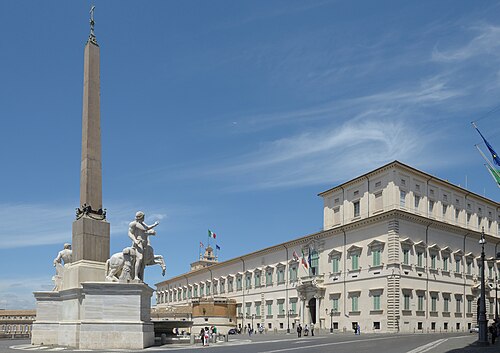
Photo: Laterbat, CC BY-SA 4.0 · Wikimedia Commons
Historic villa / palace
Villa Medici
Historic house in Rome, Italy
- Within the UNESCO World Heritage Site “Historic Centre of Rome, the Properties of the Holy See in that City Enjoying Extraterritorial Rights and San Paolo Fuori le Mura”
At a glance
- Style
- Renaissance architecture
- Architects
- Bartolomeo Ammannati, Nanni di Baccio Bigio, Annibale Lippi
- Commissioned by
- Giovanni Ricci
- Coordinates
- 41°54′30″ N, 12°28′57″ E
- Address
- Viale della Trinità dei Monti, 1
History and description
The Villa Medici is a sixteenth-century Italian Mannerist villa and an architectural complex with 7-hectare Italian garden, contiguous with the more extensive Borghese gardens, on the Pincian Hill next to Trinità dei Monti in the historic centre of Rome, Italy.
The Villa Medici, founded by Ferdinando I de' Medici, Grand Duke of Tuscany and now property of the French State, has housed the French Academy in Rome and has welcomed winners of the Prix de Rome since 1803, to promote and represent artistic creation in all its fields, an instance being the musical evocation of its garden fountains features in Ottorino Respighi's Fountains of Rome.
The Villa Medici lies within the historic district of Rome, inside the perimeter walls built by Emperor Aurelian in the third century, and the Gianicolense walls built by Pope Urban VIII in 1643, which was declared a World Heritage Site by the United Nations Educational, Scientific and Cultural Organization (UNESCO) in 1980, though it is not specifically identified amongst the mostly Roman-era monuments of that listing, and it is not part of the UNESCO World Heritage Site the "Medici Villas and Gardens in Tuscany," ascribed in 2013.
History
In ancient times, the site of the Villa Medici was part of the gardens of Lucullus, which passed into the hands of the Imperial family with Messalina, who was murdered in the villa.
In 1564, when the nephews of Cardinal Giovanni Ricci of Montepulciano acquired the property, it had long been abandoned to viticulture. The sole dwelling was the Casina of Cardinale Marcello Crescenzi, who had maintained a vineyard here and had begun improvements to the villa under the direction of the Florentine Nanni Lippi, who had died however before work had proceeded far. The new proprietors commissioned Annibale Lippi, the late architect's son, to continue work, with involvement of Michelangelo that is traditional lore, but undocumented.
In 1576, the property was acquired by Cardinal Ferdinando de' Medici, who finished the structure to designs by Bartolomeo Ammanati. The Villa Medici became the first among Medici properties in Rome, intended to give concrete expression to the ascendancy of the Medici among Italian princes and assert their permanent presence in Rome. Under the Cardinal's insistence, Ammanati incorporated into the design Roman bas-reliefs and statues that were coming to sight with almost every spadeful of earth, with the result that the facades of the Villa Medici, as it now was, became a virtual open-air museum. A series of grand gardens recalled the botanical gardens created at Pisa and at Florence by the Cardinal's father Cosimo I de' Medici, sheltered in plantations of pines, cypresses and oaks. Ferdinando de' Medici had a studiolo, a retreat for study and contemplation, built to the north east of the garden above the Aurelian wall. Now, these rooms look onto Borghese Gardens but would then have had views over the Roman countryside. These two rooms were only uncovered in 1985 by the restorer Geraldine Albers: the concealing whitewash had protected and conserved the superb fresco decoration carried out by Jacopo Zucchi in 1576 and 1577. …
French Academy in Rome
In 1803, Napoleon Bonaparte moved the French Academy in Rome to the Villa Medici to preserve an institution once threatened by the French Revolution. At first, the villa and its gardens were sad, and they had to be renovated to house the winners of the Prix de Rome. In this way, he hoped to retain for young French artists the opportunity to see and copy the masterpieces of antiquity and the Renaissance.
The young architect Auguste-Henri-Victor Grandjean de Montigny undertook the renovation.
The competition was interrupted during the First World War, and Benito Mussolini confiscated the villa in 1941, forcing the Academy of France in Rome to withdraw until 1945. Between 1961 and 1967, the artist Balthus, then at the head of the Academy, carried out a vast restoration campaign of the palace and its gardens, providing them with modern equipment. Balthus participated “hands-on” in all the phases of the construction. Where the historic décor had disappeared, Balthus proposed personal alternatives. He invented a décor that was a homage to the past and, at the same time, radically contemporary.
The competition and the Prix de Rome were abolished in 1968 by André Malraux, the French Minister of Culture. The Académie des Beaux-Arts in Paris and the Institut de France then lost their guardianship of the Villa Medici to the Ministry of Culture and the French State. From that time on, pensionnaires (residencies) were no longer restricted to artists practicing the traditional disciplines (painting, sculpture, architecture, metal engraving, precious-stone engraving, musical composition, etc.) but included to new or previously neglected artistic fields (art history, archaeology, literature, stagecraft, photography, movies, video, art restoration, writing and even cooking.) Artists are no longer recruited by a competition but by application, and their stays generally vary from six to eighteen months.
The mysterious melancholic decor Balthus created for Villa Medici has become, in turn, historic and was undergoing a critical restoration campaign in 2016. Work continued under the direction of the previous director, Richard Peduzzi, and the Villa Medici resumed organizing exhibitions and shows created by its artists in residence. …
Architectural influence
Several structures base their style on the villa. Architect Edward Lippincott Tilton designed the Hotel Colorado in Glenwood Springs, Colorado in 1893. Philanthropist James H. Dooley had a mansion called Swannanoa built on Rockfish Gap, Virginia in 1912. The NYC architectural firm Schultze and Weaver modeled the Breakers Hotel in Palm Beach, Florida after the Villa for the hotel's second reconstruction, which took place between 1925 and 1926.
The marble Medici lions by the stairs to the courtyard inspired Bernard Foucquet's bronze lions at the Lejonbacken (lion slope) on the northern side of the Royal Palace in Stockholm from 1700 to 1704.
Text from Wikipedia, the free encyclopedia, under CC BY-SA 4.0. Full article: «Villa Medici».
People
Events and people from Wikidata (CC0).
Photos
Getting there
FlaminioTrain, nearest
700 m as the crow flies
Villa MediciViale della Trinità dei Monti, 1
Aeroporto di Roma-Ciampino15.2 km
Distances are as the crow flies, not walking or driving.
Loading map…
Nearby
See on the mapMore historic villas and palaces in Lazio

- Free 1st Sunday


Frequently asked questions
Where is Villa Medici?
Villa Medici is in Rome, in the province of Roma (Lazio), Italy. Address: Viale della Trinità dei Monti, 1. GPS coordinates: 41.90827, 12.48252.
What are the opening hours of Villa Medici?
According to OpenStreetMap the opening hours are: Tuesday to Sunday: 9:30–17:30. Always check the official website before your visit.
What else is there to see near Villa Medici?
Nearby you’ll find: Trinità dei Monti (200 m away), Keats-Shelley Memorial House (300 m away), Palazzo Boncompagni Cerasi (300 m away).
Sources and licences
Text. Wikipedia, the free encyclopedia (CC BY-SA 4.0).
Data. Wikidata (CC0); opening hours and contacts OpenStreetMap (ODbL).
Photos. Wikimedia Commons, author and licence on every image.
Credits for the 9 photos
- Roma - Villa Medici - 2023-09-10 18-13-14 006 — Laterbat, CC BY-SA 4.0
- André Caplet au piano à la Villa Médicis en 1901 - btv1b10024942m (1 of 2) — Public domain
- Campo Marzio - Pincio Villa Medici 1000481 — Lalupa, CC BY-SA 3.0
- Campo Marzio - villa Medici memoria della prigione di Galilei 1160817 — Lalupa, CC BY-SA 4.0
- Florent Schmitt dans les jardins de la Villa Médicis - btv1b10024940q (1 of 2) — Caplet, André (1878-1925). Photographe, Public domain
- Roma - Villa Medici - 2023-09-10 18-13-14 001 — Laterbat, CC BY-SA 4.0
- Roma - Villa Medici - 2026-09-30 23-20-35 001 — Enrica_Ridolfi, CC BY-SA 4.0
- Roma - Villa Medici - 2026-09-30 23-32-12 001 — Enrica_Ridolfi, CC BY-SA 4.0
- Roma - Villa Medici 20231230-01 — Pymouss, CC BY-SA 4.0
Updated 28 October 2026. All sources and licences