




- UNESCO
- Free 1st Sunday
Photo: user:Lalupa, Public domain · Wikimedia Commons
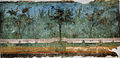
Veii (also Veius; Italian: Veio) was an important ancient Etruscan city situated on the southern limits of Etruria and 16 km (9.9 mi) north-northwest of Rome, Italy. It now lies in Isola Farnese, in the comune of Rome. Many other sites associated with and in the city-state of Veii are in Formello, immediately to the north. Formello is named after the drainage channels that were first created by the Veians.
Veii was the richest city of the Etruscan League. It was alternately at war and in alliance with the Roman Kingdom and later Republic for over 300 years. It eventually fell in the Battle of Veii to Roman general Camillus's army in 396 BC. Veii continued to be occupied after its capture by the Romans.
The site is now a protected area, part of the Parco di Veio established by the regional authority of Lazio in 1997.
The city of Veii lies mainly on a tuff plateau 190 hectares (470 acres) in area.
The Valchetta flows a few miles eastward to join the Tiber River on the south side of Labaro along the Via Flaminia and Veii's territory included this area.
Its proximity to the Tiber and the trade route to the interior, which became the Via Flaminia, augmented its prosperity. The Veiians were known to trade with the Greeks and Phoenicians. Many Grecian pottery shards have been found throughout the site, dating from as far back as the 8th century BC. Although the river brought wealth and affluence to Veii, it also placed it in competition with Rome for the domination of Latium.
The temple of Juno was the greatest and most honoured in the city.
The largest visible monument is the sanctuary of Minerva from the 7th c. BC, situated along an important route just outside the city (at modern Portonaccio). Prior to their influx of wealth around the 7th century BC, the people of Veii preferred to worship their gods and goddesses in the open air. Early "temples" consisted of small shrines surrounded by foliage. Due to their affinity to the stars, many Veiians preferred to worship under the night sky. Once the city began to prosper, an official temple was built of wood and stone. The sanctuary was one of the oldest and most revered in Etruria, standing out for its sumptuous polychrome terracotta decorations, many of which can be seen today in the Villa Giulia. The sanctuary included the temple of Apollo of about 510 BC to which belonged the Apollo of Veii (now in the National Etruscan Museum).
The impressive thermal baths and the forum built under Augustus have been partially excavated in recent years.
Many rich Tumuli and chamber tombs have been found. The most famous is the Grotta Campana uncovered in 1843, a chamber tomb with the oldest known Etruscan frescoes.
There are also long tunnels leading into the plateau of the city, which may corroborate Livy's account of the Roman victory in the Battle of Veii.
The walls of Veii, of which small sections remain, bordered the two intersecting streams using the streambeds as a ditch, with a wall across the plateau closing the triangle. …
The earliest evidence of occupation by demographic analysis, including that of the cemeteries, dates from the 10th century BC in the Late Bronze Age. Small settlements were scattered over a wider area than the plateau, and the population of the plateau at Veii is estimated to have been stable at about 1,000. In the 9th century BC, the Early Iron Age (Villanovan culture), the finds are localized to the plateau but appear to be associated with independent settlements, each with its own cemetery. Occupation gradually intensified in the 8th (remainder of Villanovan) and 7th (Orientalising period) centuries BC, by conurbation of the settlements as the site assumed an urban appearance with city blocks in a grid pattern arranged around a central square containing a water cistern. That evidence suggests that the city of Veii was shaped into its classical form in the 7th century BC by a population, presumably Etruscan, first settling there in the 10th century BC. During the settlement's early years, many homes were built in spherical shapes out of wood over a shallow trench and topped with a thatched roof. Up until the 7th century BC Veii had to depend on itself for the majority of its resources and goods. Many artisans found work in the textile industry, creating intricate wool designs for clothes and blankets. Further supporting their self-sufficiency, many yarn spools and loom weights have been discovered in the area.
The population of the early Veii practiced both inhumation and cremation within the same family. The proportion was 50% in the 9th century BC, after a predomination of cremation (90%) earlier. In the 8th century, inhumation rose to 70%, which may be attributable to an influence from Latium, where inhumation prevailed in the 9th century BC.
During the 9th and 8th centuries BC, the population density and grave goods were on the increase: more and wealthier people and also more of a disparity in wealth: the rise of a wealthier class. In the 8th century BC, both the potter's wheel and writing were introduced from Greece. During the entire period, the settlements translocated around the plateau; however, a settlement (Casale del Fosso) maintained a cemetery to the north of the plateau continuously from the late 9th century BC to the early 6th century BC. …
Text from Wikipedia, the free encyclopedia, under CC BY-SA 4.0. Full article: «Veii».
Distances are as the crow flies, not walking or driving.


Veii is in Rome, in the province of Roma (Lazio), Italy. GPS coordinates: 42.02389, 12.40139.
Nearby you’ll find: Castello di Isola Farnese (900 m away), Portonaccio (1 km away), Villa Incisa (3.5 km away).
Text. Wikipedia, the free encyclopedia (CC BY-SA 4.0).
Data. Wikidata (CC0); opening hours and contacts OpenStreetMap (ODbL).
Photos. Wikimedia Commons, author and licence on every image.
Updated 28 October 2026. All sources and licences