

- UNESCO
- Free 1st Sunday
Photo: Unknown author Unknown author, Public domain · Wikimedia Commons
Archaeological site
Building in Prima Porta, Italy
The Villa of Livia (Latin: Villa ad Gallinas Albas, lit. 'House of the White Hens') is an ancient Roman villa at Prima Porta, 12 kilometres (7.5 mi) north of Rome, Italy, along the Via Flaminia.
The Villa of Livia may have been part of Livia Drusilla's dowry that she brought when she married Octavian (later called the emperor Augustus), her second husband, in 39 BC. Some scholars believe that Livia may have received the site from her first husband, Tiberius Claudius Nero. However, most likely, it may also have been a gift given to her by Octavian upon their betrothal.
The ancient sources (e.g. Suetonius) tell us that Livia returned to this villa following the marriage. It was her sumptuous country residence complementing her house on the Palatine Hill in Rome. Livia was the main commissioner of the land and the original owner.
The villa occupied the height dominating the view down the Tiber Valley to Rome. Some of the walling that retained the villa's terraces can still be seen. Originally built on a twenty meter plateau fourteen kilometers north of Rome, the villa had views of Rome, the Tiber Valley, and the Apennine mountain rages.
The location was strategically important due to the iron-rich cliffs of red tuff that approach the river Tiber at this point, the confluence of several roads, and the northern entrance to Rome. The name Prima Porta ("First Door") came from an arch of the aqueduct over the Via Flaminia, which brought water to the villa and which travelers saw as the first indication of having reached Rome.
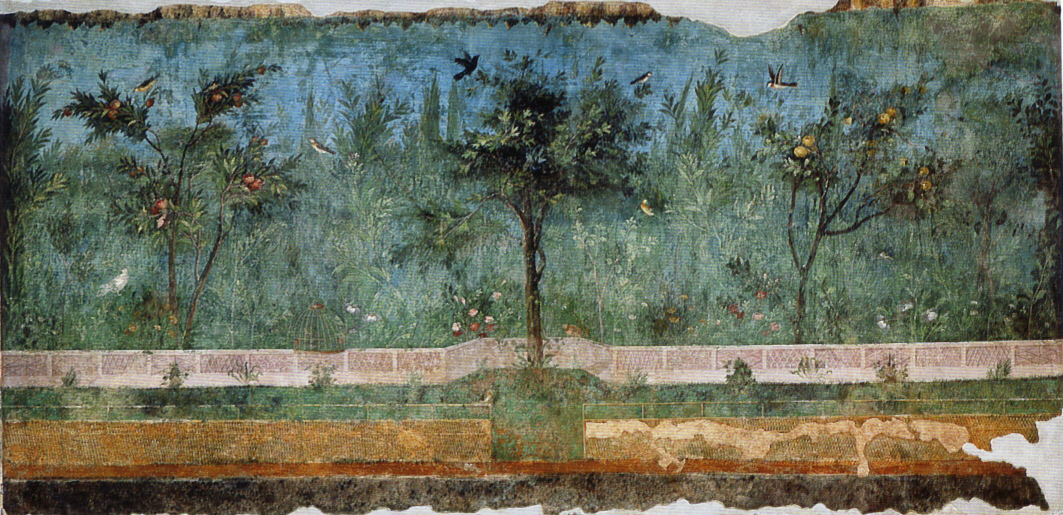
Remarkable frescoes of garden views were found which have since been removed to the Palazzo Massimo museum in Rome.
The villa was built and modified in nine phases, from the late republican age to the 6th century AD. After Livia, it remained an imperial residence.
Its Latin name, Villa Ad Gallinas Albas, referred to its breed of white chickens, which was said by Suetonius to have auspiciously omened origins. The area acclaimed the name Ad Gallinas Albas because of the legend of white fowl carrying a laural branch in it beak that fell from the talons of an eagle and onto Livia Drusilla's lap, later to be Augustus's wife. It is said that the emperor kept the fowl and its offsprings, and planted the laurel which grew wreaths that crowned him in his triumphs.
Excavation from 2002 led to the discovery of the front of the platform structure (basis villae) crowned by a windowed portico (porticus fenestrata) and the
rooms between this and the southern portico of a peristyle. An Augustan period peristyle was discovered in the central area. In the Flavian period a natatio (swimming pool) was added in the garden of the peristyle and connected to the new baths. A mosaic featuring a marine thiasos was added later to the pool.
The upper terrace had a three sided portico with a belvedere over the Tiber valley.
The site was rediscovered and explored as early as 1596, but it was not recognized as the Villa of Livia until the 19th century. In 1863–1864, a marble krater carved in refined low relief was discovered at the site. On 20 April 1863, the famous heroic marble statue of Augustus, the Augustus of Prima Porta, was found at the villa; it is now in the Vatican Museums (Braccio Nuovo). The magisterial Augustus is a marble copy of a bronze statue that celebrated the return in 20 BC of the military standards captured by the Parthians in 53 BC after the defeat of Crassus at Carrhae.
In the 19th century, the villa belonged to the Convent of Santa Maria in Via Lata. The villa and gardens have been excavated and can be visited. There are three vaulted subterranean rooms, the largest of which contained superb illusionistic frescoes of garden views in which all the plants and trees flower and fruit at once. These have since been removed to Rome, where, following cleaning and restoration, they have been reinstalled in the Palazzo Massimo. The vault above the fresco was covered with stucco reliefs, some of which survive.
A new series of more meticulous modern excavations was initiated in 1970. More modern scientific work began at the site in 1995, carried out by the Soprintendenza Archeologica di Roma and directed by Professor Gaetano Messineo, in tandem with the Swedish Institute in Rome.
The Villa of Livia is most famously known for its fresco room. This so-called "garden room" was once the adorned semi-underground room located at the imperial estate of emperor Augustus, who ruled during the Roman Empire, and his wife Livia. The room exhibits floor-to-ceiling frescoes of a garden that fades into the distance.
Once accessed through a dark five meter long hallway obstructing a visitor's vision as they adjust to the darkness and then the light again as they enter the room, visitors are transported to a garden paradise. This is believed to have created a space of relaxation and fun during the summer months as an escape from the heat outdoors, providing a greater feeling of refreshment. The room could have also retained heat in the winter months providing multifunctionality throughout the year.
There are many conflicting beliefs concerning what the garden room was used for, however, it is most commonly believed that the space served as a triclinium, where guest were entertained, meals were served, and people could lie down on beds and cushions around a low central table. …
Text from Wikipedia, the free encyclopedia, under CC BY-SA 4.0. Full article: «Villa of Livia».
Distances are as the crow flies, not walking or driving.


Villa of Livia is in Rome, in the province of Roma (Lazio), Italy. Address: via Villa di Livia, 125 - Roma. GPS coordinates: 42.00208, 12.49362.
According to OpenStreetMap the opening hours are: Monday to Friday: 10:00–13:00; Sunday: 10:00–12:00, 14:00–16:00. Always check the official website before your visit.
Yes: entry is free on the first Sunday of every month, under the Italian “Domenica al museo” scheme.
Nearby you’ll find: La Celsa (800 m away), GranTeatro (3 km away), Castello di Torcrescenza (4.2 km away).
Text. Wikipedia, the free encyclopedia (CC BY-SA 4.0).
Data. Wikidata (CC0); opening hours and contacts OpenStreetMap (ODbL).
Photos. Wikimedia Commons, author and licence on every image.
Updated 28 October 2026. All sources and licences