


- UNESCO
- Free 1st Sunday
Photo: CC BY 2.0 · Wikimedia Commons
Archaeological site
Ancient Roman bath, a landmark of Rome, Italy
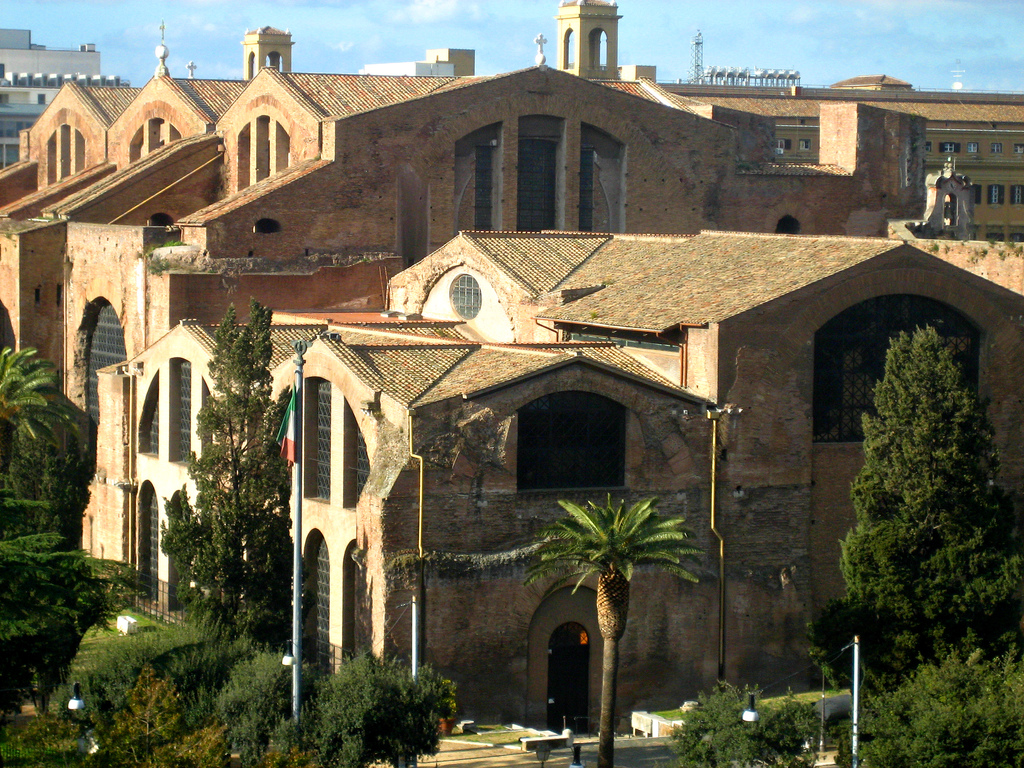
The Baths of Diocletian (Latin: Thermae Diocletiani, Italian: Terme di Diocleziano) were public baths in ancient Rome. Named after emperor Diocletian and built from AD 298 to 306, they were the largest of the imperial baths. The project was originally commissioned by Maximian upon his return to Rome in the autumn of 298 and was continued after his and Diocletian's abdication under Constantius, father of Constantine.The site houses the Basilica of Santa Maria degli Angeli e dei Martiri, built within the ruins in the 16th century, the Church of San Bernardo alle Terme, and part of the National Roman Museum.
The baths occupy the high ground on the northeast summit of the Viminal, the smallest of the Seven hills of Rome, just inside the Agger of the Servian Wall (near what are today the Piazza della Repubblica and Termini rail station). They served as baths for the people residing in the Viminal, Quirinal, and Esquiline quarters of the city. The Quadrigae Pisonis, a 2nd-century monument with various reliefs, some private homes, and a relief representing the temple of Quirinus once stood at the site but were demolished to build the baths. The water supply was provided by the Aqua Marcia, an aqueduct that had long served the city of Rome since the early 2nd century. To properly supply the baths, the supply of water to the city was increased under the order of Diocletian. The baths may have also been supplied by the Aqua Antoniniana, which was originally positioned to supply Caracalla's baths in the early 3rd century.
The baths were commissioned by Maximian in honour of co-emperor Diocletian in AD 298, the same year he returned from Africa. Evidence of this can be found in bricks from the main area of the baths, which distinctly show stamps of the Diocletianic period. This evidence shows the effect of the massive project on the brick industry in that all work by them was redirected and under the control of the emperor. Building took place between the year it was first commissioned and sometime between the abdication of Diocletian in 305 and the death of Constantius in July 306.
In the early 5th century, the baths were restored. The baths remained in use until the siege of Rome in 537 when the Ostrogothic king Vitiges cut off the aqueducts.
According to the medieval guidebook Mirabilia Urbis Romae, the baths were then known as "Palatium Diocletiani".
In the 1560s, Pope Pius IV ordered the building of a basilica in some of the remains, to commemorate Christian martyrs who according to tradition died during the baths' construction, Santa Maria degli Angeli e dei Martiri. To this was attached a Carthusian charterhouse. Michelangelo was commissioned to design the church and he made use of both the frigidarium and tepidarium structures. He also planned the main cloister of the charterhouse. A small cloister next to the presbytery of the church was built, occupying part of the area where the baths' natatio had been located. After 1575, starting under Pope Gregory XIII, several remaining halls of the baths were converted into grain and oil stores for the city of Rome. …
One of the four inscriptions around the main entrance to the Baths of Diocletian reads, translated from Latin, "Our Lords Diocletian and Maximian, the elder and invincible Augusti, fathers of the Emperors and Caesars, our lords Constantius and Maximian and Severus and Maximum, noblest Caesars, dedicated to their beloved Romans these auspicious Baths of Diocletian, which the divine Maximin on his return from Africa ordered to be built and consecrated in the name of his brother Diocletian, having purchased the premises required for so huge and remarkable work and furnishing them with the most sumptuous refinement." Although only fragments of the inscription are extant today, a complete transcription was made by an 8th- or 9th-century pilgrim and was preserved at Einsiedeln Abbey in Switzerland.
The enclosure of the bath complex took up 13 hectares (32 acres) of the district, about the same size as the Baths of Caracalla. The main entrance was to the northeast. To the southwest was a large exedra (now still visible as the outline of Piazza della Repubblica). The exedra was flanked by two large buildings, likely libraries. These in turn connected to circular halls: one of them is now the church of San Bernardo, the other is visible at the start of Via del Viminale. The central block of the baths was 280 (910 feet) by 160 meters (520 feet) or 10.85 acres (compared to the 6 acres of the Baths of Caracalla).
The central block consisted of frigidarium, tepidarium and caldarium along a single axis, with other halls arranged symmetrically around them. Flanking the frigidarium were two open-air gymnasiums (remains of the western one are accessible at Via Cernaia). Two octagonal halls flanked the caldarium.
Despite their similar size, the capacity of the Baths of Diocletian was said to be much greater than the Baths of Caracalla. This could be because the entrance and rooms were made larger than its predecessor in block size, which allowed more space and functionality. According to Olympiodorus, the baths were able to hold up to 3,000 people at one time. However, this claim is disputed because Olympiodorus never described how he calculated this figure. …
From the central structure were derived the plans for the Basilica of Constantine.
The Smithsonian's National Museum of Natural History building in Washington, D.C., was partially based on design elements from these baths, including its Diocletian windows.
Text from Wikipedia, the free encyclopedia, under CC BY-SA 4.0. Full article: «Baths of Diocletian».
Distances are as the crow flies, not walking or driving.


Baths of Diocletian is in Rome, in the province of Roma (Lazio), Italy. Address: Via Enrico de Nicola, 79 - Roma. GPS coordinates: 41.90278, 12.49833.
Nearby you’ll find: Museo Nazionale Romano (100 m away), Museum of the Baths of Diocletian (100 m away), Palazzo Massimo alle Terme (100 m away).
Text. Wikipedia, the free encyclopedia (CC BY-SA 4.0).
Data. Wikidata (CC0); opening hours and contacts OpenStreetMap (ODbL).
Photos. Wikimedia Commons, author and licence on every image.
Updated 28 October 2026. All sources and licences