




- UNESCO
- Free 1st Sunday
Photo: Livioandronico2013, CC BY-SA 4.0 · Wikimedia Commons
Archaeological site
Building in Rome, Italy
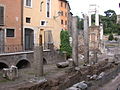
The Temple of Apollo Sosianus (previously known as the Apollinar and the temple of Apollo Medicus) is a Roman temple dedicated to Apollo in the Campus Martius, next to the Theatre of Marcellus and the Porticus Octaviae, in Rome, Italy. Its present name derives from that of its final rebuilder, Gaius Sosius.
The Apollinar and its successors can closely be linked to the site next to the theatre due to Asconius's reference to it being "outside the porta Carmentalis between the Forum Holitorium and the Circus Flaminius", Livy's placing it in the prata Flaminia (Flaminian meadows, as this area was then called) and other references placing it near to the forum, the Capitol and the theatre of Marcellus respectively.
All these indicate the presently-accepted site for this temple, just north of the theatre and east of the porticus Octaviae, on the street leading through the porta Carmentalis to the campus Martius, a little south of the present Piazza Campitelli.
The three columns of the temple which survive to full-height today belong to the Augustan rebuild, but the cult of Apollo had existed in this area since at least to the mid-5th century BC when an Apollinar (a sacred grove or altar) was recorded on this site. Since Apollo was a foreign cult, it thus legally had to be placed outside the pomerium, making it a regular spot for extra-pomerial senate meetings. (This was also Apollo's only temple in Rome until Augustus dedicated another on the Palatine Hill.)
The first temple building dates to 431 BC, when the consul Gaius Iulius Mento inaugurated one dedicated to Apollo Medicus (the doctor), in fulfilment of a vow to him during a plague of 433 BC. This building was restored in 353 BC, and perhaps in 179 BC, when the censor Marcus Aemilius Lepidus and his colleague let the contract for building a porticus from the temple to the Tiber, behind the temple of Spes. The censor's projects also included a nearby theatre. The shedding of tears for three days by a cult-statue of Apollo, cited among the prodigies at the death of the Younger Scipio, can only have occurred at this temple, there being no others to Apollo.
A neighbouring temple dedicated to Apollo's sister Diana probably dates to the late Republic, following the destruction of the Apollo temple's precinct in work on the theatre of Marcellus.
A radical reconstruction was begun by Gaius Sosius, probably just after his triumph in 34 BC. These building-works were themselves soon interrupted by the civil war between Octavian and Antony (with Sosius taking Antony's side), and only resumed some years later when Augustus was reconciled with Sosius. It was thus dedicated in the end to the name of the princeps, with the dedication day in the Augustan period of 23 September. Upon the construction of the theatre of Marcellus soon afterwards the temple's frontal staircase was demolished and replaced with two staircases on the sides of the "pronaos". …
Between 37 and 32 BC, a large reconstruction of the pediment of the Temple of Apollo Sosianus occurred under Augustus, which was indicative of his larger plans to re-structure the architectural format of Circus Flaminius, an oval shaped section in the southern portion of Campus Mauritius. The result of this Augustan re-formatting was a tight architectural relationship between Apollo Sosianus, the Temple of Bellona, and the Theatre of Marcellus. This decision was intentional and indicative of the Greek god Apollo's influence on Roman life; Apollo was the center of life at the Circus Flaminius, as the space was used for theatrical performances at the Theatre of Marcellus, horse racing around the oval shaped perimeter of the Circus, and political speeches within the oval field.
One of the most famous sculptures recovered from the surrounding areas around Apollo Sosianus was a five-foot tall sculpture of an Apollo archer. While the original position of this sculpture has been the object of scholarly debate, as some authors believed that this work was originally placed in a niche within the temple cell, this theory was disproved with the discovery of “a very accentuated stucco which hid a quadrangular hole, by those that are normally used to fix the pedimental statues with a hook to the back wall.” Based on the location of this hole, scholars discovered that the Apollo statue would have been hung on the pediment with a profile view, and his left arm most likely held a shield while he held a sword in his right hand. This determination also solidified scholars distinction between this work as a warrior of Apollo versus that of Apollo himself, as the god Apollo is typically depicted with his arms raised, adorned with a bow and arrow. Also indicative of this distinction is the lack of “characterizing element” of Apollo, such as a braid behind the nape, a characteristic reserved for depictions of heroes and gods.
The building is oriented almost perfectly towards the south, differing from the orientation of the other neighbouring buildings, including the adjoining temple of Bellona.
The Augustan phase of the temple was made up of a podium under the columns and the cella walls, with its supporting parts made up of travertine blocks to carry the weight and the non-supporting parts merely of tuff blocks and cement. The remains of the podium wall surviving beneath the cloisters of Santa Maria in Campitelli – 13 metres long, over 4 high and over 2 thick – were assumed by Delbrück to be unquestionably a part of the original structure. Frank, however, maintains that though the cappellaccio tuff core may belong to the original building, the rest (besides some concrete with an opus reticulatum facing, attributable to the 34 BC phase) belongs to the 179 BC restoration. He argues this from the use in the remains' facing of tuff from Monte Verde, the southern end of the Janiculum Hill.
The temple's hexastyle elevation was formed of Carrara marble columns along the front and the two long sides of the pronaos, with those at the back made of plastered brick. This style was continued in travertine half-columns (plastered to look like marble) against the cella walls.
The facade's architrave was made up of blocks of travertine faced and supported with marble in the pittabanda style, rather than solid blocks of marble alone. In the same way the frieze was sculpted on slabs placed on the supporting structure. The capitals are Corinthian with extra vegetable motifs (in Italian, "corinzieggiante", no English equivalent), and the frame presents a very protruding ceiling supported by brackets.
The temple's main pediment was decorated with sculptures removed from a classical temple in Greece. These date to c. 450 - 425 BC and show an amazonomachy. They are now preserved at Centrale Montemartini of the Capitoline Museums. …
Text from Wikipedia, the free encyclopedia, under CC BY-SA 4.0. Full article: «Temple of Apollo Sosianus».
Events and people from Wikidata (CC0).
Distances are as the crow flies, not walking or driving.


Temple of Apollo Sosianus is in Rome, in the province of Roma (Lazio), Italy. GPS coordinates: 41.89232, 12.47964.
Nearby you’ll find: Temple of Bellona (0 m away), Theatre of Marcellus (0 m away), Temple of Jupiter Stator (100 m away).
Text. Wikipedia, the free encyclopedia (CC BY-SA 4.0).
Data. Wikidata (CC0); opening hours and contacts OpenStreetMap (ODbL).
Photos. Wikimedia Commons, author and licence on every image.
Updated 28 October 2026. All sources and licences