


- UNESCO
- Free 1st Sunday
Photo: MM, CC BY-SA 3.0 · Wikimedia Commons
Archaeological site, 2nd century BC
Roman sanctuary in Palestrina
Palestrina (RM), Lazio
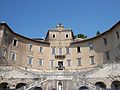
The temple of Fortuna Primigenia was an ancient Roman temple within the sanctuary of Fortuna Primigenia, a religious complex in Praeneste (now Palestrina, 35 km (22 mi) east of Rome). It was dedicated to the goddess Fortuna Primigenia (Primigenia meaning "first born" or "original") and parents brought their newly-born first child to the temple in order to improve its likelihood of surviving infancy and perpetuating the gens.
The sanctuary of Fortune occupies a series of 6 vast terraces, which, resting on gigantic masonry substructures and connected with each other by grand staircases, rise one above the other on the hill. This immense edifice, probably by far the largest Roman sanctuary, must have presented a most imposing aspect, visible as it was from a great part of Latium, from Rome, and even from the sea. It is a work of high technical and stylistic level.
The great "Cortina terrace" was adorned by porticoes on three sides and led up to the theatre's cavea crowned with porticoes. The small circular temple which topped off the sanctuary, today incorporated into the Palazzo Colonna Barberini, hosted the gilded bronze statue of goddess Fortuna represented as a young warrior.
Along the northern end of the Cortina terrace underneath the stairway of the cavea of the theatre as part of its substructure is a cryptoporticus, a barrel vaulted passage that was an integral part of the sanctuary. It linked the two wings of Corinthian columns that flanked three sides of the terrace and has six supporting arches. Its mosaic floor, only partially preserved, was made of irregular tesserae alternating with chips of polychrome stones (scutulatum). On the outside of the supporting arches are Ionic semicolumns; two big niches stood at the far ends of six arches slightly projecting from the portico front. They were not joined to the cryptoporticus behind, but had waterfalls from their vault (traces of the piping system are still visible). Inscriptions here mention restoration executed by two local magistrates in Sullan times. In the 15th century the supporting arches were bricked up and cryptoporticus was transformed into a cistern which explains the existence of the well today in the theatre.
The so-called terrace of the hemicycles which incorporates two columned exhedra was one of the central places of cult: in front of the exhedra on the right a well is still preserved which may be the one where, according to Cicero, the Praenestine nobleman Numerius Suffucius found the sortes, wooden tablets used to foretell the future. …
There was a double cult here; that of Fortuna and another where honey was believed to have oozed from an olive tree. The sanctuary brilliantly merged the two sanctuaries at the end of the 2nd century BC in an architectonic and modular structure: the first cult was located in the terrace of the hemicycles, particularly in the eastern one with the well, while the second cult centre was further up with the main temple.
The goddess Fortuna here went by the epithet of Primigenia (meaning "first born") and was represented suckling two babes, as in the Christian representation of Charity, said to be Jupiter and Juno, and she was especially worshipped by matrons. The cult featured an oracle, consulted by the picking of lots as described by Cicero. The oracle continued to be consulted down to Christian times, until Constantine the Great, and again later Theodosius I, forbade the practice and closed the temple.
Features of the sanctuary influenced Roman garden design on steeply sloped sites through Antiquity and once again in Italian villa gardens from the 15th century. The Victor Emmanuel II Monument in Rome owes much to the site.
Text from Wikipedia, the free encyclopedia, under CC BY-SA 4.0. Full article: «Sanctuary of Fortuna Primigenia».
Events and people from Wikidata (CC0).
Distances are as the crow flies, not walking or driving.


Sanctuary of Fortuna Primigenia is in Palestrina, in the province of Roma (Lazio), Italy. GPS coordinates: 41.84040, 12.89250.
Yes: entry is free on the first Sunday of every month, under the Italian “Domenica al museo” scheme.
Wikidata dates it to the 2nd century BC.
Nearby you’ll find: Museo archeologico nazionale (0 m away), Praeneste (0 m away), Palazzo Colonna Barberini (0 m away).
Text. Wikipedia, the free encyclopedia (CC BY-SA 4.0).
Data. Wikidata (CC0); opening hours and contacts OpenStreetMap (ODbL).
Photos. Wikimedia Commons, author and licence on every image.
Updated 28 October 2026. All sources and licences