



- UNESCO
- Free 1st Sunday
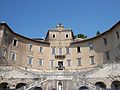
Photo: Domenico Castelli, Public domain · Wikimedia Commons
Archaeological site
Ancient city of Latium in central Italy
Palestrina (ancient Praeneste; Ancient Greek: Πραίνεστος, Praínestos) is a modern Italian city and comune (municipality) with a population of about 22,000, in Lazio, about 35 kilometres (22 miles) east of Rome. It is connected to the latter by the Via Prenestina. It is built upon the ruins of the ancient city of Praeneste.
Palestrina is the birthplace of composer Giovanni Pierluigi da Palestrina.
Palestrina is still dominated today by the enormous ancient Roman sanctuary of Fortuna Primigenia built on a series of terraces on the slope of the hill on which the town stands. Further massive Roman terraces support the town itself. The ancient city, however, probably dates from an even earlier period from the 7th c. BC.
Ancient mythology connected the origin of Praeneste to Caeculus, or to other fabled characters such as Telegonus, Erulus or Praenestus. The name probably derives from the word Praenesteus, referring to its overlooking location.
Early burials show that the site was already occupied in the 8th or 7th century BC. Excavations in the necropolis have shown that in the late 8th century BC (Orientalising Period) a major cultural advance took place with notable eastern imports and with a close relationship with Etruria; the princely 7th c. Barberini (excavated in 1855) and Bernardini tombs had contents of at least the same quality as those in the cemeteries of Etruscan Caere (Cerveteri).
Praeneste soon became one of the most powerful and wealthy of the Latin towns.
Of the objects found in the oldest graves dating from about the 7th century BC, the cups of silver and silver-gilt and most of the gold and amber jewellery are Phoenician (possibly Carthaginian), but the bronzes and some of the ivory articles seem to be of the Etruscan civilization.
The earliest settlement was probably a citadel on the top of the hill around which a cyclopean wall was built, some of which remains today. In addition two walls of the same date and also visible today descended the slopes down to the town where a cross wall along the lower part of the sanctuary completed the circuit.
Præneste was already a rich and prosperous town when Rome was still emerging. The rapid development of the Latin towns led to the Latin League from the 8th c. BC for protection against the Etruscans and enemies from surrounding areas, and eventually brought Rome and Præneste together with the others. But Præneste because of her history and wealth felt superior to the others and became Rome's most hated rival as Rome grew rapidly. …
The modern town of Palestrina is centred on the terraces once occupied by the massive sanctuary of Fortuna and by other terraces below it. The town came to largely obscure the sanctuary, the monumental remains of which were revealed as a result of American bombing of German positions in World War II.
Praeneste was chiefly famed for its great Temple of Fortuna Primigenia connected with the oracle known as the Praenestine lots (sortes praenestinae).
Archaeologists working in the 1950s were able to identify the area around the Cathedral and the Piazza Regina Margherita as the original Forum of Ancient Praeneste. The buildings of the forum comprised a central temple, whose walls were re-used for the cathedral, and a two-storey civil basilica consisting of four naves separated by columns, once roofed but today an open space. Its façade included a sundial described by Varro, traces of which may still be seen.
The basilica was flanked by two buildings, the easternmost apsidal hall containing a raised podium (suggestus) and the public treasury, the aerarium, identified by an inscription dating it to ~150 BC. At some later date (perhaps around 110-100 BC), these two buildings were each embellished with a wonderful nymphaeum and a magnificent mosaic floor.
The western nymphaeum is a natural cave enlarged and enriched through three niches, while its roof was embellished with artificial stalactites. A huge arch made of limestone blocks creates a monumental entrance, whilst the space in front of it is paved with an extremely fine white mosaic. The main mosaic represents a seascape: a temple of Poseidon on the shore characterised by an altar and a high column. The latter is topped by a big metal vase and decorated by two shields; next to it are a trident and a rudder. There are colourful and realistic fish of all kinds, crustaceans and molluscs swimming in the sea.
The eastern nymphaeum was decorated with the spectacular Nile mosaic of Palestrina with scenes from the Egyptian river, now relaid in the Palazzo Colonna Barberini in Palestrina on the uppermost terrace (now the National Archaeological Museum of Palestrina).
These mosaics were enriched with a veil of water from the nymphaea, enhancing the colours of the depiction. It is thought they were realised by artists from Alexandria at the end of the 2nd century BC. …
Palestrina was the home town of the 3rd-century Roman writer Aelian, and of the 16th-century composer Giovanni Pierluigi da Palestrina.
Thomas Mann spent some time there in 1895 and, two years later, during the long harsh summer of 1897, he stayed over again, with his brother Heinrich Mann, in a sojourn that provided the backdrop, nearly half a century later, for Adrian Leverkühn's pact with the Devil in Mann's novel Doktor Faustus.
Text from Wikipedia, the free encyclopedia, under CC BY-SA 4.0. Full article: «Praeneste».
Distances are as the crow flies, not walking or driving.


Praeneste is in Castel San Pietro Romano, in the province of Roma (Lazio), Italy. GPS coordinates: 41.84042, 12.89253.
Nearby you’ll find: Sanctuary of Fortuna Primigenia (0 m away), Museo archeologico nazionale (0 m away), Palazzo Colonna Barberini (0 m away).
Text. Wikipedia, the free encyclopedia (CC BY-SA 4.0).
Data. Wikidata (CC0); opening hours and contacts OpenStreetMap (ODbL).
Photos. Wikimedia Commons, author and licence on every image.
Updated 28 October 2026. All sources and licences