


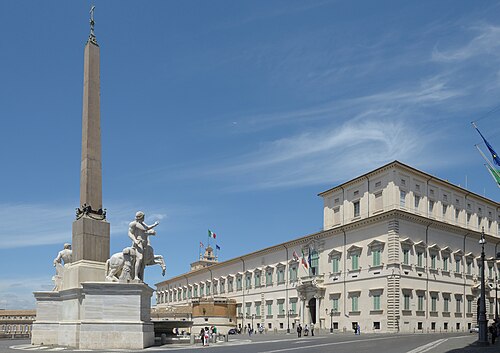
Photo: Livioandronico2013, CC BY-SA 4.0 · Wikimedia Commons
Historic villa / palace
Papal Palace of Castel Gandolfo
17th-century papal palace in the city of Castel Gandolfo, Italy
Castel Gandolfo (RM), Lazio
At a glance
- Architect
- Carlo Maderno
- Protection
- Italian national heritage
- Coordinates
- 41°44′50″ N, 12°39′01″ E
History and description
The Papal Palace of Castel Gandolfo, or the Apostolic Palace of Castel Gandolfo from its Italian name Palazzo Apostolico di Castel Gandolfo, is a 54.6-hectare (135-acre) complex of buildings in a garden setting in the city of Castel Gandolfo, Italy, including the principal 17th-century villa, an observatory and a farmhouse with 30.4 hectares (75 acres) of farmland. The main structure, the Papal Palace, has served for centuries as a summer residence and vacation retreat for the pope, the leader of the Catholic Church, and is afforded extraterritorial status as one of the properties of the Holy See, though the main Apostolic Palace building served as a museum from 2016 until July 5, 2026. It has been restored as the summer residence once again. It overlooks Lake Albano.
History
The Vatican acquired the castle in 1596, in payment of a debt owed by the Savelli family. It dated from the 13th century.
The gardens occupy the site of a residence of the Roman Emperor Domitian. The palace was designed by Swiss-Italian architect Carlo Maderno for Pope Urban VIII, who began using it in the spring of 1626. Since then, about half of his successors have used the properties as a summer residence and vacation retreat, except for the years between 1870 and 1929 when the popes, in dispute with Italy over territorial claims, did not leave Vatican City. Pope Pius XI had the facilities modernized and began using the retreat again in 1934. In accordance with the Lateran Treaty of 1929, the palace and the adjoining Villa Barberini added to the complex by Pope Pius XI are extraterritorial properties of the Holy See.
During World War II, an unknown number of Jewish refugees took shelter at the palace under the protection of the Holy See and many people used the site as a refuge from Allied bombing raids in 1944, though more than 500 people died in one such attack.
Pope Pius XII died at the palace in 1958, as did Pope Paul VI in 1978. Pope John Paul II had a swimming pool built at the palace, which was criticized by some. Paparazzi used the opportunity to take photos of him.
Pope Benedict XVI flew to the palace at the conclusion of his papacy on 28 February 2013, was joined by Pope Francis for lunch on 23 March, and returned to Vatican City on 2 May. Francis visited the property twice more, but never stayed overnight. In June 2013, Francis announced he would not spend the summer in Castel Gandolfo as many of his predecessors had, but would lead the Angelus there on 14 July. In retirement, Benedict used it at Francis's invitation for a two-week vacation in 2015.
On 7 December 2013, Pope Francis named Osvaldo Gianoli as the Director of the Pontifical Villas of Castel Gandolfo. In March 2014, the Vatican opened the Barberini Gardens to paid visitors on escorted tours during morning hours every day but Sunday. Beginning 11 September 2015, the public was able to travel from Vatican City to Castel Gandolfo by a train that had previously been reserved for use by the pope. Before the end of the year, products from the farm, previously only available to Vatican employees, were made available for purchase by the public. …
Legal status
Pursuant to the Lateran Treaty of 1929, the Papal Palace of Castel Gandolfo is Italian territory, but owned by the Holy See and equipped with extraterritoriality comparable to that of diplomatic missions. It is exempt from Italian taxes and expropriations, and Italian authorities are prohibited from entering it without the consent of the Holy See.
Text from Wikipedia, the free encyclopedia, under CC BY-SA 4.0. Full article: «Papal Palace of Castel Gandolfo».
People
Events and people from Wikidata (CC0).
Photos
Getting there
Castel GandolfoTrain, nearest
200 m as the crow flies
Papal Palace of Castel Gandolfo
Aeroporto di Roma-Ciampino7.5 km
Distances are as the crow flies, not walking or driving.
Loading map…
Nearby
See on the mapMore historic villas and palaces in Lazio

- Free 1st Sunday


Frequently asked questions
Where is Papal Palace of Castel Gandolfo?
Papal Palace of Castel Gandolfo is in Castel Gandolfo, in the province of Roma (Lazio), Italy. GPS coordinates: 41.74710, 12.65030.
What else is there to see near Papal Palace of Castel Gandolfo?
Nearby you’ll find: Castel Gandolfo (100 m away), Bergantino nymphaeum (300 m away), Villa of Domitian (1 km away).
Sources and licences
Text. Wikipedia, the free encyclopedia (CC BY-SA 4.0).
Data. Wikidata (CC0); opening hours and contacts OpenStreetMap (ODbL).
Photos. Wikimedia Commons, author and licence on every image.
Credits for the 9 photos
- Pontifical Palace (Castel Gandolfo) — Livioandronico2013, CC BY-SA 4.0
- Castel Gandolfo - Palazzo Pontificio - 2026-09-13 17-28-24 001 — Albarubescens, CC BY-SA 4.0
- Castel Gandolfo - Palazzo Pontificio - Il Portone — 66colpi, CC BY-SA 4.0
- Castel Gandolfo - Palazzo Pontificio - La Madonnina — 66colpi, CC BY-SA 4.0
- Castel Gandolfo - Palazzo Pontificio - Le sale bis — 66colpi, CC BY-SA 4.0
- Castel Gandolfo - Palazzo Pontificio — Deblu68, Public domain
- Castel Gandolfo Palazzo apostolico — Marco Velliscig, CC BY-SA 4.0
- Castel Gandolfo, Pontifical palace and Vatican Observatory, — H. Raab ( User:Vesta ), CC BY-SA 4.0
- Courtyard - Pontifical Palace - Castel Gandolfo - DSC04255 — Daderot, CC0
Updated 28 October 2026. All sources and licences