




- Most beautiful villages
Photo: George McFinnigan From Italian Wikipedia (uploaded by Gaucho ), CC BY-SA 3.0 · Wikimedia Commons
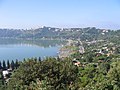
Castel Gandolfo, colloquially known as Castello in the Castelli Romani dialects, is a small town located 25 km (16 mi) southeast of Rome, in the Italian region of Lazio. Situated on a hilltop in the Alban Hills with panoramic views of Lake Albano, Castel Gandolfo is home to approximately 8,900 residents and is renowned as one of Italy's most scenic towns. It is one of I Borghi più belli d'Italia ("The most beautiful villages of Italy").
Within the town's boundaries lies the Apostolic Palace of Castel Gandolfo, which has served as the summer residence and vacation retreat for most popes since 1626. Although the palace is located within the boundaries of Castel Gandolfo, it holds an extraterritorial status as one of the properties of the Holy See and is not under Italian jurisdiction. It has been transformed into a museum and is now open to the public. Notwithstanding the main Apostolic Palace's current status as a museum, the Castel Gandolfo complex resumed its traditional status as the pope's summer residence and vacation retreat in July 2025.
Archaeological finds from the 16th century BC come from the area of what is now Castel Gandolfo.
The site of the modern town is a candidate for the site of legendary ancient Alba Longa, capital of the Latin League. It was later developed by the Emperor Domitian into his vast palace.
Its name is derived from a fortification of the ducal Gandolfi family (of Genoese origin, named after St. Gondolfus) in the 12th century, which passed to the Savelli family from whom the Apostolic Camera purchased it in 1596 for 150,000 scudi. Pope Clement VIII (1592–1605) was the first pope to come to Castel Gandolfo, but the rebuilding of the old castle was the project of Urban VIII, who first made it an official papal residence in 1626.
During the Napoleonic Wars, some 900 anti-French citizens of neighboring Velletri held out in Castel Gandolfo, resisting the siege by Joachim Murat.
During World War II, Pope Pius XII opened up the grounds of Castel Gandolfo to refugees escaping the fighting taking place around Rome. On 22 January 1944, the first of what became 12,000 people began arriving on the property, often bringing with them their cows, horses, mules and sheep. Included were many Roman Jews, and other non-Catholics. During the time they lived there, 36 children were born, almost all of whom were named after the Pope who gave them safe harbor. The pope's private apartment was turned into a nursery.
Pope Benedict (2005–2013) loved it so much he briefly retired there after leaving the papacy. Pope Francis (2013–2025), however, rarely traveled there, with a gap of nearly 12 years with no visits. However, he did open the pontifical palace and gardens to the public for the first time, increasing tourism to the town. His successor Pope Leo XIV (2025–present) first used it as a summer residence in 2025, and said that he would continue the tradition; 2026 will be the 400-year anniversary as a papal residence. On 6 July 2025, Pope Leo XIV would begin staying at Castel Gandolfo for a six-week vacation, thus resuming the tradition of Castel Gandolfo being used as the pope's retreat and summer home. However, the main Apostolic Palace at Castel Gandolfo still remains a museum, with Leo XIV instead staying at the Castel Gandolfo's Villa Barberini.
The parish church, dedicated to St. Thomas of Villanova was designed by Bernini (1658–1661) on the order of the Chigi Pope Alexander VII, it has a square Greek key cross plan and houses a notable painting by Pietro da Cortona portraying Christ's crucifixion.
Church of Our Lady of the Lake, wanted personally by Pope Paul VI, was consecrated by the same pope in 1977, on the shores of Lake Albano.
Church of Santa Maria Assunta, construction began in 1619 with the consecration of the first stone by Pope Paul V.
Church of Santa Maria, modern construction, situated in the populous district of Borgo San Paolo near State Road 7 Via Appia, the Ugo Bazzi theater adjoins the church.
Church of San Sebastiano, dedicated to the patron saint of the city and located on State Road 7 Via Appia adjacent to the church cemetery.
Church of Santa Maria Della Cona.
The Apostolic Palace of Castel Gandolfo, the pope's summer residence, is a 17th-century building designed by Carlo Maderno for Pope Urban VIII. The papal palace and the adjoining Villa Barberini, which was added to the complex by Pius XI, have enjoyed extraterritorial rights since the signing of the 1929 treaty with Italy; the little piazza directly in front was renamed Piazza della Libertà in the first flush of Italian unity after 1870. The Papal Palace remained unused from 1870 until 1929.
Villa Cybo, built by Cardinal Camillo Cybo, was annexed to the whole of the Pontifical Villas at the time of Pope Clement XIV who purchased it in 1774 from the owner at the time, Francesco III d'Este, Duke of Modena, for the sum of 80,000 crowns.
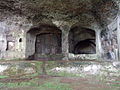
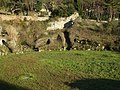
Villa Barberini, built by the nephew of Pope Urban VIII (Maffeo Barberini), was incorporated in the extraterritorial complex of the Pontifical Villas in 1929: the manor houses the headquarters of the College of Propaganda Fide. As part of its extensive formal gardens is located the existing remains of the complex built by the Roman Emperor Domitian.
Villa Santa Caterina, currently used by the Catholic Institute of Technology. During the construction of this villa, situated in the Herculaneum area, the Roman ruins of the villa commonly attributed to Publius Clodius Pulcher were discovered. …
Text from Wikipedia, the free encyclopedia, under CC BY-SA 4.0. Full article: «Castel Gandolfo».
Distances are as the crow flies, not walking or driving.


Castel Gandolfo is in Castel Gandolfo, in the province of Roma (Lazio), Italy. GPS coordinates: 41.74694, 12.65194.
Nearby you’ll find: Papal Palace of Castel Gandolfo (100 m away), Bergantino nymphaeum (200 m away), Villa of Domitian (1 km away).
Text. Wikipedia, the free encyclopedia (CC BY-SA 4.0).
Data. Wikidata (CC0); opening hours and contacts OpenStreetMap (ODbL).
Photos. Wikimedia Commons, author and licence on every image.
Updated 28 October 2026. All sources and licences