
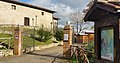


- Most beautiful villages
Photo: Fiat 500e, CC BY-SA 4.0 · Wikimedia Commons
Historic village
Italian comune
Greccio is an old hilltown and comune of the province of Rieti in the Italian region of Lazio, overhanging the Rieti Valley on a spur of the Monti Sabini, a sub-range of the Apennines, about 16 kilometres (10 miles) by road northwest of Rieti, the nearest large town.
It is one of I Borghi più belli d'Italia ("The most beautiful villages of Italy"). The town hall of the comune is in the frazione of Limiti di Greccio.
Greccio was the place where, in December 1223, Saint Francis of Assisi devised the first living Nativity scene (in Italian: presepe). The Nativity scene tradition continues there to this day, and a memorial of Saint Francis, the Sanctuary of Greccio, may be visited.
Modern Greccio, which is of medieval origin, was founded on lands of ancient Greek colonization, in a place where there was, in ancient times, a colony founded by colonists from Magna Graecia. They had fled or were exiled from their homeland as a result of war.
The earliest records of Greccio date back to the 10th and 11th centuries with the name of "curtis de Greze". The Benedictine Monk Gregory of Catino (1062–1133) refers to the town of "Grecciae" in his work "Summary Farfense". From the remains of the ancient buildings, it shows that Greccio became a fortified medieval castle surrounded by walls and protected by a six towers fortress.
In documents from the 11th century, the toponym of Greccio is cited with many variations until 1091, when the name "Grecciae", from which the current name derives, seems to spread; the community also experienced a fair amount of development, favored by the abundance of flat arable land and good pastures.
During the struggle with neighboring cities, the castle was destroyed in 1242 by the troops of Frederick II. They had a difficult history until 1799 when the town was destroyed and looted by the Napoleonic army. The town was called for the first time with its current name "Greccio" around 1720.
Greccio was the place where, in December 1223, Saint Francis of Assisi devised the first living Nativity scene (in Italian: presepe). Francis' 1223 living nativity scene is commemorated on the calendars of the Catholic, Lutheran and Anglican liturgical calendars, and its creation is described by Saint Bonaventure in his Life of Saint Francis of Assisi c. 1260.
Saint Francis' manger scene is said to have been enacted at Christmas 1223 in a cave near the Sanctuary of Greccio. The very small chapel where it is said to have taken place survives. The painting over its altar, and others before 1400, by Giotto at the Assisi Lower Church, and by Antonio Vite in Pistoia, depict Saint Francis kneeling and placing a small baby into a chest-like manger. Giotto adds a miniature ox and ass. The Nativity scene tradition continues there to this day, and a memorial of Saint Francis, the Sanctuary of Greccio, may be visited.
The Hermitage of Greccio Sanctuary (Italian: Santuario Eremo di Greccio) is one of the four shrines erected by Saint Francis of Assisi in the Sacred Valley, along with the Sanctuary of Fonte Colombo, the Sanctuary of the Forest, and the convent of Poggio Bustone. Francis presented the first living Nativity scene in a nearby cave in December 1223.
Inside there are frescoes modern and original chapel of the saint carved in the rock. Francis, recalling a visit he had made years before to Bethlehem, resolved to create the manger he had seen there. The ideal spot was a cave in nearby Greccio. He would find a baby, hay upon which to lay him, an ox, and an ass to stand beside the manger. Word went out to the people of the town.
At the appointed time, the townspeople arrived carrying torches and candles. One of the friars began celebrating Mass while Francis himself gave the sermon. His biographer, Thomas of Celano, recalls that Francis stood before the manger, overwhelmed with love and filled with a wonderful happiness. For Francis, the simple celebration was meant to recall the hardships Jesus suffered even as an infant, a savior who chose to become poor for our sake, a truly human Jesus. The Sanctuary of Greccio may be visited. …
Text from Wikipedia, the free encyclopedia, under CC BY-SA 4.0. Full article: «Greccio».
Distances are as the crow flies, not walking or driving.


Greccio is in Greccio, in the province of Rieti (Lazio), Italy. GPS coordinates: 42.45000, 12.75000.
Nearby you’ll find: Museo Internazionale del Presepe (600 m away), San Pastore (2.3 km away), Villa romana di Cottanello (8.1 km away).
Text. Wikipedia, the free encyclopedia (CC BY-SA 4.0).
Data. Wikidata (CC0); opening hours and contacts OpenStreetMap (ODbL).
Photos. Wikimedia Commons, author and licence on every image.
Updated 28 October 2026. All sources and licences