



- Most beautiful villages
Photo: Hagai Agmon-Snir حچاي اچمون-سنير חגי אגמון-שניר, CC BY-SA 4.0 · Wikimedia Commons
Historic village
Town in the region Umbria, in Italy
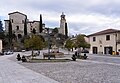
Stroncone is a comune (municipality) in the Province of Terni in the Italian region Umbria, located about 70 km southeast of Perugia and about 8 km south of Terni. It is one of I Borghi più belli d'Italia ("The most beautiful villages of Italy").
There have been attempts to connect the area around Stroncone with the former city of Trebula Suffenas, but it is instead reported that only around the 10th century a group settled on the hill and built a castle.
Stroncone is first documented in 1012, when Giovanni di Pietro made a donation to the monastery of San Simeone. The donation included land in the Stroncone area, houses and small rural dwellings within the castle, and a share in the church of Sant'Angelo, which in that document is referred to as an oratory.
In the 11th century Stroncone was a fortified castle with walls, with houses, a square, and places of worship inside. It was linked to Narni and lay within the Diocese of Narni. In 1156 the castle was donated to the monks of Farfa.
In 1215 Pope Innocent III granted Stroncone municipal self-rule. Politically it is identified as Guelph. Its civic arms are given as a white cross on red, together with the papal keys. In the 13th century Stroncone and Narni supported the papal army against Emperor Frederick II, while Terni opposed them.
Throughout the 13th century Stroncone was involved in harsh and bloody conflicts with Narni. In 1357 the Ghibellines drove the Guelphs out of the castle; the Guelphs later reoccupied it and expelled their opponents.
In the 14th century governance is associated with rectors of the Papal State, named as Ugo Augeri, Bernardus De Lacu, Pietro di Vico, Girolamo Orsini, Francesco Orsini, and Nicola Orsini. After the end of the Avignon Papacy, in 1377 these were replaced by vicars of the Holy See, who ruled through a commissioner. In January 1378 Pope Gregory XI recognized Stroncone as directly subject to the Holy See, a privilege later confirmed by Pope Leo X.
The fortress is recorded as having been occupied in 1394 by Pandolfo Malatesta. In 1404, after Andrea Tomacelli seized the fortress, the people of Stroncone rose up and put his soldiers to flight.
In 1463 Pope Pius II, returning to Rome after the end of a plague, visited Stroncone and left an important account of the fertile countryside and the town's strong position.
In the 15th century the Friars Minor are credited with strong political and economic influence. Among the institutions founded were a mount of piety in 1466 and a Monte Frumentario in 1489. …
Text from Wikipedia, the free encyclopedia, under CC BY-SA 4.0. Full article: «Stroncone».
Distances are as the crow flies, not walking or driving.


Stroncone is in Stroncone, in the province of Terni (Umbria), Italy. GPS coordinates: 42.49824, 12.66274.
Nearby you’ll find: Teatro Sergio Secci (6.8 km away), Museo archeologico di Terni (6.8 km away), Anfiteatro Fausto (7 km away).
Text. Wikipedia, the free encyclopedia (CC BY-SA 4.0).
Data. Wikidata (CC0); opening hours and contacts OpenStreetMap (ODbL).
Photos. Wikimedia Commons, author and licence on every image.
Updated 28 October 2026. All sources and licences