




- Most beautiful villages
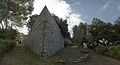
Photo: Hagai Agmon-Snir حچاي اچمون-سنير חגי אגמון-שניר, CC BY-SA 4.0 · Wikimedia Commons
Historic village
Italian comune
Panicale is a comune (municipality) in the Province of Perugia in the Italian region Umbria. Located on the eastern slope of Mount Petrarvella, in the southeast of Valdichiana, it overlooks Lake Trasimeno and is about 35 km from Perugia.
As of 1 January 2025, it had a population of 5,312 and an area of 78.8 km2. It is one of I Borghi più belli d'Italia ("The most beautiful villages of Italy").
Archaeological evidence indicates that the area was already settled in the 2nd millennium BC. By the 7th century BC an Etruscan presence is documented. During the Roman period the site is believed to have hosted a military camp and to have served as a refuge during the Perusine War between Lucius Antonius and Octavian in the 1st century BC.
In 917 Berengar I confirmed the village as a fief to Marquis Uguccione II Bourbon del Monte. Various nobles of Arezzo later bore the title of Counts of Panicale. In 1037 the community achieved independence from Uguccione II, marking the emergence of a free commune.
In 1131 the settlement suffered damage during the passage of imperial troops and from subsequent factional strife and civil wars.
In the 13th century it submitted to the Signoria of Perugia, while retaining a measure of local autonomy. Civic institutions developed during this period: in 1316 the first municipal statute was compiled in Latin, and it was subsequently revised in 1356 and again in 1386.
In 1355 the Emperor Charles IV stayed overnight in Panicale while travelling from Rome to Pisa under the escort of Perugian ambassadors; on that occasion he granted the lordship to Guillaume III Roger de Beaufort, nephew of Pope Clement VI and brother of Gregory XI.
In 1416 Panicale was subjected by Braccio Fortebraccio, who retained control until 1425, when the allied forces of the Sforza and Cardinal Vitelleschi compelled him to withdraw to defend Montone.
In 1484 the municipal statute was translated into the vernacular.
In 1540, following the Salt War, Perugia was definitively subjected to the Papal State, and new legal and administrative structures were introduced.
In 1642 the army of the Duke of Parma, aided by troops of the Grand Duke of Tuscany, sacked Panicale and demolished its fortress and fortifications. From that time the town experienced a documented phase of economic and civic decline. …
The collegiate church of San Michele Arcangelo is the parish church of Panicale. It was built in 1618 over a pre-existing Romanesque church, from which it still retains the façade, and it was restored in 1696. The building is largely of brick, with door frames in travertine and sandstone, and a sandstone tabernacle set on the rear side. Inside it preserves a painting of the Madonna and Saints by Perugino, a panel by Giovan Battista Caporali and a Nativity scene with God the Father.
The church contains an organ built in 1836 by Angelo Morettini of Perugia. The body of Saint Pellegrino, venerated as the town's patron, is preserved there in a gilded urn.
The church of San Sebastiano was built between the late 14th century and the 15th century and was reshaped into its present form in 1623, when it was furnished with capitals, cornices, two altars and two small choir galleries.
The church contains a fresco of The Martyrdom of Saint Sebastian (1505), considered among the masterpieces of Perugino. The church also contains Madonna enthroned with musical angels. On the exterior, terracotta plaques on the upper left side bear the dates 1690 and 1725, while the outer wall of the garden area bears the date 1692.
The Sanctuary of the Madonna di Mongiovino lies about 7 kilometres (4.3 mi) from Panicale, just below the castle of Mongiovino. It was built in 1524 by Rocco da Vicenza to replace an older chapel that housed a miraculous image of the Madonna. Built in sandstone, it has a Greek-cross plan and an octagonal dome supported internally by four pillars. Its portals are attributed to Rocco himself and to Giuliano da Verona, Bernardino da Siena and Lorenzo da Carrara.
The interior is arranged around a square plan with four corner chapels and a main chapel containing the miraculous painting. Among the works mentioned are a Deposition from the Cross by Arrigo Fiammingo, a Resurrection by Nicolò Pomarancio, and an Coronation of Mary painted on the dome by Mattia Battini, alongside other sacred images including the miraculous Madonna and Child dated to the 14th century. The high altar in stone and terracotta statues placed in the organ niches, attributed to Bevignate da Perugia and Arrigo Fiammingo, are also noted. …
Text from Wikipedia, the free encyclopedia, under CC BY-SA 4.0. Full article: «Panicale».
Distances are as the crow flies, not walking or driving.


Panicale is in Panicale, in the province of Perugia (Umbria), Italy. Address: Ufficio Turistico, Piazza dell'Ospedale, 06064 Panicale PG. GPS coordinates: 43.02941, 12.10004.
Nearby you’ll find: Chiesa di San Sebastiano (300 m away), Paciano (2.5 km away), Castello di Montalera (4.8 km away).
Text. Wikipedia, the free encyclopedia (CC BY-SA 4.0).
Data. Wikidata (CC0); opening hours and contacts OpenStreetMap (ODbL).
Photos. Wikimedia Commons, author and licence on every image.
Updated 28 October 2026. All sources and licences