


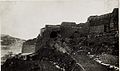


Photo: Unknown author Unknown author, Public domain · Wikimedia Commons
Fortress / Tower
Forte Belvedere-Gschwendt
Fortress in Lavarone, Italy
Lavarone (TN), Trentino-South Tyrol
At a glance
- Type
- Fortress / Tower
- Period
- Modern era, 1908
- Protection
- Italian national heritage
- Coordinates
- 45°55′21″ N, 11°17′15″ E
- Address
- Via Tilorer, 1, Lavarone
History and description
The Austro-Hungarian fortress of Lavarone (in Trentino), better known as Forte Belvedere Gschwent, (German: Werk Gschwent) stands at an altitude of 1177 metres south of the Oseli subdivision on a rocky spur that extends towards the Valdastico and the Rio Torto valley, dominating its headlands. The fort belongs to the large system of Austro-Hungarian fortifications on the Italian border.
Description
The designer was the captain of the general staff of the engineers, Rudolf Schneider, who built it starting in 1908 under the direction of the military engineers of Trento and following the indications of the Imperial and Royal Ministry of War in Vienna. A firm from Vienna was commissioned to carry out the work, also using local labour.
Unlike most fortresses of the period that were still built according to traditional models and schemes, Rudolf Schneider adopted new and in some respects experimental solutions in its construction. It is immediately noticeable that the fort is not gathered in a single architectural complex, but is rather spread out, with several blockhouses for close combat placed far from each other, in the middle of which the battery block for long-distance combat was placed. Behind this is the body of the casemates with the troop accommodation (about 220 soldiers) and the services. Everything is connected by means of corridors and galleries in the limestone rock. The main body of the fort was arranged on three levels and is the largest of the forts built by the Austro-Hungarian military engineers in Trentino. It was a hinge point between the surrounding forts: Vezzena (Forte Campo di Luserna, Forte Verle and Forte Vezzena) and Folgaria (Forte Cherle, Forte Sommo Alto and Forte Dosso del Sommo). The entire fort is approximately 200 metres long and 100 metres wide.
The steep rock cliffs on three sides of the Valdastico gave Forte Belvedere a natural protection from enemy infantry attacks. Along the front line a deep ditch had been dug with a double strip of wire fences, which could only be defeated by a machine gun attack. On the flanks and on the ravine sides wire fences 6 to 12 meters high were also present, which could also only be defeated by a machine gun attack. Forte Belvedere could therefore be considered practically impregnable. …
World war I
On May 23, 1915, the Kingdom of Italy declared war on Austria-Hungary.
On the day of the declaration of war, the official garrison of the fort was composed of: 1 commander, 2 artillery officers, 1 infantry officer, 1 medical officer, 130 non-commissioned officers and gunners, 50 Landesschützen; 8 telephone operators, 5 medical workers, 5 sappers, 5 ordinances (order runners) and 5 orderlies.
Although never directly assaulted by Italian infantry, throughout the first year of the war Forte Belvedere was subjected to very intense bombings. The enemy artillery fire caused considerable damage to the structures on several occasions and also caused victims among the garrison, but never reached the intensity reached by the bombings against Fort Lusern and Post Vezzena.
On May 23, 1915, at 6:00 pm, with the declaration of war by Italy on Austria-Hungary, hostilities began. At 5:00 a.m. the following day the first cannon shots were fired against Forte Belvedere. In addition to the cannons of the Italian forts Forte Verena and Forte Campolongo, the Italian artillery was located at Porta Manazzo, near Monte Campomolon, at the Vena pass and on Mount Toraro.
On the Austrian side, the only artillery in the field in the first days of the war consisted of the batteries of the belt of forts, often too weak. Without the possibility of countering the Italian action, only the great resistance of the forts to the bombardments guaranteed the holding of the line. Only later would the 30.5 cm mortar placed on the Costalta hill and the other large caliber artillery come into action.
The post-war period
At the end of the conflict, Forte Belvedere, like the other forts of the Plateaus, became property of the Italian state. In the 1920s, a line of seven fortresses in a state of partial efficiency stood there, among the pastures and woods of these mountains, in memory of a war still too close to be forgotten.
About a decade later, however, a series of events would irremediably mark the history of these fortifications. Those that are often remembered as "the years of recovery" began. In those years, the fascist government had embarked on the path of colonial politics and autarky, isolating Italy on the international level. As an immediate consequence, problems arose in the supply of those raw materials essential to the national industry. To contain at least a small part of the serious crisis in supplies to the steel industry, the demolition of the armored works of the First World War was also considered. Already in the mid-1930s, many of the Altopiani Forts were mined to recover the iron they contained. These buildings, a marvel of Austrian military technology, were thus reduced to shapeless piles of rubble. Forte Belvedere, unlike the others, was saved from demolition by the intervention of King Vittorio Emanuele III, who wanted at least one fort to remain as a permanent testimony of the great war for future generations.
With great foresight, in the 1960s the Osele family purchased the fort to exploit its tourist value, equipping it with a lighting system and information boards for the various rooms and making it visitable as a museum in itself.
In 1997, the fort, one of the largest and best preserved, was purchased by the municipality of Lavarone which, with the financial support of the government of the autonomous province of Trento, immediately launched and carried out a series of restoration and enhancement interventions on the site, which led to the construction of the modern museum.
Text from Wikipedia, the free encyclopedia, under CC BY-SA 4.0. Full article: «Forte Belvedere-Gschwendt».
Timeline
- 1908Built
Events and people from Wikidata (CC0).
Photos
Getting there
CaldonazzoTrain, nearest
8.5 km as the crow flies
Forte Belvedere-GschwendtVia Tilorer, 1, Lavarone
Distances are as the crow flies, not walking or driving.
Loading map…
Nearby
See on the mapMore fortresses and towers in Trentino-South Tyrol


Frequently asked questions
Where is Forte Belvedere-Gschwendt?
Forte Belvedere-Gschwendt is in Lavarone, in the province of Trento (Trentino-South Tyrol), Italy. Address: Via Tilorer, 1, Lavarone. GPS coordinates: 45.92250, 11.28750.
How old is Forte Belvedere-Gschwendt?
Wikidata dates it to 1908.
What else is there to see near Forte Belvedere-Gschwendt?
Nearby you’ll find: Luserna (2.8 km away), Fortress Campo Luserna (3.8 km away), Forte Sebastiano (4.6 km away).
Sources and licences
Text. Wikipedia, the free encyclopedia (CC BY-SA 4.0).
Data. Wikidata (CC0); opening hours and contacts OpenStreetMap (ODbL).
Photos. Wikimedia Commons, author and licence on every image.
Credits for the 9 photos
- Werk Gschwendt — Unknown author Unknown author, Public domain
- Forte Belvedere-Gschwendt 1 — Llorenzi, CC BY-SA 4.0
- Lavarone-Forte Belvedere-Gschwendt-from east — Matteo Ianeselli, CC BY-SA 3.0
- Lavarone-Forte Belvedere-Gschwendt-north — Matteo Ianeselli, CC BY-SA 3.0
- Lavarone-Forte Belvedere-Gschwendt-trench-east — Matteo Ianeselli, CC BY-SA 3.0
- Lavarone-view from Forte Belvedere-east — Ianezz, CC BY-SA 3.0
- Ansicht Werk Gschwendt. (BildID 15640029) — K.u.k. Kriegspressequartier, Lichtbildstelle - Wien, Public domain
- Werk "Gschwendt". Aufgenommen im Mai 1916. (BildID 15533965) — K.u.k. Kriegspressequartier, Lichtbildstelle - Wien, Public domain
- Richard R. Whitaker Architect — EitomAo, CC BY 4.0
Updated 28 October 2026. All sources and licences