


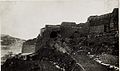
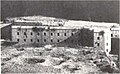


Photo: anonymous photographer during World War I, Public domain · Wikimedia Commons
At a glance
- Type
- Fortress / Tower
- Period
- Modern era, 1911
- Coordinates
- 45°53′30″ N, 11°12′02″ E
History and description
Fort Sommo, also known as Fort Sommo Alto (Italian: Forte Sommo Alto, German: Zwischenwerk Sommo), is an Austro-Hungarian fort built in the Lavarone-Folgaria group, a group of forts built between the municipalities of Lavarone and Folgaria in Northern Italy. Fort Sommo was classed as an "intermediate work", meaning that it was less heavily armed than Fort Lusern and Fort Verle, but more heavily armed and armored than a roadblock. The fort was built between 1911 and September 25, 1914. Sommo was built to bridge the gap between the forts Sebastiano and Serrada. Overall, Sommo was considered the weakest of the seven forts of the Lavarone-Folgaria group in terms of armament and armor. The fortifications in the Lavarone-Folgaria group were also built to hold back the Italians while Austrian troops assembled for an attack against Veneto.
Construction
The fort was originally to have two 10 cm howitzers in casemates facing Fort Serrada, but this plan was dropped in favor of two 10 cm howitzers in 25 cm-thick rotating armored domes placed 140 ft apart. Two more tower howitzers (T.H.) were planned, but because of rising costs, they were placed in the casemate battery. The fort was built of steel-reinforced concrete in three distinct parts: the casemate battery and two smaller infantry works, "S" and "R", near the fort. Only the top floor was above ground, and the rear of the fort was dug into the rock. Three of the four sides were covered by earth, while the fourth was partially exposed to fit more guns facing the Italian border.
Casemate block
The casemate block is rectangular and is anchored to the natural rock at each end. Its three floors were the basement, the 1st floor, and the 2nd floor, which housed the 10cm howitzers. Also on top of the fort was a rotatable observation stand and an armored machine gun dome.
In the rear of the basement, a tunnel led to the infantry works “R” and “S”. There was also a postern, which replaced the front entrance after Italian shelling made it unusable during the war.
On the 2nd floor there was a continuous corridor with entrances to the howitzers and the observation dome.
Infantry works
Complex “R” consisted of 2 adjacent bunkers "behind" Fort Sommo, named after their position (left or right) as seen from the fort. They are connected to each other and Sommo by a rock postern. The bunkers had the job of controlling the Val Orsana.
Complex “S”, just like Complex “R”, consists of 2 bunkers and is connected to the casemate block by a postern. The two bunkers are called "Front" and "Trench". Complex "S" had the job of guarding the Coe pass, as well as the access road.
Armament
2 armored domes with 1 dome having a machine gun, and 1 having 2 machine guns in Complex “R”’s right bunker
1 armored casemate with 2 machine guns in Complex “R”’s left bunker
2 armored domes, 1 with a machine gun, and 1 with 2 machine guns in Complex “S”’s front bunker
Text from Wikipedia, the free encyclopedia, under CC BY-SA 4.0. Full article: «Forte Sommo Alto».
Timeline
- 1911Built
Events and people from Wikidata (CC0).
Photos
Getting there
CallianoTrain, nearest
9.6 km as the crow flies
Forte Sommo Alto
Distances are as the crow flies, not walking or driving.
Loading map…
Nearby
See on the mapMore fortresses and towers in Trentino-South Tyrol


Frequently asked questions
Where is Forte Sommo Alto?
Forte Sommo Alto is in Folgaria, in the province of Trento (Trentino-South Tyrol), Italy. GPS coordinates: 45.89167, 11.20056.
How old is Forte Sommo Alto?
Wikidata dates it to 1911.
What else is there to see near Forte Sommo Alto?
Nearby you’ll find: Werk Serrada (1.7 km away), Forte Sebastiano (3.4 km away), Base Tuono (3.5 km away).
Sources and licences
Text. Wikipedia, the free encyclopedia (CC BY-SA 4.0).
Data. Wikidata (CC0); opening hours and contacts OpenStreetMap (ODbL).
Photos. Wikimedia Commons, author and licence on every image.
Credits for the 2 photos
- Zwischenwerk Sommo 1916 — anonymous photographer during World War I, Public domain
- Zwischenwerk Sommo — Steinbeisser, CC0
Updated 28 October 2026. All sources and licences